Typhoon season in Japan runs mostly through August and September, and a strong typhoon can knock out power or water for days across a wide area. One of the most common points of confusion for residents is: “If the power went out and everything in my fridge spoiled, will my home insurance cover it?” The short answer is usually no. Here’s a practical breakdown of what’s actually covered, what isn’t, and what to have on hand before the next storm.
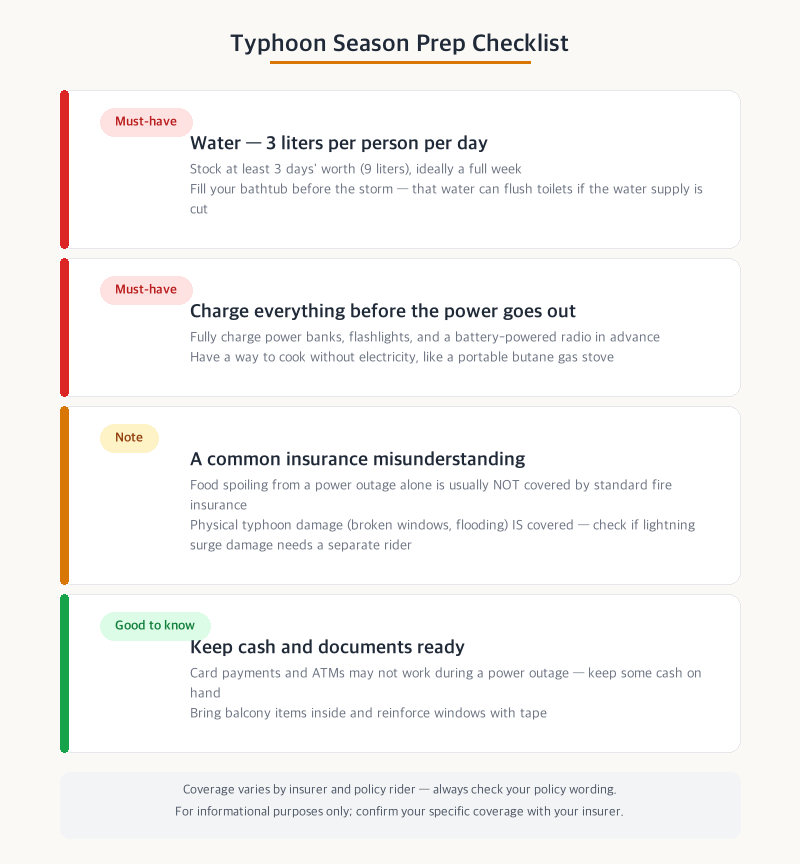
Typhoon Season Prep Checklist
When to Start Preparing
Japan’s typhoon season is concentrated mostly in August and September, and it’s not unusual for a single major typhoon to cause power and water outages lasting several days across a wide region. Mountainous and coastal areas in particular can take longer to restore service. Once a typhoon forecast appears, it’s worth starting preparations several days in advance rather than waiting until the last minute.
What Fire/Home Insurance Actually Covers (and Doesn’t)
Japanese fire insurance (kasai hoken) is typically split into two separate coverages you choose when you sign up: the “building” itself and its “contents.” For typhoon damage specifically, wind-damage coverage and flood/water-damage coverage are the relevant riders. Where it gets confusing is that a power outage by itself is treated very differently from physical storm damage.
| Situation | Typically Covered? |
|---|---|
| Roof or windows damaged by strong wind | Yes (wind-damage coverage, if you insured the building) |
| Flooding caused by the typhoon | Yes (requires separate flood/water-damage coverage, varies by policy) |
| Appliance (e.g. fridge) itself damaged by a lightning strike | Often yes (lightning-damage coverage, if you insured contents) |
| Food spoiling in the fridge purely from a power outage | No (not typically a covered event) |
| Cost of a hotel stay because the power was out | No (there’s no physical damage to the building or contents) |
In short: if the typhoon left physical damage — a broken window, a damaged roof, flooding — you may have a valid claim. But food spoiling simply because the power went out, with no other physical damage, generally isn’t a covered event. It’s also worth checking whether your policy covers the “building,” the “contents,” or both — if you only insured the building, damage to appliances themselves won’t be covered either. Exact coverage varies by insurer and policy rider, so always check your specific policy wording. (If you’ve rented or owned in the US, this will feel familiar — standard homeowners and renters insurance there similarly excludes food spoilage from a mere power outage, treating it the same way as any other loss without a covered physical cause.)
💡 Run your own numbers — try the Japan Overtime Pay Calculator (2026).
Disaster Prep Checklist
- Water — 3 liters per person per day; stock at least 3 days’ worth (9 liters), ideally a full week
- Power outage essentials — fully charge power banks, flashlights, and a battery-powered radio before the storm arrives
- A way to cook without electricity — a portable butane gas stove, for example
- Cash — card payments and ATMs may not work during an outage, so keep some cash on hand
- Documents and valuables — keep your passport, residence card, etc. organized in a waterproof pouch in advance
Before the Typhoon Arrives
- Fill your bathtub with water in advance — it can be used to flush toilets if the water supply is cut
- Bring balcony items (planters, drying racks) inside so they don’t get blown away
- Reinforce windows with tape or protective film
- Check your insurance policy to confirm whether you’re covered for “building,” “contents,” or both, and whether wind/flood riders are included
Frequently Asked Questions
Q. The power went out and everything in my fridge spoiled. Can I claim this on insurance?
A. Most standard fire/home insurance policies don’t cover this. A power outage by itself isn’t physical damage to the building or its contents. Some policies may have exceptions, so check your specific policy wording.
Q. What if the typhoon broke a window or blew off part of the roof?
A. That kind of physical damage is typically covered under wind-damage coverage, as long as you insured the ‘building.’ If you didn’t, it won’t be covered, so check what your policy actually includes.
Q. What about an appliance like a fridge that was damaged by a lightning strike?
A. Unlike spoiled food, physical damage to the appliance itself from a lightning strike is often covered under lightning-damage coverage — but only if you insured ‘contents,’ not just the building.
Q. How much water should I stock up on before typhoon season?
A. The general guideline is 3 liters per person per day, with at least 3 days’ worth (9 liters) recommended, and up to a full week if you have the space to store it.
Key Takeaways
- Food spoiling in the fridge from a power outage alone is usually not covered by fire/home insurance.
- Physical typhoon damage — broken windows, roof damage, flooding — can be covered under wind and flood riders.
- Stock at least 3 days’ worth of water (3 liters per person per day, 9 liters minimum).
- Keep some cash on hand, since card payments and ATMs may not work during an outage.
This article is for general informational purposes only and is not an endorsement of any specific insurance product. Coverage varies by insurer, policy, and rider — always confirm your specific coverage directly with your insurance company.