Living in Japan under shakai hoken (employee health insurance) or kokuho (national health insurance), it’s easy to assume you’re covered wherever you travel. But when you leave Japan — whether to visit the US, see family, or just take a vacation — your Japanese health insurance offers only a limited safety net through a system called kaigai ryoyohi (overseas medical expense reimbursement), and it works very differently from what most people expect. Here’s what it actually covers, what changed for Japan-issued credit card travel insurance in March 2026, and when a standalone travel policy is still worth buying.
What Japan’s Health Insurance Actually Covers When You Travel Abroad
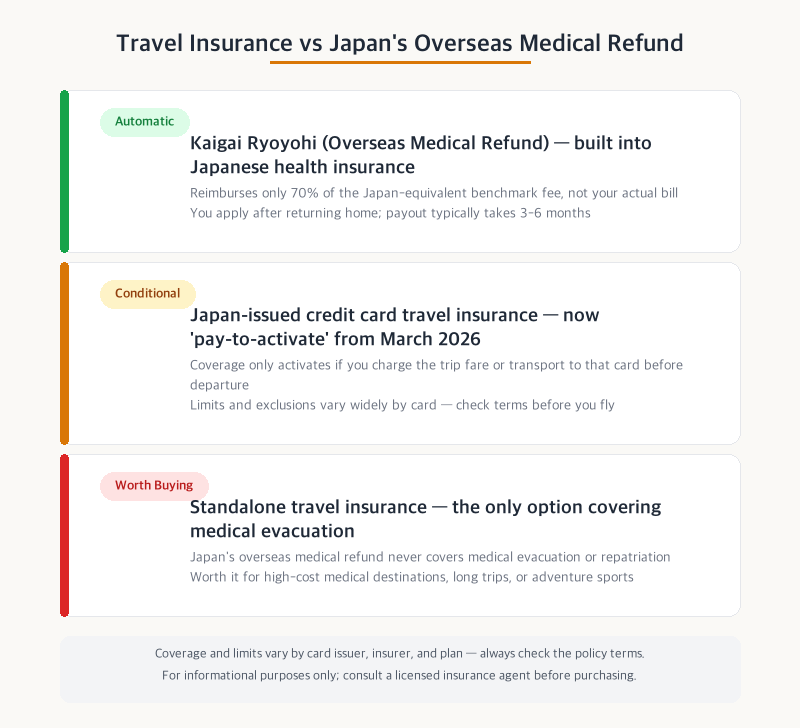
If you’re enrolled in Japanese health insurance and get sick or injured unexpectedly while abroad, you can apply for a partial refund after you return to Japan. But the fine print matters:
- Coverage is limited — only treatment that would be covered under Japan’s domestic insurance system qualifies, and trips taken specifically for medical treatment are excluded entirely. Cosmetic procedures, premium dental materials, and orthodontics are also excluded.
- The refund formula isn’t what you think — you don’t get back what you actually paid abroad. Japan calculates a benchmark fee based on what the same treatment would cost domestically (per the Ministry of Health, Labour and Welfare’s standard fee schedule), and reimburses 70% of that benchmark — not 70% of your actual bill. If you were treated somewhere with higher medical costs than Japan (which includes most of the US), the gap between what you paid and what you get back can be substantial.
- The timeline is slow — you have two years from the day after you paid to file a claim, and payout typically takes 3 to 6 months after you apply.
For context, this is actually more than many Americans have: Original Medicare provides essentially no coverage outside the US, except in a handful of narrow emergency exceptions. So kaigai ryoyohi is a real benefit of being on Japan’s system — it’s just far from a full substitute for travel insurance.
The Catch — Why Kaigai Ryoyohi Isn’t a Substitute for Travel Insurance
The biggest gaps between kaigai ryoyohi and an actual travel insurance policy come down to three things:
- Medical evacuation — not covered at all. If you need to be airlifted to a better-equipped facility or flown back to Japan for treatment, that cost is entirely outside the scope of kaigai ryoyohi. Emergency medical evacuation abroad commonly runs $50,000 to over $250,000 depending on distance and severity — a cost that would otherwise come entirely out of pocket.
- No coverage for lost luggage, liability, or trip cancellation. These are standard in travel insurance policies but simply don’t exist under kaigai ryoyohi.
- No cashless treatment. A travel insurance policy often lets you receive treatment at a partner hospital without paying upfront. Kaigai ryoyohi requires you to pay the full bill yourself first, then apply for a partial refund after you’re home — meaning you need cash on hand during a medical emergency abroad.
Japan-Issued Credit Card Travel Insurance Rules Changed in March 2026
Many long-term residents assume their Japan-issued credit card automatically includes travel insurance just by carrying the card — historically true under what’s called jido futai (automatic coverage). But starting with trips departing March 31, 2026, card issuers have been progressively switching to riyo futai (“pay-to-activate” coverage): insurance only kicks in if you charged your trip fare or public transportation costs to that specific card before departure. Simply owning the card is no longer enough at most issuers — check which charges qualify, the coverage limits, and any deductibles before you fly, since terms vary significantly by card.
| Feature | Kaigai Ryoyohi (Japan Health Insurance) | Japan Credit Card Travel Insurance | Standalone Travel Insurance |
|---|---|---|---|
| How you get it | Automatic if enrolled in Japanese health insurance | Card ownership + (from Mar 2026) trip payment on that card | Separate application and payment before the trip |
| Medical cost coverage | 70% of Japan-equivalent benchmark fee only | Actual cost up to the card’s limit | Actual cost up to the policy’s limit |
| Medical evacuation | Not covered | Sometimes included, varies by card | Usually included (varies by plan) |
| Cashless treatment | No — pay first, apply for refund later | Limited to partner providers | Often available through large partner hospital networks |
| Payout timing | Apply after returning; 3-6 months | Per claims process | Per claims process |
How Does This Compare to Being Covered in the US?
If you’re American and wondering how this stacks up against home: it’s not more generous there. Original Medicare covers essentially nothing outside the US, with only a few narrow emergency exceptions. Medigap supplemental plans (C, D, F, G, and others) will cover 80% of certain medically necessary emergency costs abroad, and standard US employer health plans are almost always domestic-network only. In other words, needing a separate international travel policy isn’t a quirk of living in Japan — it’s standard practice for US travelers heading anywhere outside the country too, regardless of what health coverage they carry at home.
Pre-Departure Checklist
- Check the medical cost level at your destination. If you’re heading somewhere with high medical costs (the US is a prime example), the 70%-of-benchmark refund from kaigai ryoyohi likely won’t cover your actual exposure.
- Confirm whether you need a rider for adventure activities or long stays. Skiing, diving, and similar activities are frequently excluded from base coverage.
- If relying on card-based coverage, confirm you met the payment condition. Under the new riyo futai rules, failing to charge your trip fare to the right card before departure can mean no coverage at all.
- Look for a policy with a cashless hospital network. This is the practical difference between paying out of pocket abroad and not.
- Gather documentation in advance for a kaigai ryoyohi claim. Itemized receipts, medical statements, and diagnosis paperwork (in English if possible) are much easier to get on-site than after you’ve left.
Frequently Asked Questions
Q. If I’m covered under Japan’s health insurance, do I still need travel insurance?
A. Yes. Kaigai ryoyohi only reimburses 70% of a Japan-equivalent benchmark fee (not your actual bill), the payout arrives months after you return, and it never covers medical evacuation. A standalone travel policy fills those gaps with cashless treatment and evacuation coverage.
Q. Does kaigai ryoyohi refund the full amount I actually paid abroad?
A. No. It refunds 70% of the fee calculated using Japan’s domestic standard fee schedule for the same treatment, not your actual bill. If you were treated somewhere with higher medical costs than Japan, the gap between what you paid and what you get back can be large.
Q. Is my Japan-issued credit card’s travel insurance enough on its own?
A. For trips departing March 2026 onward, most cards now require you to pay for your trip fare or transportation with that card before departure to activate coverage. If you don’t meet that condition, you may have no coverage at all — check your card’s terms before flying.
Q. How does this compare to what I’d have back in the US?
A. Original Medicare provides essentially no coverage outside the US, and even Medigap only covers 80% of certain emergency costs abroad. Standard US employer health plans are typically domestic-network only, so needing a separate travel policy isn’t unique to living in Japan — it’s standard practice for US travelers too.
Key Takeaways
- Japan’s kaigai ryoyohi system reimburses only 70% of a Japan-equivalent benchmark fee, not your actual medical bill, and pays out months after you return.
- It never covers medical evacuation, which can cost $50,000-$250,000+ abroad — a gap only standalone travel insurance fills.
- Japan-issued credit card travel insurance largely shifted to a ‘pay-to-activate’ model for trips departing from March 2026.
- US-based coverage isn’t more generous — Original Medicare covers essentially nothing abroad, making a standalone travel policy standard practice either way.
This article is for general informational purposes only. Actual coverage, limits, and claims processes vary by individual card issuer, insurer, and policy. Confirm your specific situation with an insurance agent or your card issuer directly.