If you’ve signed a lease in Japan, you’ve probably been told that fire insurance (kasai hoken) is “required.” It’s not a legal mandate, but nearly every rental contract makes it a condition of the lease, and the management company often steers you toward a specific provider. On top of that, Japan’s earthquake risk raises the separate question of whether you need earthquake insurance (jishin hoken) too. With typhoon season (August-September) approaching, now is a good time to review what your policy actually covers. Here’s what expat renters in Japan need to know about fire insurance, earthquake insurance, and how it compares to renters insurance back in the US.
Why Fire Insurance Is Effectively Mandatory When Renting in Japan
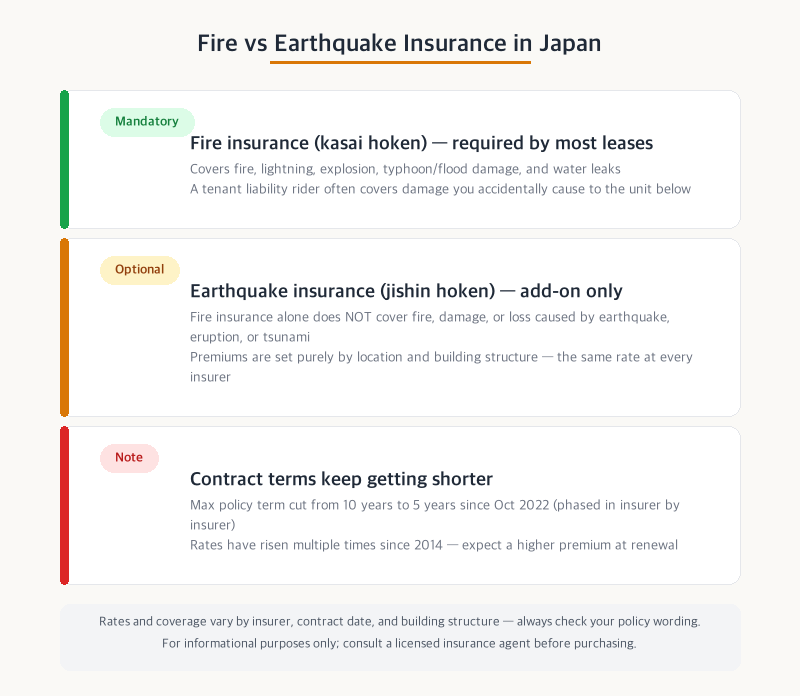
Most Japanese lease agreements make fire insurance a contractual condition, even though it isn’t legally required. The landlord wants coverage for fire or water damage to the building, and the tenant needs coverage for personal belongings and liability toward neighbors — so the practice has become standard. You’ll often be asked to sign up through an agent designated by the management company, but if your lease doesn’t explicitly prohibit it, you may be able to buy a comparable or better policy directly from an insurer of your choice. It’s worth checking before you sign.
Despite the name, a standard tenant’s fire insurance policy covers more than just fire. Typical coverage includes:
- Fire, lightning, and explosion — the baseline coverage
- Wind and water damage — broken windows from typhoons/storms, flooding from heavy rain
- Water leak damage — belongings damaged when, say, a washing machine hose bursts
- Theft — damage or loss from a break-in (varies by rider)
- Tenant liability rider — covers damage you accidentally cause to a third party, such as flooding the unit below yours because your washing machine leaked
The tenant liability rider matters more than most renters realize. Water leak disputes are one of the most common sources of friction in Japanese apartment living, and without this rider, you could be personally on the hook for another tenant’s repair bill. Confirm it’s included before you sign.
Earthquake Insurance Is a Separate Add-On, Not Automatic
This is where a lot of people get tripped up. Earthquake insurance can only be purchased as a rider on top of fire insurance — you cannot buy it standalone. More importantly, if you only carry fire insurance, you have zero coverage for fire, structural damage, or loss caused by an earthquake, volcanic eruption, or resulting tsunami. Fire caused by an earthquake is explicitly excluded from standard fire insurance — one of the most common and costly misunderstandings among renters.
Earthquake insurance premiums are set by location and building structure (wood vs. non-wood), and the rate is identical no matter which insurer you buy it from — a byproduct of the fact that earthquake insurance runs on a government-backed reinsurance scheme rather than pure market competition. That said, premiums can differ by as much as 3.7x between low-risk and high-risk regions.
| Feature | Fire Insurance (Kasai Hoken) | Earthquake Insurance (Jishin Hoken) |
|---|---|---|
| Required to lease? | Effectively mandatory in most contracts | Optional (add-on for fire insurance holders only) |
| Standalone purchase | Yes | No — rider on fire insurance only |
| What it covers | Fire, lightning, explosion, wind/water damage, leaks, theft | Fire, damage, or loss caused by earthquake, eruption, tsunami |
| What sets the premium | Insurer, plan, building structure — varies | Location and building structure only — same at every insurer |
| Tenant liability | Available as a rider | Not applicable |
How Japan Compares to Renters/Homeowners Insurance in the US
The structure will feel familiar if you’ve had renters or homeowners insurance in the US, with a few key differences worth flagging. In the US, renters insurance isn’t legally required either, but many landlords require it as a lease condition — same logic as Japan. Where the two systems diverge is earthquake and flood coverage: in the US, standard homeowners and renters policies typically exclude both earthquake and flood damage, requiring separate coverage (e.g., through the National Flood Insurance Program for flood, or state-specific programs like the California Earthquake Authority for quake damage — usually only available to homeowners, not renters, in many states). Japan’s system is arguably more accessible for renters in this regard, since earthquake coverage is available as a simple add-on to the same fire insurance policy everyone already has, at a government-regulated rate rather than a market-priced one.
Contract Terms Keep Getting Shorter — Check This at Renewal
Fire insurance policies in Japan used to be sold with terms as long as 36 years. As typhoon and flood damage has increased, insurers have progressively shortened the maximum contract length — down to 10 years around 2015, and then, starting October 2022, insurers began phasing in a further cut to a maximum 5-year term. If you locked in a 10-year policy years ago, your next renewal is likely coming sooner than you’d expect. Rates have also risen multiple times since 2014, largely attributed to increased wind and flood damage from climate change, so expect your premium to be higher at renewal than it was last time. When a renewal notice arrives, compare the coverage terms and the premium against your previous policy — don’t assume it’s unchanged.
💡 Run your own numbers — try the Japan Fire & Quake Insurance Calculator (2026).
Typhoon Season (Aug-Sep) Checklist
- Re-confirm wind and water damage are covered — older policies may have narrower coverage than current standard products.
- Check your deductible — minor damage below the deductible threshold won’t be reimbursed, so know your actual claimable range.
- Photograph and video damage immediately — documenting broken windows or water intrusion right after a typhoon passes makes claims far smoother.
- Confirm your tenant liability rider is active — if a typhoon breaks your window and water damages the unit below, you’ll need this rider to be covered for that liability.
- Take basic physical precautions ahead of a forecast typhoon — bring balcony items inside, tape or reinforce windows, and secure curtains or blinds.
💡 Tip: Estimate Your Premium With a Calculator
Enter your building structure, prefecture, and assessed value into our Japan Fire & Earthquake Insurance Calculator to get a rough premium estimate.
Frequently Asked Questions
Q. Is fire insurance a legal requirement when renting in Japan?
A. Not legally, but nearly every lease agreement makes it a contractual condition, so it’s effectively mandatory. Management companies often push their own designated provider, but if the lease doesn’t explicitly restrict it, you may be able to purchase from a different insurer instead.
Q. If I only have fire insurance, am I covered when an earthquake causes a fire?
A. No. Fire, damage, or loss caused by earthquake, eruption, or tsunami is not covered by fire insurance alone. You need to add earthquake insurance (jishin hoken) as a separate rider to be covered.
Q. Is it true that earthquake insurance costs the same no matter which insurer I use?
A. Yes. Earthquake insurance runs on a government-backed reinsurance scheme, so for the same location and building structure, the premium is identical across every insurance company.
Q. Why do fire insurance contract terms keep shrinking?
A. As typhoon and flood damage has increased, insurers have progressively cut the maximum policy term to manage long-term risk. Terms that were once as long as 36 years dropped to a 10-year maximum around 2015, and insurers began phasing in a further cut to a 5-year maximum starting October 2022.
Key Takeaways
- Fire insurance isn’t legally required but is effectively mandatory under most Japanese leases, covering fire, wind/water damage, leaks, and theft.
- Earthquake insurance can only be added as a rider to fire insurance — without it, earthquake-caused fire, damage, or loss is not covered at all.
- Earthquake insurance premiums are set only by location and building structure, identical across insurers, though they can vary up to 3.7x by region.
- Maximum contract terms have shortened from 10 years to 5 years — always compare coverage and premium changes at renewal.
This article is for general informational purposes only. Actual coverage, claims processes, and terms vary by insurer and individual policy. Confirm your specific situation with an insurance agent or your insurance company directly.