
Bring your dog or cat to a Japanese veterinary clinic and the bill can be a shock. Human healthcare in Japan is heavily subsidized through national health insurance, but that system simply doesn’t extend to pets. If you’ve moved to Japan with an animal in tow, “should I get pet insurance?” is a question worth thinking through carefully. Here’s why vet bills run high in Japan, how pet insurance actually works, and how it compares to what you may be used to in the US.
Why Vet Bills Are High — There’s No Public Insurance for Pets
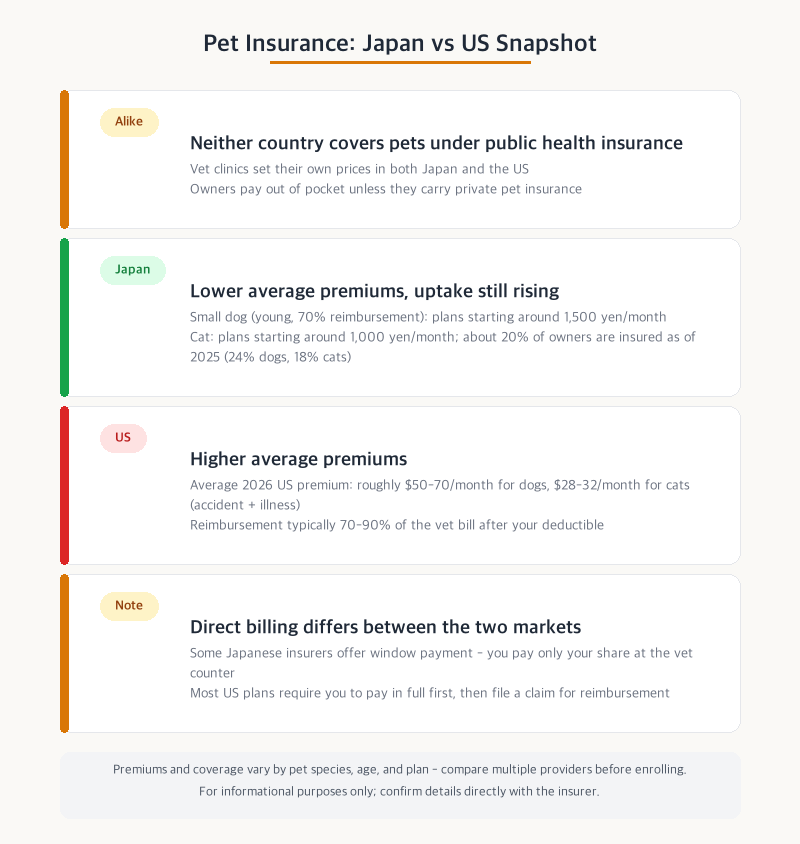
Japan has robust public health insurance for people, but nothing equivalent exists for animals. As a result, veterinary pricing in Japan has a few notable features:
- Prices vary by clinic — unlike human medicine, where fees are nationally standardized, vet clinics set their own prices, so the same procedure can cost very different amounts at different clinics.
- You pay the full bill yourself — without insurance, you cover 100% of the cost at the time of treatment.
- Routine costs are modest, but big bills happen — monthly spending is often under 10,000 yen, but a surgery for something like a swallowed foreign object averages around 89,000 yen, and digestive-system surgery plus hospitalization can average around 650,000 yen.
According to Anicom Sompo’s 2025 survey, average annual treatment costs among insured pets run about 89,000 yen for dogs and 47,000 yen for cats, and these numbers climb quickly as a pet ages. A major illness requiring surgery, such as a fracture or tumor removal, can produce a bill in the 100,000-500,000 yen range.
How Japanese Pet Insurance Works
Several insurers — Anicom Sompo and Ipet Sompo among the largest — sell pet insurance in Japan, and most plans share a similar structure:
| Feature | Typical Terms |
|---|---|
| Reimbursement rate | 50% or 70% are the most common tiers; some plans offer 90% or even 100% |
| Enrollment age limit | Varies by insurer (e.g., new enrollment up to age 7, or up to age 12 for some plans) |
| Claims process | Some insurers offer “window payment” — you pay only your share at the clinic counter; others require you to pay in full and file a claim afterward |
| Deductible | Varies by plan — some have no deductible, others do |
| Sample monthly premium | Small dog: plans starting around 1,500 yen; cat: plans starting around 1,000 yen (rises with age and reimbursement rate) |
Your pet’s age at enrollment, breed, and any pre-existing conditions significantly affect both premium and eligibility, so it’s worth getting quotes from a few insurers. Whether a plan supports window payment matters a lot in practice — check which insurers your nearest vet clinic works with before you decide.
How Japan Compares to Pet Insurance in the US
If you’re coming from the US, the overall setup will feel familiar with a few key differences. Neither country has public health coverage for pets — vet clinics in both places set their own prices, and owners without insurance pay entirely out of pocket. Where the two markets diverge is cost and claims process. US premiums run considerably higher: the 2026 average is roughly $50-70/month for dogs and $28-32/month for cats on an accident-and-illness plan, compared to Japanese plans that can start around 1,500 yen/month (roughly $10) for a young small dog. Reimbursement in the US typically runs 70-90% after a deductible — similar in concept to Japan’s 50-70% tiers, though often a bit more generous. The biggest practical difference is billing: window payment (paying only your share at the counter) is available at some Japanese clinics, while the vast majority of US pet insurance plans require you to pay the full bill first and submit a claim for reimbursement afterward — expect to front the cost either way if your clinic doesn’t support direct billing.
Quarantine Basics When Bringing a Pet Into Japan
If you’re relocating to Japan with a dog or cat, incomplete rabies vaccination paperwork can mean your pet is held in quarantine at the airport animal quarantine station. For dogs and cats 90 days or older, if the required post-vaccination waiting period (about 30 days) has already elapsed, same-day clearance is possible; if not, your pet will be held for the remaining portion of that period. Requirements depend on your departure country and vaccination history, so confirm the current rules with Japan’s Animal Quarantine Service well before you travel.
💡 Tip: Check These Before You Enroll
- Whether your nearest vet clinic partners with an insurer that supports window payment
- Whether any pre-existing condition or breed-specific issue is excluded from coverage
- The enrollment age cap and whether premiums rise significantly at renewal
Frequently Asked Questions
Q. Why do vet costs vary so much between clinics in Japan?
A. Unlike human medicine, veterinary fees in Japan aren’t set by the government — each clinic prices its own services, so the same procedure can cost quite different amounts depending on where you go.
Q. Is pet insurance mandatory in Japan?
A. No, it’s not a legal requirement. But since Japan has no public health insurance for pets, you’d otherwise pay 100% of vet costs yourself, so many owners choose coverage as a safeguard against a major illness or accident.
Q. Should I choose a 50% or 70% reimbursement plan?
A. Higher reimbursement means a higher premium. It comes down to balancing your monthly premium against what you’d be comfortable paying out of pocket if a big bill hits — there’s no universal right answer, so compare quotes from a few insurers.
Q. Will my pet automatically be quarantined when I enter Japan?
A. Not necessarily. If your dog or cat is 90+ days old and has already completed the roughly 30-day waiting period after rabies vaccination, same-day clearance is possible. If your paperwork or vaccination timing falls short of the requirements, your pet will be held for the remaining period.
Key Takeaways
- Japan has no public health insurance for pets, so you pay vet bills in full, and prices vary freely by clinic.
- As of 2025, average annual treatment costs among insured pets run about 89,000 yen for dogs and 47,000 yen for cats, with major surgeries reaching 100,000-500,000 yen.
- Pet insurance typically offers 50-70% reimbursement, with plans starting around 1,500 yen/month for a small dog and 1,000 yen/month for a cat — noticeably cheaper than typical US premiums.
- About 20% of Japanese pet owners carry insurance as of 2025 (24% of dog owners, 18% of cat owners); enrolling while your pet is young means lower premiums and a lower chance of being declined.
This article is for general informational purposes only. Actual policy terms, coverage, and quarantine procedures vary and change over time. Confirm current details directly with the insurer or Japan’s Animal Quarantine Service.