If you’re an American marrying a Japanese national, there’s one thing worth knowing before you start the paperwork: Japan’s registration system and the US system don’t mirror each other. You’ll register your marriage at a Japanese city or ward office — but there’s no equivalent “second registration” waiting for you back home, because the US simply doesn’t have a national family registry the way Japan and Korea do. Here’s what actually happens on each side.
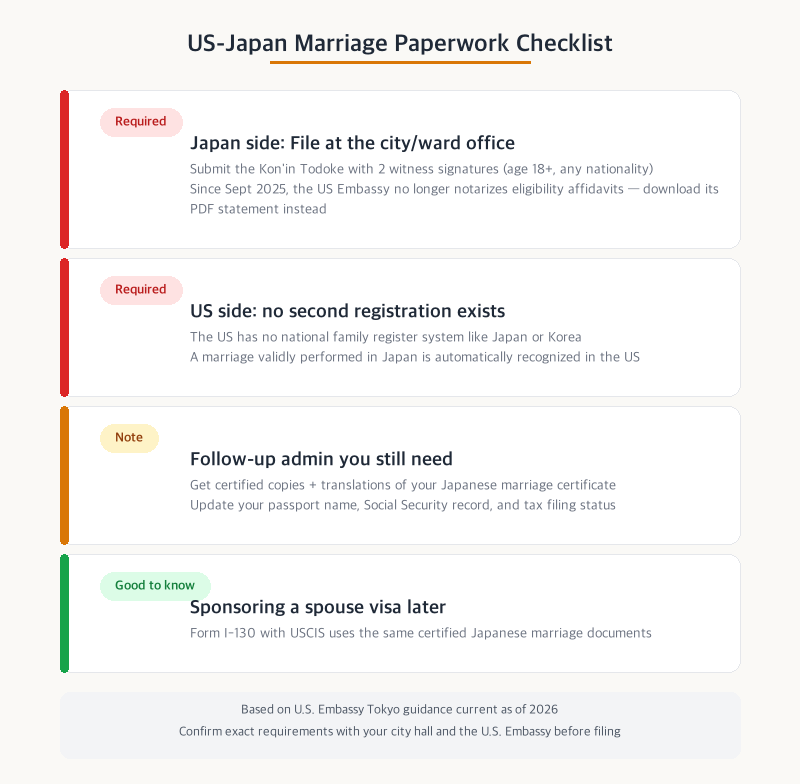
US-Japan Marriage Paperwork Checklist
The Japan Side: Registering at the City or Ward Office
Marriage in Japan becomes legal the day a couple submits the Marriage Notification Form (Kon’in Todoke, 婚姻届) and it’s accepted by a local municipal office — any city hall, ward office, or satellite office will do, though it’s worth confirming requirements with your specific office in advance.
| Requirement | Detail |
|---|---|
| Kon’in Todoke form | Available at any city hall or ward office; requires signatures from 2 witnesses aged 18 or older, of any nationality |
| Proof you’re free to marry | Since September 1, 2025, the US Embassy in Japan no longer notarizes “Affidavits of Competency to Marry.” The Embassy’s first suggestion is to download its PDF statement (explaining that the US government doesn’t issue this type of certificate) and present that at your city office — but not every ward office accepts this letter alone as sufficient proof |
| Backup option, if your office won’t accept the PDF | A state-issued “certificate/letter of no marriage record,” or an affidavit notarized by a US state notary public, generally paired with a signed statement explaining that a federal competency certificate isn’t obtainable |
| Japanese spouse’s documents | Koseki (family register) extract and related civil documents, per your city office’s requirements |
The day your paperwork is accepted is your legal marriage date in Japan — there’s no separate waiting period. Because practice varies by municipality, it’s worth calling your specific city or ward office before your appointment to confirm exactly which document they’ll accept.
The US Side: Why There’s No Second Registration
This is the part that surprises a lot of Americans. Korea and Japan each maintain a national family register that has to reflect a marriage before it’s considered fully valid domestically. The United States has no such system. As a general rule, a marriage validly performed and registered under the law of the place where it happened — in this case, Japan — is automatically recognized as valid in the US, without a separate federal “re-registration” step.
That doesn’t mean there’s nothing to do. You’ll still need to handle several follow-up items using your Japanese marriage documents:
- Request multiple certified copies of your Japanese marriage certificate (the acceptance certificate, or juri shomeisho), plus certified English translations
- Update your US passport name through the State Department, if you’re changing your name
- Report a name change to the Social Security Administration
- Update your federal tax filing status with the IRS (married filing jointly or separately)
- If you plan to sponsor your spouse for a US visa or green card later, file Form I-130 with USCIS — using the same certified Japanese marriage documents as supporting evidence
Common Mistakes to Avoid
- Assuming a Japanese marriage certificate alone is enough for every US administrative purpose without certified translation
- Forgetting to request enough certified copies of the Japanese certificate — you’ll likely need more than one over time
- Not checking your city office’s specific document requirements before your appointment, since they can vary slightly by municipality
Frequently Asked Questions
Do I need to register my marriage again once I’m back in the US?
A. No. The US has no national family register system, so there’s no federal “re-registration” step. A marriage validly performed in Japan is generally recognized automatically. You will, however, need certified copies and translations of your Japanese marriage certificate for practical things like name changes and visa sponsorship.
What happened to the Affidavit of Competency to Marry?
A. As of September 1, 2025, the US Embassy and consulates in Japan stopped notarizing this document. The Embassy’s suggested first step is to download a statement (PDF) from its website and present that to your city office — but some ward offices don’t accept this letter alone, and instead ask for a state-issued letter of no marriage record or a state-notarized affidavit. Requirements differ by municipality, so confirm with your specific city office before your appointment.
Who can serve as witnesses on the Kon’in Todoke?
A. Any two people aged 18 or older, regardless of nationality, can sign as witnesses.
Do I need my Japanese marriage certificate translated for US purposes?
A. Generally yes — US agencies (State Department, SSA, IRS, USCIS) typically require a certified English translation alongside the certified Japanese document.
Key Takeaways
- Marriage becomes legal in Japan the day your Kon’in Todoke is accepted at a city or ward office.
- Since September 2025, the US Embassy no longer notarizes eligibility affidavits. Try its downloadable PDF statement first, but confirm with your city office — some require a state-notarized affidavit instead.
- The US has no equivalent second registration — a marriage valid in Japan is automatically recognized in the US.
- You’ll still need certified copies and translations for name changes, tax status, and any future spouse visa sponsorship.
This article is for general informational purposes only and is not legal or immigration advice. Requirements vary by municipality and individual circumstances, so confirm exact procedures with your city/ward office and the US Embassy in Japan before filing.