
If you’re living in Japan, you’ve probably noticed how much of daily life runs through points — supermarkets, convenience stores, even the neighborhood ramen shop. Locals call this habit “poikatsu” (ポイ活), short for “point activity,” and it’s become a genuinely mainstream way to stretch a budget. Here’s how foreign residents can get in on it too.
What Exactly Is Poikatsu?
Poikatsu simply means consciously earning and using points from everyday spending, rather than letting them accumulate unused. There are three main ways people do this in Japan:
- Presenting a credit card or point card when paying
- Shopping through online retailers that award points
- Routing purchases or services through point-aggregator websites
Japan’s Big 3 Point Systems in 2026
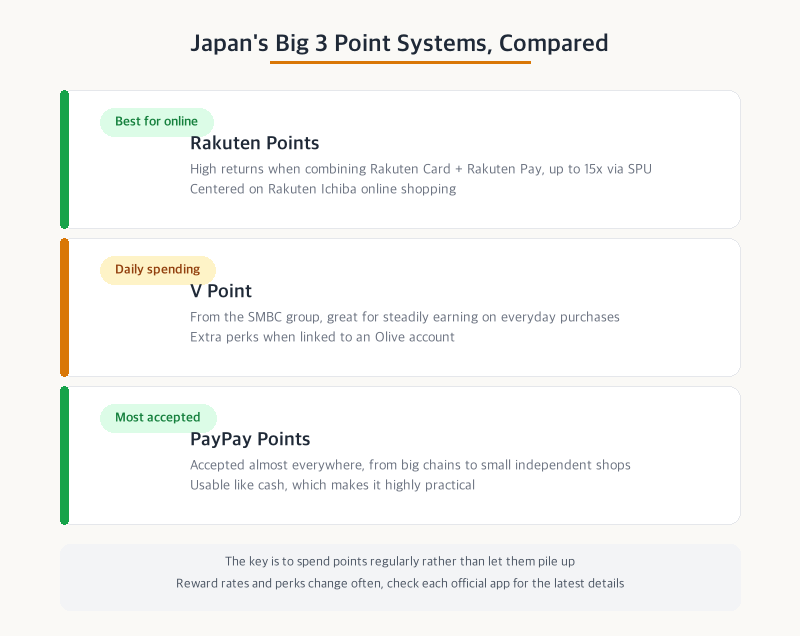
| Point System | Strength | Best For |
|---|---|---|
| Rakuten Points | High returns when pairing Rakuten Card with Rakuten Pay, up to 15x via the SPU program | Frequent online shoppers |
| V Point | From the SMBC group; extra perks when linked to an Olive account | People with lots of small daily transactions |
| PayPay Points | Accepted at an enormous range of merchants, from big chains to tiny local shops | Anyone who wants points to spend like cash |
Can Foreign Residents Actually Do This? The Credit Card Hurdle
Poikatsu really starts with getting a Japanese credit card, and that’s where foreign residents hit their first real question mark. Applications from foreigners almost always require a Residence Card (在留カード), and approval tends to hinge on:
- A Japanese address
- Remaining validity period on your Residence Card
- A Japanese bank account
- A Japanese phone number
- Stable income
If you haven’t been in Japan long, cards like Rakuten Card (which weighs income stability more heavily than nationality or visa type) or the GTN Epos Card (designed specifically for foreign residents) tend to have a better approval track record as a first card.
💡 Run your own numbers — try the Japan Overtime Pay Calculator (2026).
Practical Poikatsu Tips
- Don’t let points pile up — spending them soon after you earn them is generally the safest way to avoid losing value to expiration or devaluation.
- Focus on one or two point ecosystems rather than spreading small amounts across many — concentration compounds faster.
- If you’re shopping through a point-aggregator site, double-check the reward rate and confirm the site’s legitimacy before you commit.
Quick Summary
| Item | Detail |
|---|---|
| Core idea | Consciously earn and promptly use points from everyday spending |
| Big 3 point systems | Rakuten Points, V Point, PayPay Points |
| Entry requirement | A Japanese credit card (Residence Card, Japan address/bank account/phone, stable income) |
| Good first cards for foreigners | Rakuten Card, Epos Card, GTN Card (foreigner-focused) |
This article is for general informational purposes only. Reward rates, perks, and approval criteria vary by card issuer and change over time. Always check each provider’s official website for current terms before applying.
Frequently Asked Questions
Q. What exactly is poikatsu?
A. It means consciously earning and promptly using points from everyday spending — via a credit/point card, online shopping, or point-aggregator sites — rather than letting them sit unused.
Q. What are Japan’s Big 3 point systems in 2026?
A. Rakuten Points (up to 15x via the SPU program when pairing Rakuten Card with Rakuten Pay), V Point (from the SMBC group, extra perks via Olive), and PayPay Points (accepted at an enormous range of merchants).
Q. What’s the biggest hurdle for a foreign resident starting poikatsu?
A. Getting a Japanese credit card. Approval typically hinges on a Residence Card, a Japanese address, a Japanese bank account, a Japanese phone number, and stable income.
Q. Which cards are easiest for a foreign resident to get first?
A. Rakuten Card, which weighs income stability more heavily than nationality or visa type, or the GTN Epos Card, which is designed specifically for foreign residents.
Key Takeaways
- Poikatsu means earning and promptly using points from everyday spending, not letting them accumulate.
- Japan’s Big 3 point systems are Rakuten Points, V Point, and PayPay Points.
- The entry point is a Japanese credit card, which requires a Residence Card, local address, bank account, phone number, and stable income.
- Rakuten Card and the GTN Epos Card are solid first-card options for newer residents.
- Focus on one or two point ecosystems and spend points soon after earning them.