If you’re navigating Japan’s work visa system, two categories tend to cause the most confusion: Specified Skilled Worker (Tokutei Ginou) and Engineer/Specialist in Humanities/International Services (often shortened to “Gijinkoku”). Both let you work in Japan, but they differ sharply in who qualifies, what kind of work you can do, how long you can stay, and whether your family can join you. Here’s a practical comparison if you’re weighing a job change or a status of residence switch.
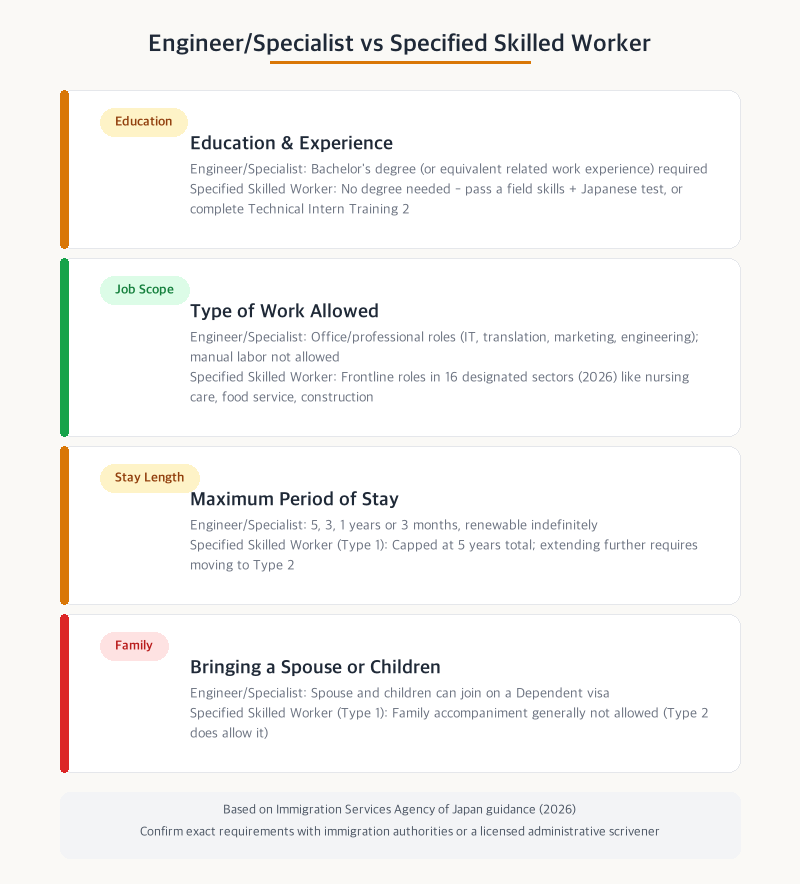
Engineer/Specialist vs Specified Skilled Worker
What Engineer/Specialist in Humanities/International Services Covers
This status is designed for people working in roles that require specialized knowledge — either in the natural sciences (engineers, programmers, etc.), the humanities (management, marketing, planning, etc.), or work that draws on a foreign national’s cultural background or language skills (translation/interpretation, language teaching, overseas sales, etc.).
- Education/experience requirement: In principle you need a bachelor’s degree (or higher) in a field related to your job, or a substantial amount of relevant work experience if you lack the degree. International-business-type roles typically require at least 3 years of related work experience if there’s no matching degree; other fields generally expect a relevant academic background.
- Relevance to the job: Your degree or experience has to genuinely connect to the work you’ll actually be doing — if that link is too thin, the application can be denied.
- Work it does not cover: Manual or unskilled labor — cleaning, waiting tables, working a convenience-store register — is not permitted under this status.
What Specified Skilled Worker Covers
Specified Skilled Worker was created in 2019 to bring in workers who can contribute immediately in industries facing serious labor shortages. As of 2026, 16 designated sectors qualify — including nursing care, food service, accommodation, construction, agriculture, fisheries, automobile maintenance, and building cleaning — with 3 more sectors set to be added (bringing the total to 19) following a January 2026 cabinet decision. You qualify by passing a sector-specific skills test and a Japanese language test; workers who successfully completed Technical Intern Training (Type 2) in the same field are often exempt from those tests.
Specified Skilled Worker Type 2 is reserved for more experienced workers in a narrower set of sectors, but in exchange it has no cap on renewals and allows family members to join.
💡 Run your own numbers — try the Japan Overtime Pay Calculator (2026).
Key Differences at a Glance
| Item | Engineer/Specialist | Specified Skilled Worker (Type 1) |
|---|---|---|
| Education/experience | Bachelor’s degree in a related field, or equivalent work experience | No degree required; pass sector skills test + Japanese test |
| Job scope | Office/professional roles (IT, translation, marketing, etc.) | Frontline work in 16 designated sectors (nursing care, food service, construction, etc.) |
| Maximum stay | No overall cap (5/3/1-year or 3-month terms, renewable repeatedly) | Capped at 5 years total |
| Family accompaniment | Allowed, via a Dependent visa | Generally not allowed (Type 2 does allow it) |
| Changing jobs | Relatively flexible within the same field of expertise | Can change employers within the same designated sector; moving sectors requires reapplying |
Which One Actually Works Better for You
Neither status is universally “better” — it comes down to your own education/experience and the kind of work you want to do.
- If you have a university degree and want to build a career in IT, translation, marketing, or planning-type office work, Engineer/Specialist is the natural fit. It has no cap on renewals and allows your family to join, which also makes it a workable path toward long-term residency or permanent residency later.
- If you don’t have a degree or white-collar work history but want to work right away in a designated sector like nursing care, food service, or construction, Specified Skilled Worker can be a lower-barrier entry point. Just factor in the 5-year cap on Type 1 and the fact that family accompaniment generally isn’t allowed at that stage.
- If you’re already in Japan as a Technical Intern Trainee, switching to Specified Skilled Worker Type 1 in the same sector is often the most realistic next step.
If you’re considering a status change or a first-time application, it’s worth organizing your education, work history, and target occupation before consulting the Immigration Services Agency or a licensed administrative scrivener (gyoseishoshi).
Frequently Asked Questions
Q. Can I switch from Specified Skilled Worker Type 1 to Engineer/Specialist?
A. Yes, but the job you’re switching into must satisfy Engineer/Specialist’s education/experience and job-relevance requirements. Simply applying because your Type 1 period is ending isn’t enough — you need to be able to document a relevant degree or sufficient related work experience.
Q. What happens once I reach the 5-year cap on Specified Skilled Worker Type 1?
A. You cannot renew Type 1 beyond a total of 5 years. To keep working in Japan in the same field, check whether your sector is covered under Specified Skilled Worker Type 2 and transition to that, or look at meeting the requirements for a different status like Engineer/Specialist.
Q. Can I take a side job or part-time work on an Engineer/Specialist visa?
A. Unskilled work unrelated to your main job (like a convenience-store shift) generally requires separate permission to engage in activity outside your status of residence. Even side work related to your main job should be checked against your employer’s policies and whether that permission is needed.
Q. Exactly how many sectors does Specified Skilled Worker cover?
A. As of the first half of 2026, 16 sectors are designated, with 3 more sectors set to be added (bringing the total to 19) following a January 2026 cabinet decision. The exact list is revised periodically, so check the Immigration Services Agency’s latest published materials for the current count.
Key Takeaways
- Engineer/Specialist targets office/professional roles and requires a related bachelor’s degree or equivalent work experience.
- Specified Skilled Worker requires no degree — you qualify through a sector-specific skills test and Japanese test, across 16 designated sectors as of 2026.
- The biggest gaps are maximum stay and family accompaniment: Engineer/Specialist has no renewal cap and allows dependents; Specified Skilled Worker Type 1 caps at 5 years and generally doesn’t allow family to join.
- Which visa suits you depends on your own education, experience, and target occupation — consult the Immigration Services Agency or a licensed administrative scrivener before applying or changing status.
This article is for general informational purposes only and is not legal advice. Requirements and designated sectors are revised periodically, so confirm current details with the Immigration Services Agency of Japan or a licensed administrative scrivener/immigration attorney.