If you’re visiting Japan or living somewhere with limited public transit, renting a car or joining a car-sharing service becomes a practical necessity. Between license requirements, insurance layers, ETC toll cards, and typical costs, there’s more to plan for than back home. Here’s a practical rundown for a foreign resident.
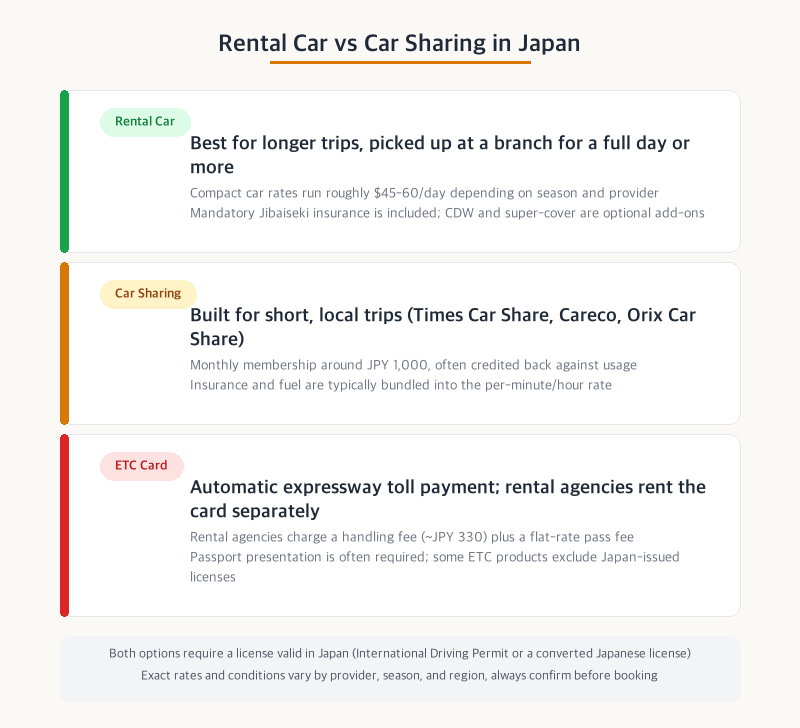
Rental Car vs Car Sharing in Japan
First, What License Do You Actually Need
To rent a car or use car sharing in Japan, you need a license that’s valid there. There are two main routes: an International Driving Permit (IDP), valid for up to one year from your entry date into Japan and only recognized if issued under the 1949 Geneva Convention, or converting your home country’s license into a Japanese one (gaimen kirikae), a formal conversion process. We’ve covered the detailed differences between these two routes — validity periods, procedures, required documents — in a separate guide; the short version is that an IDP is generally enough for a short trip, while a full conversion is worth considering for a longer stay.
Rental agencies typically require your International Driving Permit, passport, and a credit card in your own name at the counter.
Insurance: Mandatory Jibaiseki Is Just the Baseline
Every registered vehicle in Japan is legally required to carry Jibaiseki insurance (compulsory automobile liability insurance), and rental/car-share vehicles are no exception. The catch is that Jibaiseki only covers bodily injury to third parties, with a capped payout — it does not cover property damage or damage to the rental vehicle itself.
To fill that gap, rental agencies typically bundle a supplementary liability and vehicle damage policy into the base rate, but structured so you’re still on the hook for a deductible (menseki-kin) if an accident happens. To reduce or eliminate that deductible, you can add a Collision Damage Waiver (CDW), or go further with a “super cover” option that removes the deductible entirely. Always check what’s included in the base rate and how large the deductible is before booking, and add CDW if you want real peace of mind.
Rough Cost Expectations
| Item | Approximate Cost |
|---|---|
| Compact car rental (per day) | Roughly $45-60, varying by season and provider |
| CDW add-on | Roughly JPY 1,000-2,000 per day |
| Car-share monthly membership | About JPY 900-1,100, often credited back against usage |
| ETC card rental fee | Handling fee (~JPY 330) plus a separate flat-rate pass charge |
💡 Run your own numbers — try the Japan Overtime Pay Calculator (2026).
ETC Cards: Worth Sorting Out Before You Hit the Expressway
Japan’s expressways use an automated toll system called ETC, letting you pass through tollgates without stopping — and several tourist/short-term-resident discount passes are built around having an ETC card. Rental agencies can rent you an ETC card, typically for a handling fee plus a separate flat-rate pass charge. Many require passport presentation at sign-up, and it’s worth confirming in advance since some ETC products explicitly exclude Japan-issued licenses.
Car Sharing (Times Car Share, Careco, and Similar Services)
While rental cars are built around full-day bookings, car-sharing services like Times Car Share, Careco, and Orix Car Share let you grab a vehicle parked in your neighborhood for just an hour or two. Monthly membership runs around JPY 900-1,100 depending on the provider, and many services credit that fee back against your actual usage, so it’s not a wasted cost if you use the service regularly. Insurance and fuel are typically already bundled into the per-minute/hour rate, which is a meaningful difference from renting. That said, sign-up still requires the same license check — an IDP or a converted Japanese license — as a standard rental.
Quick Summary
| Item | Rental Car | Car Sharing |
|---|---|---|
| Best for | Longer trips, full-day or multi-day use | Short trips, local errands |
| What’s in the base rate | Vehicle + Jibaiseki; supplementary insurance has a deductible by default | Insurance and fuel typically included |
| Extra costs | CDW add-on, ETC card fees | Monthly fee (credited against usage), check ETC availability |
| License required | International Driving Permit or converted Japanese license | Same |
Frequently Asked Questions
Q. Is mandatory Jibaiseki insurance enough to cover me in an accident?
A. No. Jibaiseki only covers bodily injury to third parties, with a capped payout. Property damage and damage to the rental vehicle itself need to be covered by supplementary insurance or a collision damage waiver.
Q. Do I have to buy the Collision Damage Waiver (CDW)?
A. It’s not legally required, but it significantly reduces or eliminates your deductible in an accident, so it’s commonly recommended, especially if you’re driving unfamiliar roads.
Q. Do I need to arrange an ETC card in advance?
A. It’s not mandatory, but it lets you pass through tollgates without stopping and is often required for certain discount passes, so it’s worth requesting when you book your rental if you’re planning a longer expressway trip.
Q. Is car sharing cheaper than renting a car?
A. It depends on your usage pattern. Car sharing tends to work out cheaper for frequent, short, local trips, while a rental car is generally more economical for a full day or a longer-distance trip.
Key Takeaways
- Both rental cars and car sharing require an International Driving Permit or a converted Japanese license.
- Jibaiseki only covers bodily injury, so supplementary insurance like CDW is worth adding.
- Rental cars suit longer trips; car sharing suits short, local trips.
- Arrange an ETC card in advance if you’re planning to use Japan’s expressways.
This article is for general informational purposes only. Actual rates, insurance terms, and ETC card requirements vary by provider, vehicle type, region, and season, so confirm the latest details with the specific rental or car-sharing company before booking.