If you’ve ever gotten health insurance in the US through the ACA marketplace, you already know the basics: you estimate your income, pick a plan, and your subsidy is calculated off that estimate — with a true-up at tax time. Japan’s National Health Insurance (Kokumin Kenko Hoken, or NHI) works on a fundamentally different logic, and understanding that difference explains a lot of the “why is my premium bill so high” confusion foreign residents run into.
Japan NHI vs US ACA Marketplace
The Three Components of an NHI Premium
Your NHI premium is the sum of three separate components:
| Component | Who pays it | What it funds |
|---|---|---|
| Medical portion | All enrollees | Covers actual medical care costs |
| Elderly support portion | All enrollees | Supports the healthcare system for those 75 and older |
| Long-term care portion | Only ages 40-64 | Funds Japan’s long-term care insurance system |
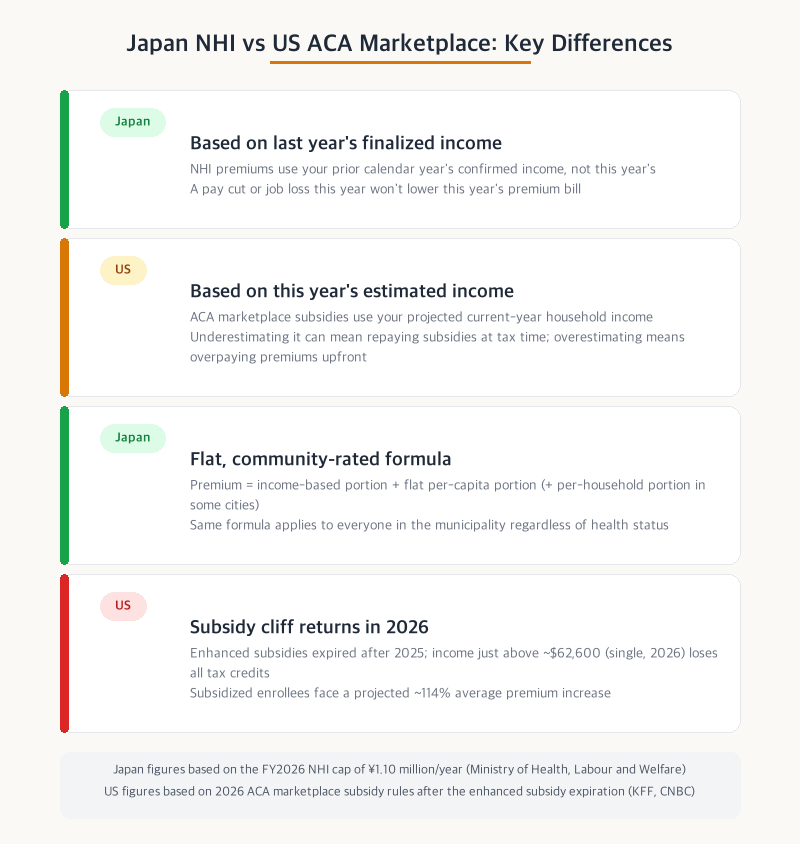
Each of these three components is calculated as an income-based portion plus a flat per-capita portion, and in some municipalities, a flat per-household portion is added on top.
Income-Based vs. Flat Portions
- Income-based portion: Your prior year’s income (after standard deductions) multiplied by a rate set by your municipality. This scales with income.
- Per-capita portion: A flat amount charged per enrolled person, regardless of income. More household members means a higher total.
- Per-household portion: A flat amount charged once per household, where the municipality has adopted it.
This means even with zero income, you’ll still owe the flat per-capita (and possibly per-household) portions. That’s the direct answer to “why do I owe anything if I have no income right now?”
The Big Difference from the US: Which Year’s Income Counts
This is where Japan’s system runs in the opposite direction from the US marketplace. NHI premiums notified around June each year (covering that April through the following March) are based on your finalized income from the previous calendar year (January-December). Your 2026 premium is based on your 2025 income — already locked in, not an estimate.
Compare that to the ACA marketplace, where your subsidy is based on your projected current-year income, reconciled against your actual income when you file taxes. Underestimate your income and you may owe money back; overestimate it and you overpay premiums that get refunded later. Japan’s system has no such reconciliation step — the number is simply fixed a year in arrears.
This creates a specific trap for foreign residents leaving a job:
- If you quit a company job and switch to NHI, your premium is still based on your higher salary from before you quit — even though your current income may be zero.
- The first year of freelancing in Japan often means a much higher bill than expected, since it reflects your final year of employee salary.
- Conversely, if you have an unusually high-income year, expect a correspondingly higher premium the following year — plan cash flow accordingly.
The 2026 Cap and the Subsidy Cliff — Two Very Different Safety Valves
Japan’s NHI has an annual cap: for FY2026, the maximum you’ll ever be charged is ¥1.10 million per year (¥670,000 medical + ¥260,000 elderly support + ¥170,000 long-term care), regardless of how high your income is.
The US ACA marketplace works differently — there’s no premium cap, and starting in 2026, the “subsidy cliff” that briefly disappeared during the enhanced-subsidy years is back. Once your household income exceeds 400% of the federal poverty level (roughly $62,600 for a single person, $84,600 for a two-person household, or $128,600 for a family of four in 2026), you lose all premium tax credits — not a gradual phase-out, a hard cutoff. On average, subsidized enrollees are facing about a 114% jump in annual premiums in 2026 following the expiration of enhanced subsidies.
In short: Japan smooths out the top end with a hard cap; the US marketplace can suddenly remove support entirely once you cross a threshold.
What This Means If You’re Moving From the US System
- Don’t assume your NHI premium will immediately reflect a pay cut or job loss — it won’t, until the following year’s calculation cycle.
- If you’re leaving employer-based Shakai Hoken to become a freelancer, compare NHI against Japan’s voluntary continued enrollment option (staying on your former employer’s insurance for up to 2 years) — this is often cheaper if your prior salary was high.
- Rates vary by municipality, so if you’re considering relocating within Japan, check the NHI rate table for your destination city before you move.
Frequently Asked Questions
Do I owe NHI premiums even with zero income?
A. Yes. The flat per-capita portion (and per-household portion, where it applies) is charged regardless of income. Low-income households can qualify for automatic reductions, but the amount rarely drops to zero.
Why is my premium so high right after I quit my job?
A. Because NHI premiums are based on your finalized income from the previous calendar year. If you had a full-time salary for most of last year, that’s what’s reflected now, even if your current income is much lower.
Is the rate the same everywhere in Japan?
A. No. Both the income-based rate and the flat per-capita and per-household amounts vary by municipality. Check your specific city or ward office for exact figures.
Is there a cap on how much I can be charged?
A. Yes. For FY2026 the annual cap is ¥1.10 million total (¥670,000 medical + ¥260,000 elderly support + ¥170,000 long-term care), no matter how high your income is.
Key Takeaways
- NHI premium = (medical + elderly support + long-term care) portions, each split into income-based + flat per-capita (+ per-household) amounts.
- Premiums are based on your finalized prior-year income — the opposite of the ACA’s current-year estimate-and-reconcile approach.
- The 2026 annual cap is ¥1.10 million; the US instead has a hard subsidy cliff at 400% of the federal poverty level.
- Rates vary by municipality — always confirm exact figures with your local city or ward office.
This article is for general informational purposes only and is not tax or administrative advice. Confirm your exact premium calculation with your local municipal NHI office.