Whether you’re building a financial plan in Japan or simply thinking about what you left behind in the US, life insurance almost always comes down to the same two categories: term life and whole life. They sound like variations on the same product, but they differ in nearly every way that matters — how long coverage lasts, how the premium behaves over time, and whether you get any money back if you stop paying. This matters even more for expats, since US insurers generally won’t sell you a new policy once you’re living abroad. Here’s how the two compare, using current US pricing as a reference point.
Term Life Insurance — Cheaper Upfront, But It Resets Against You
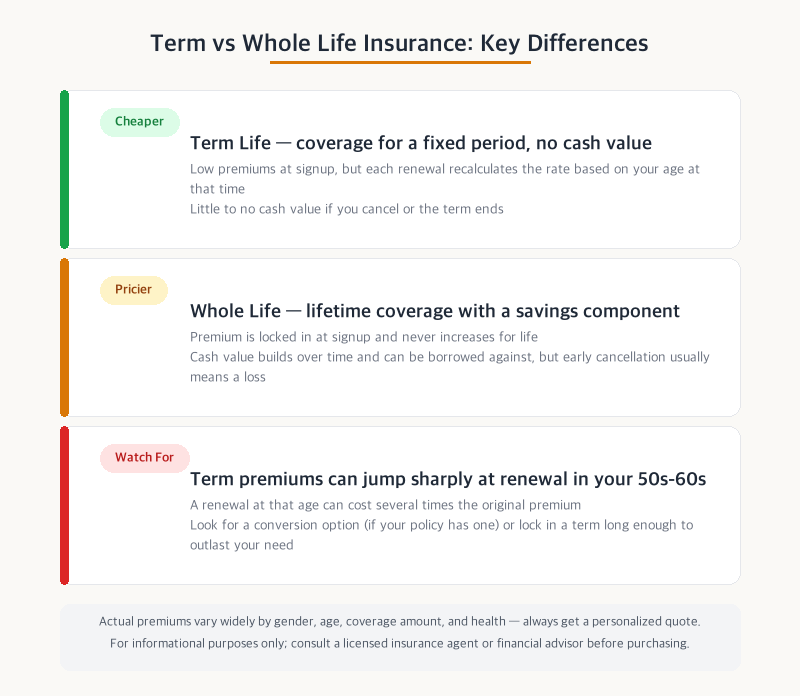
Term life insurance covers you for a fixed period — typically 10, 20, or 30 years. When the term ends, the policy simply expires, though many policies allow you to renew. The catch: a renewal is priced using your age at the time of renewal, not your original age. That means the low premium that made term life attractive when you signed up doesn’t stay low. Most term policies also have no cash value — if you cancel or the term ends without a claim, you get nothing back. The trade-off is straightforward: term life is dramatically cheaper than whole life for the same death benefit, which is why it’s the default choice for most working-age people.
Whole Life Insurance — Expensive, But the Premium Never Moves
Whole life insurance covers you for your entire life, and its defining feature is that the premium is fixed at the moment you buy the policy and never increases. It also builds cash value over time — a savings-like component you can eventually borrow against — which is why it’s sometimes used for estate planning or covering final expenses. The cost, however, is steep: whole life typically runs 5 to 15 times more expensive than term life for the same coverage amount, depending on age. As a concrete example, a 35-year-old man buying $500,000 in coverage might pay around $40/month for a 20-year term policy versus roughly $545/month for whole life covering the same amount — a gap that’s typical, not exceptional. Canceling a whole life policy early usually means getting back less than you paid in.
| Feature | Term Life | Whole Life |
|---|---|---|
| Coverage length | Fixed period (10, 20, 30 years) | Lifetime |
| Premium level | Low at signup | Much higher for the same death benefit |
| Premium over time | Recalculated (and rises) at each renewal, based on age then | Fixed at signup, never changes |
| Cash value | None or negligible | Builds over time, borrowable |
| Best for | A defined period of need (e.g., until kids are financially independent) | Lifelong coverage, estate planning, final expenses |
The Trap — Why Term Premiums Can Blindside You Later
The most commonly overlooked detail with term life is what happens at renewal. Because the rate resets using your age at that moment, a renewal in your late 50s or 60s can cost several times what you originally paid — sometimes enough to make the policy unaffordable right when you’re approaching retirement, exactly when your need for coverage may still be real. This is why it’s worth checking, before you buy, whether the policy includes a conversion option that lets you switch to a permanent (whole life) policy without a new medical exam. Without that option, converting later means going through medical underwriting again — and if your health has declined, you could face a higher premium or be denied coverage entirely.
💡 Run your own numbers — try the Japan Fire & Quake Insurance Calculator (2026).
A Note for Americans Living Abroad
If you’re a US citizen living in Japan and considering term or whole life insurance issued in the US, there’s an important practical wrinkle: most US insurers won’t issue a new policy to someone who is currently living outside the US. A small number of carriers offer expatriate-specific policies or riders designed for Americans abroad, sometimes with added features like currency protection, but these are a narrower market with more restrictions — for example, coverage may be denied or priced higher if your work or travel takes you to regions the insurer considers high-risk. If you already hold a US policy from before you moved, it typically stays in force; the friction is mainly around buying new coverage while abroad. It’s worth deciding whether you actually need US-based coverage versus a Japan-based policy before you start shopping.
Which Should You Choose?
- If you need a large amount of coverage for a defined period — such as until your children are financially independent — term life delivers the most coverage per dollar.
- If your goal is lifetime coverage plus a source of funds for final expenses or an estate, whole life’s fixed premium and cash value make more sense.
- If your primary goal is actually saving or investing, a separate investment vehicle is usually more efficient than whole life’s cash value component, which accumulates only after fees are deducted.
- If you buy term life, check for a conversion option before you sign — it matters far more once you’re a decade or two in.
- Always compare quotes across multiple insurers. Pricing for the same coverage type varies significantly by carrier.
Frequently Asked Questions
Q. Which is cheaper, term life or whole life?
A. Term life is significantly cheaper at signup, but the premium is recalculated (and rises) at each renewal based on your age at that time. Whole life locks in the premium for life at the moment you buy it.
Q. Do I get money back if I cancel a term life policy?
A. Most term policies have no cash value, so canceling typically returns nothing. Whole life policies build cash value over time, but canceling early usually means getting back less than you paid in.
Q. Can I convert a term life policy to whole life later?
A. If your policy includes a conversion option, you may be able to switch to whole life without a new medical exam. Confirm whether this option is included and under what conditions before you buy.
Q. Can I buy a new US life insurance policy while living in Japan?
A. Generally no — most US insurers won’t issue a new policy to someone currently living abroad. A limited number of carriers offer expatriate-specific policies, often with added restrictions, so it’s worth checking whether a Japan-based policy might serve you better.
Key Takeaways
- Term life is far cheaper at signup, but each renewal recalculates the premium based on your age at that time — it can rise sharply by your 50s or 60s.
- Whole life locks in the premium for life and builds cash value, but typically costs 5-15x more than term for the same coverage.
- Most term policies have no cash value if canceled; whole life policies risk a loss if canceled early.
- Most US insurers won’t issue new life insurance policies to Americans currently living abroad — check expatriate-specific options if you need US-based coverage.
This article is for general informational purposes only. Actual premiums, coverage terms, and cash value depend on the insurer, product, and the applicant’s age, gender, and health. Consult a licensed insurance agent or financial advisor before purchasing.