If a family member passes away leaving debts in Japan larger than their assets, you may need to formally renounce (disclaim) the inheritance — and Japan gives you a surprisingly short window to decide. Unlike the more familiar US concept of a “disclaimer,” Japan requires an actual family court filing, and the deadline is much tighter. Here’s how Japan’s inheritance renunciation process works, and how it compares to disclaiming an inheritance in the US.
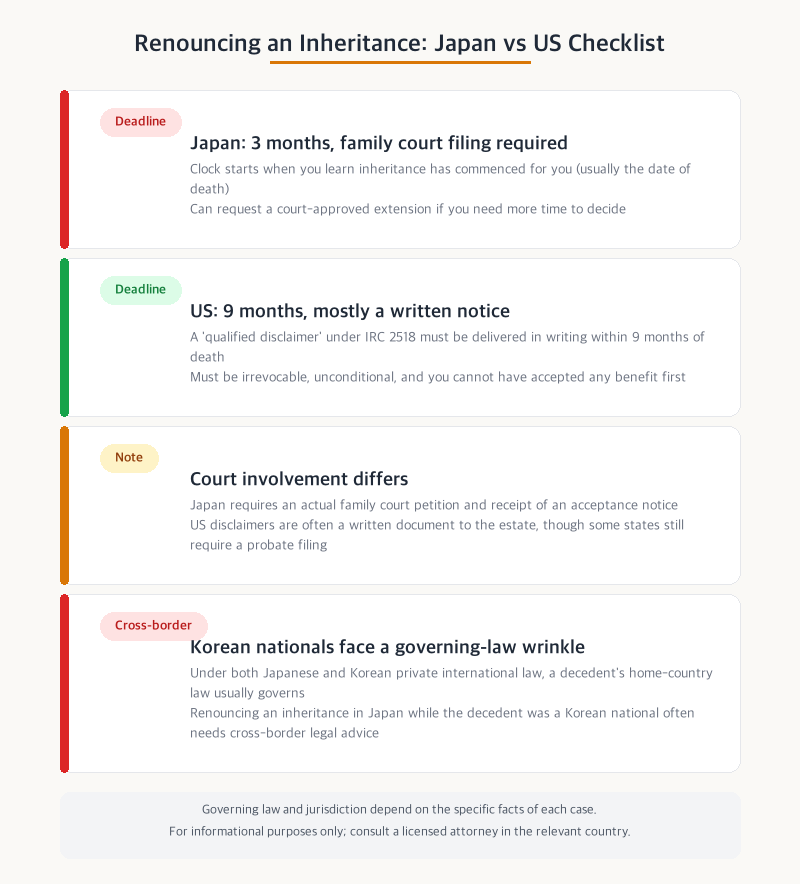
Renouncing an Inheritance: Japan vs US Checklist
Japan’s 3-Month Deadline — When Does the Clock Start?
Under Article 915 of Japan’s Civil Code, you have 3 months from the day you learned that inheritance had commenced for you — usually the date you learned of the death — to decide whether to accept, renounce, or take “qualified acceptance” of an inheritance. The exact start date can shift depending on your position in the order of succession, so pinning down the correct start date matters. If you can’t finish investigating the estate’s assets and debts in time, you can petition the family court in advance for an extension of this decision period.
The Family Court Filing Process
| Item | Detail |
|---|---|
| Jurisdiction | The family court with jurisdiction over the decedent’s last address |
| Documents typically required | A renunciation petition (soujutsu-sho), the decedent’s residence deregistration certificate (or family register deregistration certificate), the petitioner’s family register certificate, etc. |
| Outcome | After the court reviews the filing and accepts it, it issues a formal notice of acceptance of the renunciation |
Each heir can file individually — you don’t need the consent of other co-heirs to renounce your own share.
💡 Run your own numbers — try the Japan/US Inheritance Deadline Calculator (2026).
How This Compares to a US Qualified Disclaimer
In the US, the closest equivalent is a “qualified disclaimer” under Internal Revenue Code Section 2518. The core requirements are different in both mechanics and timing:
| Japan (Renunciation) | US (Qualified Disclaimer, IRC 2518) | |
|---|---|---|
| Deadline | 3 months from learning that inheritance commenced for you | 9 months from the later of the date of the transfer, or the day the disclaimant turns 21 |
| Where you file | A formal petition to the family court with jurisdiction over the decedent’s last address | A written document delivered to the estate representative/titleholder — no court filing required for the disclaimer itself |
| Core requirements | File within the deadline; court reviews and issues an acceptance notice | Must be irrevocable and unconditional, in writing, delivered within the deadline, the disclaimant must not have accepted any benefit, and the interest must pass without direction to the spouse or someone other than the disclaimant |
| Extension | Available by petitioning the family court before the 3-month deadline | Not applicable in the same way — the 9-month deadline is fixed by statute |
The practical takeaway: Japan’s process is faster-moving (3 months, not 9) and requires an actual court filing rather than just a written notice — so if you’re dealing with an estate in Japan, you have far less runway to investigate assets and debts than you would under US disclaimer rules.
The Cross-Border Wrinkle for Korean Nationals
If the decedent held a nationality other than Japan’s — for example, a Korean national who passed away while living in Japan — a separate governing-law question comes into play. Both Japan’s Act on General Rules for Application of Laws (Article 36) and the private international law rules of many other countries generally apply the decedent’s home-country law to inheritance matters. That means the substantive inheritance law may not be Japanese law at all, even though a Japan-based family court filing is often still practically required to clear title to any assets located in Japan. This is a genuinely cross-border legal question, and it’s worth getting advice from an attorney qualified in both the decedent’s home country and Japan.
💡 Tip: Enter the date of death and instantly see both the Japan 3-month and US 9-month deadlines with our Inheritance Disclaimer Deadline Calculator.
Frequently Asked Questions
Q. What happens if I miss Japan’s 3-month deadline?
A. In principle, missing the deadline without filing means you’re treated as having accepted the inheritance outright (including any debts). If you can’t decide in time, you need to petition the family court for an extension before the 3-month deadline passes.
Q. Does a US qualified disclaimer require going to court?
A. No — a qualified disclaimer under IRC 2518 is a written document delivered to the estate representative or titleholder, not a court filing. This is a key mechanical difference from Japan’s process, which requires an actual family court petition.
Q. Do all heirs have to renounce together in Japan?
A. No. Each heir can file a renunciation petition individually with the family court, and it doesn’t require the consent of other co-heirs.
Q. If the decedent wasn’t a Japanese national, does Japanese law still apply to the inheritance?
A. Not necessarily — inheritance is generally governed by the decedent’s home-country law under both Japanese and many other countries’ private international law rules. However, a family court filing in Japan is often still practically necessary to clear title to assets located in Japan, so both the governing law and the jurisdiction question need to be considered together.
Key Takeaways
- Japan gives you 3 months from learning inheritance commenced for you to decide whether to renounce.
- Renouncing in Japan requires an actual family court petition, filed individually by each heir.
- The US equivalent — a qualified disclaimer under IRC 2518 — gives you 9 months and only requires a written document, no court filing.
- If the decedent held another nationality, the governing law and the Japan filing requirement are separate questions that both need review.
This article is for general informational purposes only and is not legal advice. Governing law and jurisdiction depend on the specific facts of each case — consult a licensed attorney in the relevant country before making a decision.