
Buying a home with your spouse in the US usually means picking between joint tenancy and tenancy in common, then signing one mortgage together. Japan does things a bit differently: many couples use a system called a pair loan (pea ron), where each spouse takes out a separate mortgage and co-guarantees the other’s loan. If you’re a foreign resident buying property with a Japanese (or foreign) spouse, the mechanics — and the tax traps — are worth understanding before you sign anything.
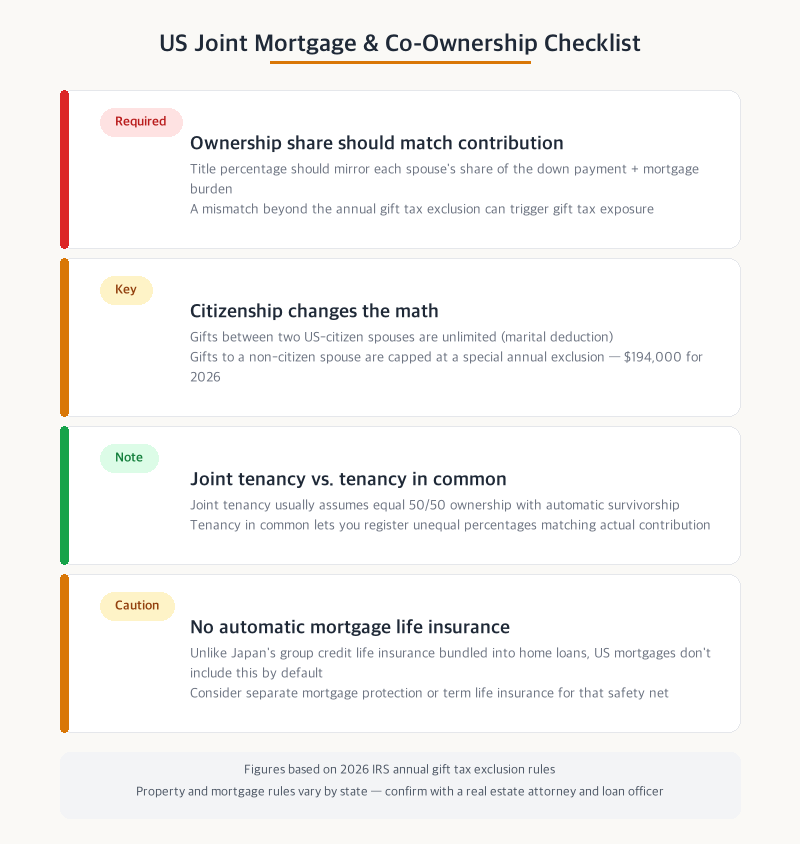
US Joint Mortgage & Co-Ownership Checklist
What a Pair Loan Actually Is
In a pair loan, each spouse signs their own separate mortgage contract and becomes the guarantor on the other’s loan. This is different from a “joint liability” loan (rentai-musai), where both spouses are jointly responsible for a single loan. The appeal of a pair loan is that because each spouse holds a separate loan in their own name, each can claim Japan’s mortgage tax deduction (juutaku-loan tokubetsu koujo) independently — similar in spirit to how both spouses on a joint US mortgage can each deduct their share of mortgage interest, but structured as two entirely separate loan contracts rather than one shared one.
Why Ownership Percentage Matters — the Gift Tax Trap
The core rule in Japan, much like the US: your registered ownership percentage on the title should match your actual financial contribution (down payment plus mortgage burden). If the husband contributes 70% of the funds and the wife 30%, but the title is registered as a 50/50 split, that 20% gap can be treated as a gift to the wife.
| Situation | Result |
|---|---|
| Ownership % = actual contribution % | No issue |
| Mismatch, but gap is within the annual exclusion | Not subject to gift tax |
| Mismatch beyond the annual exclusion | The excess can be subject to gift tax |
This is functionally the same issue American couples face: contributing unequally to a down payment but titling the property 50/50 can trigger gift tax exposure back home too — the annual gift tax exclusion for 2026 is $19,000 per recipient ($38,000 if a married couple elects gift-splitting on a joint return). One important wrinkle for international couples: gifts between two US-citizen spouses are unlimited under the marital deduction, but if your spouse is not a US citizen, gifts to them are only shielded up to a special annual exclusion — $194,000 for 2026 — rather than being unlimited. If you’re a US citizen married to a non-citizen and helping fund a jointly-titled property, that cap is worth keeping in mind.
In a Japanese pair loan, this same logic extends to your monthly repayment ratio — if your registered ownership share doesn’t match how much each of you actually pays toward the loan each month, it can both reduce your mortgage tax deduction and raise the same gift tax question.
How Mortgage Approval Differs for a Foreign Spouse
If one spouse is a foreign national without permanent residency, most Japanese lenders will typically require:
- The Japanese or permanent-resident spouse to act as a joint guarantor
- Combined income review (shunyu gassan) using both spouses’ incomes
- Stable income documentation and a comparatively larger down payment
Once the foreign spouse obtains permanent residency, the picture changes considerably — megabanks, regional banks, and online-only banks all become viable options, and couples gain much more freedom to choose between a pair loan, a joint-liability loan, or combined-income review, on close to the same terms a Japanese national couple would get. If permanent residency isn’t there yet, lender criteria vary widely, so it’s worth getting pre-screened by several banks before signing a purchase contract.
💡 Run your own numbers — try the Japan Gift Tax Calculator (2026).
The Group Credit Life Insurance Gap
Most Japanese mortgages bundle in group credit life insurance (dan-shin), which automatically pays off the remaining loan balance if the borrower dies or becomes severely disabled. This is a notable difference from the US, where mortgages don’t automatically include anything equivalent — you’d need to separately purchase mortgage protection insurance or term life insurance if you want that safety net. But there’s a catch even within Japan’s system: because a pair loan is two separate contracts, each spouse’s dan-shin only covers their own loan. If one spouse dies, the other spouse’s loan doesn’t disappear — it’s still owed in full. It’s worth putting a written agreement in place with your spouse beforehand covering how you’d handle ownership and the remaining mortgage in the event of divorce or death.
Practical Checklist Before You Buy
- Decide exactly how much each of you is contributing to the down payment and mortgage, then set the title percentage to match.
- Keep monthly repayments proportional to your ownership share to avoid a reduced mortgage deduction or a gift tax question.
- If one spouse is a foreign national, get pre-screened by multiple lenders to compare terms.
- Understand that group credit life insurance only covers each spouse’s own loan — consider separate life insurance if you want broader coverage.
- Document your ownership percentage and the funding records behind it — this makes things much easier if either tax authority ever asks questions later.
Frequently Asked Questions
If our ownership percentage doesn’t match our actual contributions, does that automatically trigger gift tax?
A. Not automatically — if the gap is within the annual gift tax exclusion, it isn’t taxed. Only the amount exceeding that threshold is at risk of being taxed as a gift.
Can we still get a pair loan without permanent residency?
A. It depends on the lender, but most will require the Japanese or permanent-resident spouse to act as a joint guarantor. Options expand significantly once permanent residency is granted.
Does one spouse’s death automatically clear the other spouse’s loan too?
A. No. In a pair loan, each spouse’s group credit life insurance only covers their own separate loan. The surviving spouse’s own mortgage remains fully owed.
What’s the difference between a pair loan and a joint-liability loan?
A. A pair loan means two separate mortgage contracts with mutual guarantees; a joint-liability loan means a single mortgage that both spouses are jointly responsible for. Tax treatment and lender requirements differ between the two, so ask your lender to walk through both options.
Key Takeaways
- Your registered ownership percentage should match your actual funding contribution to avoid gift tax exposure.
- A pair loan means two separate mortgages with mutual guarantees, letting each spouse claim their own mortgage deduction.
- Without permanent residency, expect to need a Japanese/PR spouse as guarantor; PR opens up far more lender options.
- Group credit life insurance only covers each spouse’s own loan — plan for divorce/death scenarios in writing.
This article is for general informational purposes only and is not legal or tax advice. Consult a real estate attorney, tax professional, and your lender before signing a purchase contract.