If you’re a foreign resident in Japan and you travel abroad or shop on overseas websites, the card in your wallet matters more than you’d think. Japan’s major credit card issuers have been quietly raising their overseas transaction fees, and the gap between the cheapest and most expensive options is now large enough to actually notice on your statement.
How Overseas Card Fees Are Built
Every overseas card transaction typically carries two layers of fees:
- The card network’s fee — charged by Visa, Mastercard, and similar networks
- The issuer’s own overseas handling fee — set independently by the bank or card company
Together, these make up the total percentage added to your purchase when you pay in a foreign currency.
Mainstream Japanese Cards vs Cheaper Alternatives
| Card | Total Overseas Fee | Notes |
|---|---|---|
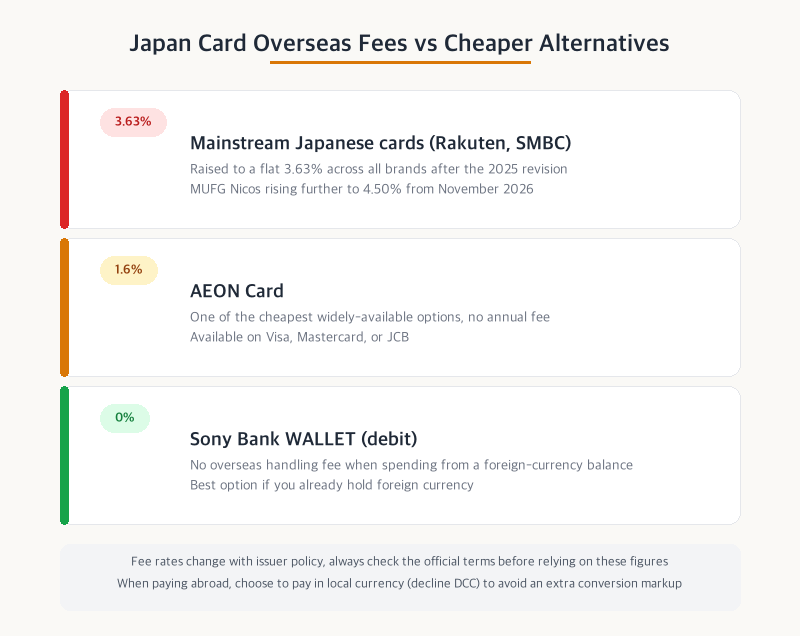
| Rakuten Card / Mitsui Sumitomo Card | 3.63% | Raised to a flat rate across all brands following a 2025 revision |
| MUFG Nicos | 4.50% (from November 2026) | A further increase is scheduled, among the highest in Japan |
| AEON Card | 1.6% | One of the cheapest widely available options, no annual fee |
| Sony Bank WALLET (debit) | 0% | No overseas fee when spending from a foreign-currency balance |
So What Should You Actually Use?
- If you frequently shop on overseas websites or travel outside Japan, it’s worth checking whether a card from your home country still makes sense to keep active for those purchases — many non-Japanese cards carry lower foreign transaction fees than Japan’s mainstream options.
- If you do want a Japan-issued option for overseas spending, AEON Card (1.6%) or Sony Bank WALLET (0% when funded with foreign currency) are meaningfully cheaper than Rakuten Card or Mitsui Sumitomo Card at 3.63%.
- At checkout, you’ll sometimes be asked whether to pay in the local currency or have it converted to yen on the spot (Dynamic Currency Conversion, or DCC). Always choose the local currency — DCC almost always bakes in a worse exchange rate.
Quick Summary
| Item | Detail |
|---|---|
| Mainstream Japanese card fees | 3.63%, with some issuers rising to 4.5% |
| Cheaper Japanese alternatives | AEON Card (1.6%), Sony Bank WALLET (0%) |
| Worth checking | Whether your home-country card still has a lower foreign transaction fee |
| Checkout tip | Decline DCC and pay in local currency |
This article is for general informational purposes only. Fee rates are set by each card issuer and change over time. Always check the current terms on the official website before relying on these figures.
Frequently Asked Questions
Q. How are overseas credit card fees actually calculated?
A. They combine two layers — the card network’s fee (Visa, Mastercard, and similar) and the issuer’s own overseas handling fee — added together as the total percentage charged on foreign-currency purchases.
Q. How much do mainstream Japanese cards charge?
A. Rakuten Card and Mitsui Sumitomo Card both charge 3.63% following a 2025 revision, and MUFG Nicos is set to rise to 4.50% from November 2026, with a further increase scheduled.
Q. Are there cheaper Japanese card options?
A. Yes — AEON Card charges just 1.6% with no annual fee, and Sony Bank WALLET charges 0% when spending from a foreign-currency balance.
Q. What should I do at checkout when asked to choose a currency?
A. Always choose to pay in the local currency rather than accepting Dynamic Currency Conversion (DCC) to yen — DCC almost always bakes in a worse exchange rate.
Key Takeaways
- Overseas card fees combine the card network’s fee plus the issuer’s own handling fee.
- Rakuten Card / Mitsui Sumitomo Card charge 3.63%; MUFG Nicos rises to 4.50% from November 2026.
- AEON Card (1.6%) and Sony Bank WALLET (0% with a foreign-currency balance) are cheaper Japanese alternatives.
- Always decline DCC and pay in the local currency at checkout.