One of the first practical decisions after settling in Japan is which bank to open an account with. Online banks like Rakuten Bank, Sony Bank, and PayPay Bank have gained popularity for their convenience, but megabanks like MUFG, Mizuho, and SMBC still serve a huge share of residents. Here’s a practical comparison for a foreign resident deciding where to bank.
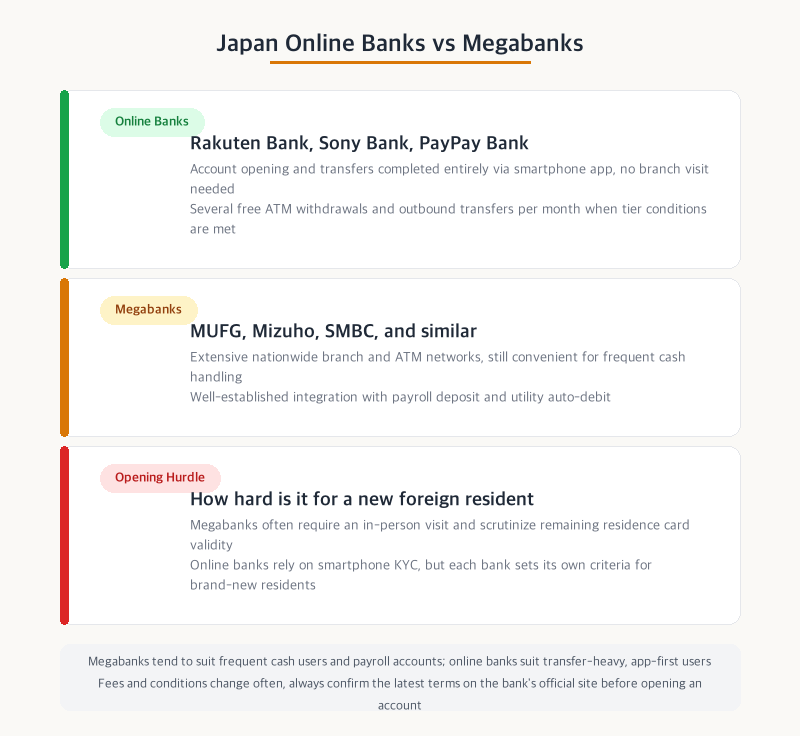
Japan Online Banks vs Megabanks
Opening an Account: The Gap Widens for Brand-New Residents
Megabanks have traditionally required an in-person branch visit and document review, and some scrutinize how much validity remains on your residence card or which visa category you hold. Many megabanks have started offering video-call consultations to simplify the process, but a branch visit or physical paperwork is still common.
Online banks, on the other hand, often let you complete the entire application and identity verification (eKYC) through a smartphone app, with no branch visit required — that’s the biggest draw. That said, “online” doesn’t automatically mean “easy”: each online bank sets its own criteria for how recently you arrived in Japan, so it’s worth checking the official requirements before applying. (We’ve covered the general documents and process for opening a Japanese bank account in a separate guide.)
Fees: ATM and Transfer Fees Are the Biggest Difference
The core advantage of online banks is that many offer several free ATM withdrawals and free outbound transfers per month once you meet certain conditions — designating payroll deposit, reaching a certain account tier, or using a linked service like an affiliated brokerage. Megabanks tend to offer more limited free allowances, often requiring you to maintain a minimum balance to waive fees.
The tradeoff is that online banks typically have no branch network of their own and rely on convenience-store ATMs (Seven Bank, Lawson ATMs, etc.). Once you use up your free monthly allowance, fees can kick in — worth checking closely if you handle cash often.
💡 Run your own numbers — try the Japan Overtime Pay Calculator (2026).
Comparing App Usability and Access
| Item | Online Banks | Megabanks |
|---|---|---|
| Account opening | Completed via smartphone app; screening criteria vary by bank | Often requires a branch visit or video consultation and document review |
| ATM access | Relies on convenience-store ATMs, no proprietary branch network | Nationwide branch and ATM network, strong for cash handling |
| Fee waivers | Multiple free transfers/withdrawals common once conditions are met | Waivers typically conditional on maintaining a minimum balance |
| App UX | Mobile-first design, quicker to adopt newer UI patterns | Apps have improved recently but tend to be more conservative |
| Payroll/utility auto-debit | Usually possible, though some employers restrict which banks they support | Traditionally well-integrated and reliable |
Which One Fits You
If you handle a lot of cash and want your payroll deposit and utility auto-debits to run smoothly, a megabank account still makes a solid primary account. If you transfer money frequently and want to manage everything from your phone, an online bank is often the better fit for fees and convenience. In practice, many residents keep both: a megabank account for payroll and bills, and an online bank account for transfers and savings.
💡 Tip: For the documents and residency requirements needed to open any Japanese bank account, see our guide “Opening a Bank Account in Japan: A Guide for New Residents.”
Frequently Asked Questions
Q. Can any foreign resident open an online bank account right away with just a residence card?
A. No — each bank sets its own screening criteria for how recently you arrived and how much validity remains on your residence card. Applications made right after arrival are sometimes declined, so check the specific bank’s official requirements before applying.
Q. Do online banks have no ATMs at all?
A. They don’t operate their own branch network, but you can withdraw and deposit cash through affiliated convenience-store ATMs like Seven Bank or Lawson ATMs. Fees can apply once you exceed your monthly free allowance, so this matters if you handle cash often.
Q. Do I have to receive my paycheck into a megabank account?
A. Not necessarily. Many employers can deposit payroll into an online bank account too, but some restrict payroll deposits to a specific bank or megabanks only — it’s worth confirming with HR when you’re hired.
Q. Is it fine to keep accounts at multiple banks?
A. Yes, this is common. Just be aware that dormancy policies and account management differ by bank, so it’s generally recommended to keep only as many accounts as you actually need, split by purpose (payroll, savings, transfers).
Key Takeaways
- Online banks (Rakuten, Sony, PayPay, etc.) stand out for app-only account opening and conditional fee waivers.
- Megabanks (MUFG, Mizuho, SMBC, etc.) stand out for their nationwide branch/ATM network and reliable payroll/utility integration.
- Account-opening difficulty for new residents varies by bank, so always check the latest requirements before applying.
- Frequent cash users tend to favor megabanks, while transfer-heavy, app-first users tend to favor online banks — many residents use both.
This article is for general informational purposes only. Actual fees, screening criteria, and promotional conditions change frequently by bank and by period, so confirm the latest official information with the specific bank before opening an account.