If you’ve spent a summer in Japan, you’ve probably opened an August or September electricity bill and wondered why it jumped so much even though your usage didn’t feel that different. Here’s what’s actually driving the increase, what the 2026 government subsidy covers, and which savings habits actually make a noticeable difference.
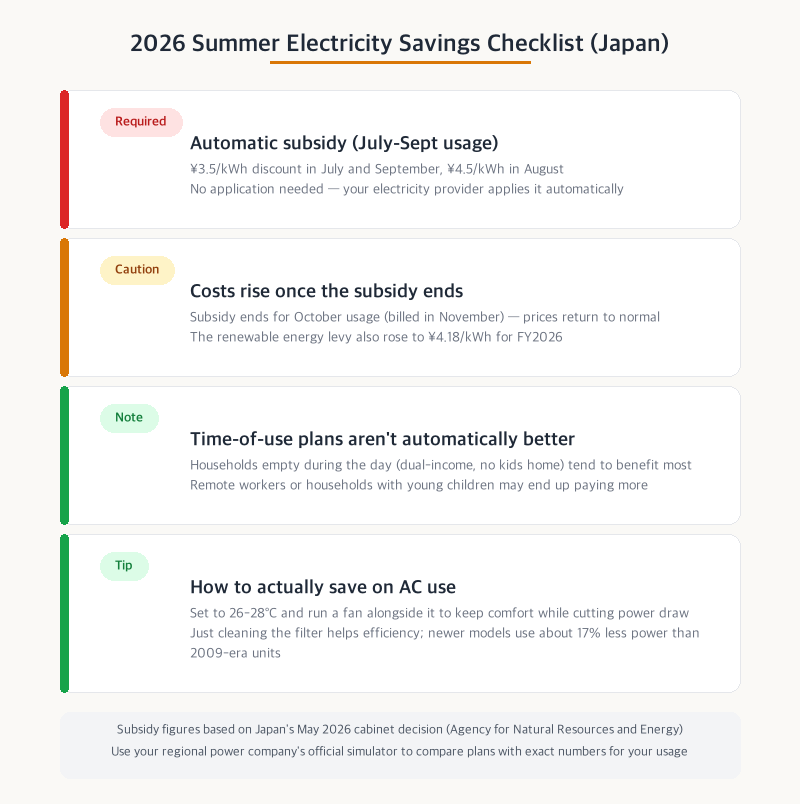
2026 Summer Electricity Savings Checklist
Why Summer Electricity Bills Spike
Three factors tend to stack on top of each other during Japanese summers:
- Higher AC usage: Cooling load simply increases, so absolute consumption goes up.
- A higher renewable energy levy: For FY2026, this is ¥4.18 per kWh — a line item automatically added to every bill regardless of your usage, so the base rate itself rises.
- Fluctuating fuel cost adjustments: This is adjusted monthly based on the cost of fuel used for power generation, which tracks international energy prices.
The 2026 Summer Subsidy — No Application Needed
Japan’s government finalized a subsidy for electricity and gas bills covering July-September 2026 usage (billed August-October) via a cabinet decision on May 26, 2026. For a standard household, this works out to roughly ¥5,000 in savings across the three months combined.
| Item | Detail |
|---|---|
| Electricity discount rate | ¥3.5 per kWh in July and September, ¥4.5 per kWh in August |
| Eligibility | Low-voltage contracts (households/small businesses) plus high-voltage contracts (businesses) for electricity; city gas for households and businesses using under 10 million m³/year |
| How it’s applied | No application required — your electricity/gas provider applies the discount automatically on your bill |
| Coverage period | July 2026 usage (billed August) through September 2026 usage (billed October) |
The key thing to watch for: the subsidy ends for October usage (billed in November). Rather than assuming your bills will stay manageable through the whole hot season, it’s worth building real savings habits now, since the subsidy’s disappearance will land right as the weather starts to cool but bills haven’t yet.
Are Time-of-Use Plans Actually Worth Switching To?
Power companies offer various plans with cheaper rates during specific hours, often overnight. Whether these actually save you money depends heavily on your household’s daily rhythm.
- Dual-income households empty during the day: Likely to benefit, since most usage shifts to evening and night hours.
- Remote workers or households with young children at home: Daytime cooling use is high, so a time-of-use plan can actually cost more than a standard flat-rate plan.
The most reliable way to know for sure is to plug your recent usage data into your power company’s own rate simulator and compare the actual numbers for your household.
AC Savings Habits That Actually Make a Difference
- Set to 26-28°C and run a fan alongside it: Raising your AC’s set temperature by even one degree noticeably cuts power draw, and circulating air with a fan keeps the room feeling just as cool while using less energy overall.
- Clean the filter regularly: A dust-clogged filter significantly reduces cooling efficiency. Cleaning it roughly every two weeks meaningfully improves performance.
- Consider replacing an old unit: According to Japan’s Agency for Natural Resources and Energy, a 2019-model AC unit uses about 17% less power than a 2009-model unit doing the same job. If your unit is old, it’s worth weighing the replacement cost against the ongoing savings.
- Block direct sunlight through windows: Curtains or blinds that block direct sun reduce how much the room heats up in the first place, easing the load on your AC.
Frequently Asked Questions
Do I need to apply for the electricity subsidy?
A. No. Your electricity and gas provider applies the discount automatically to your bill — there’s no separate application process.
How long does the subsidy last?
A. It covers July 2026 usage (billed in August) through September 2026 usage (billed in October). Starting with October usage (billed in November), bills return to their normal rate without the subsidy.
Will switching to a time-of-use plan automatically save me money?
A. Not automatically. Households empty during the day tend to benefit, but remote workers or households with young children may end up paying more. Compare your actual usage pattern using your power company’s rate simulator before switching.
What’s the ideal AC temperature setting?
A. Generally 26-28°C, paired with a fan to circulate air. This keeps the room feeling just as comfortable while reducing power consumption.
Key Takeaways
- Summer bill increases come from higher usage + a higher renewable energy levy + fuel cost adjustments stacking together.
- The 2026 government subsidy for July-September usage saves a standard household about ¥5,000 total, applied automatically with no application needed.
- Time-of-use plans aren’t automatically better — they depend heavily on your household’s daily schedule, so simulate first.
- Setting your AC to 26-28°C, running a fan, and cleaning the filter are the habits that actually move the needle.
This article is for general informational purposes only. Confirm your household’s exact rates and charges with your electricity/gas provider’s bill and official rate simulator.