Sign a lease in Japan, and you’ll almost certainly run into a “guarantor company screening” (保証会社, hoshou gaisha). It’s not a concept most Western renters have encountered before, so the natural question is: is this really required, or can I just line up a personal co-signer instead? Short answer: for a new foreign resident, using a guarantor company is close to mandatory in practice — here’s why, and what it costs.
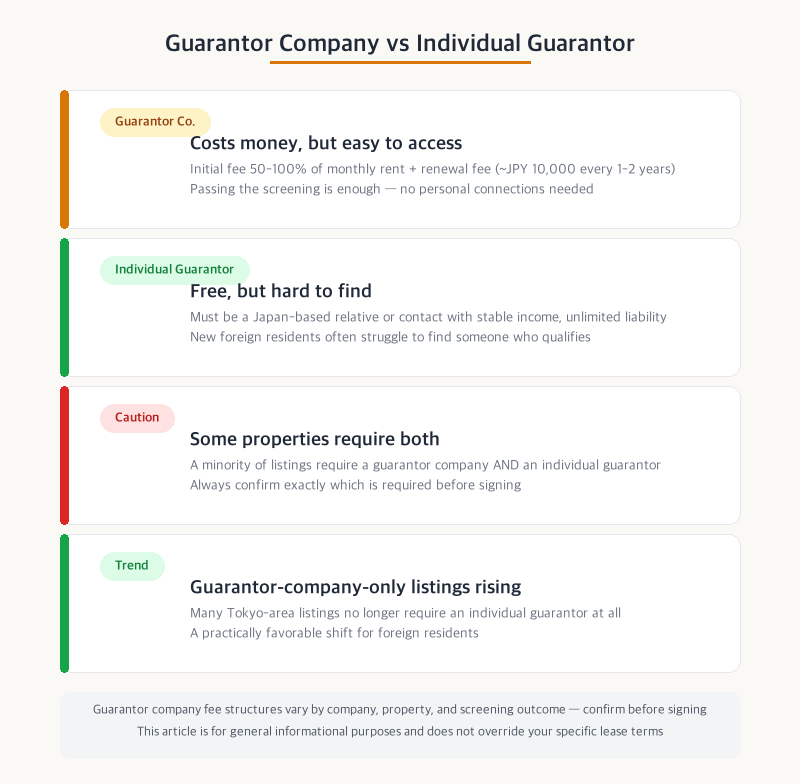
Guarantor Company vs Individual Guarantor
What Is a Guarantor Company?
A guarantor company is a business that pays the landlord on your behalf if you fall behind on rent. You pay the company a guarantee fee when you sign the lease, and in exchange it screens your creditworthiness and backs your tenancy. In today’s Japanese rental market, the vast majority of listings require this screening — for Japanese and foreign renters alike, it’s become the de facto standard process.
The Cost: Initial Fee Plus Renewal Fee
| Item | Detail |
|---|---|
| Initial guarantee fee | Typically 0.5-1 month’s rent (50-100%). Example: on JPY 80,000 rent, that’s JPY 40,000-80,000 |
| Renewal fee | Roughly JPY 10,000 every 1-2 years (or 1-2% of rent annually), depending on the company |
| Fee structure | Some companies charge more upfront with no ongoing fee; others charge less upfront and spread costs across monthly/annual renewals |
The key point: this isn’t a one-time payment. Every time your lease renews (typically every two years in Japan), a renewal fee kicks in again. Always confirm the exact initial fee, the renewal fee amount, and the renewal cycle before signing.
How This Differs From an Individual Guarantor
An individual guarantor (rentai hoshounin, 連帯保証人) is a person who takes on the same unlimited liability as you if you fall behind on rent or breach the lease. They typically need to be a Japan-based relative with stable income, and often have to submit proof of income and employment. Unlike a guarantor company, there’s no fee involved — but that’s precisely because the person taking on the role is shouldering real financial risk on your behalf.
Why Foreign Residents Struggle to Find One
For someone who’s just arrived in Japan, meeting this bar is genuinely difficult:
- Most new foreign residents simply don’t have a relative living in Japan
- Even asking a friend is a big ask — “unlimited liability equal to the tenant’s” is not a small favor to request
- Meeting the income-proof and paperwork requirements usually requires a long-established contact in Japan, which most newcomers don’t have
This is exactly why landlords and leasing agents typically tell foreign applicants upfront that a guarantor company is required — in practice, it has become the substitute for having a personal guarantor.
The Trend: More Listings Now Require Only a Guarantor Company
In the past, many properties required both a guarantor company AND a personal guarantor. More recently, especially in the Tokyo area, a growing share of listings accept a guarantor company alone, with no personal guarantor needed. This is a practically favorable shift for foreign residents. That said, some properties still require both, so it’s worth confirming exactly which is needed before you commit to a listing.
How This Compares to US Lease Guarantee Services
If you’ve rented in the US, the closest equivalent is a third-party lease guarantee service like TheGuarantors or Insurent — increasingly used by landlords instead of, or alongside, a personal co-signer.
| Japan (Guarantor Company) | US (Lease Guarantee Service) | |
|---|---|---|
| Initial fee | 50-100% of one month’s rent | TheGuarantors: 4.75-7.5% of annual rent (US citizens), 7-10% (non-citizens) |
| Alternative provider example | — | Insurent: ~70-90% of one month’s rent for a year (with US credit history), ~98-110% without it |
| Renewal cost | ~JPY 10,000 every 1-2 years | New guaranty fee may apply again at lease renewal |
| Who typically uses it | Most renters, foreign and Japanese alike | Renters without a qualifying US co-signer or sufficient credit history |
The mechanics are strikingly similar: both let you skip finding a personal guarantor by paying a company to take on that risk instead, and both charge a fee that scales with your rent. The main difference is that in the US, this is more often positioned as an alternative for renters who can’t find a co-signer, whereas in Japan a guarantor company has become close to a universal requirement, regardless of whether you could find a personal guarantor.
Checklist Before You Sign
- Does this listing require only a guarantor company, or a personal guarantor as well?
- What percentage of monthly rent is the initial guarantee fee?
- What’s the renewal fee, and how often does it recur?
- Does the screening check your residence status (visa), and what documents are required?
Frequently Asked Questions
Q. Can I skip the guarantor company and just use a personal guarantor?
A. A few listings allow it in theory, but most landlords and management companies require guarantor company screening as standard risk management. For a newly arrived foreign resident, it’s realistic to assume a guarantor company will be required.
Q. Can you fail the guarantor company screening?
A. Yes. Results depend on your residence status, income, and employment type (full-time, contract, self-employed, etc.). If you’re rejected by one guarantor company, some agents will try screening you through a different one.
Q. What happens if I don’t pay the renewal fee?
A. It’s treated as a breach of the guarantee agreement and can lead to it being terminated — which in turn can put you in breach of the lease itself. Don’t miss a renewal deadline.
Q. Why do some listings require both a guarantor company and a personal guarantor?
A. The landlord is layering two forms of risk protection. These listings tend to be a higher hurdle for foreign renters, so it’s worth prioritizing listings that accept a guarantor company alone.
Key Takeaways
- A guarantor company’s initial fee is typically 50-100% of one month’s rent, plus a renewal fee of roughly JPY 10,000 every 1-2 years.
- An individual guarantor costs nothing but takes on unlimited liability — a big ask of anyone.
- New foreign residents rarely have someone who qualifies, making a guarantor company practically mandatory.
- More listings, especially in Tokyo, now accept a guarantor company alone — a favorable trend for foreign renters.
This article is for general informational purposes only. Actual guarantor company terms and fees vary by company, property, and screening outcome — always confirm current conditions with your leasing agent before signing.