
Getting your first credit card in a new country can be surprisingly hard, and the US is no exception for recent arrivals. Even people with excellent credit back home often get denied for their first US credit card, simply because credit histories don’t cross borders — US credit bureaus have no record of your financial behavior elsewhere. Here’s why that happens and what strategies actually work.
First Credit Card Rejections and How to Fix Them
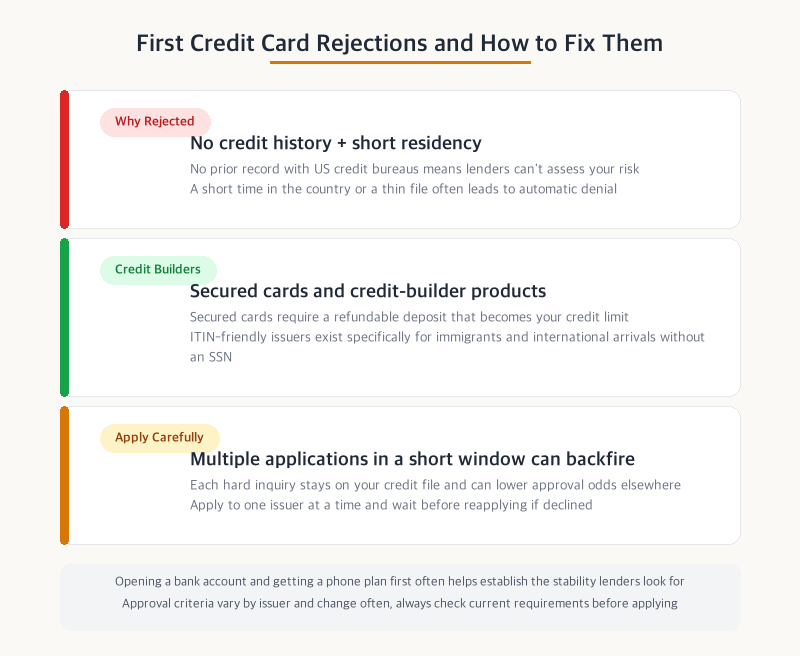
Why Your First Application Gets Rejected
US credit card approvals rely heavily on your file with the three major credit bureaus — Equifax, Experian, and TransUnion. A brand-new arrival typically has no credit file at all, sometimes called being “credit invisible.” Without any track record, issuers have no basis to judge your repayment risk, so they default to caution. On top of that, a missing or new Social Security Number (SSN), unstable income documentation, or a short time in the country all compound the odds of rejection.
Lenders generally look more favorably on applicants who can show stable income, a US bank account, and a phone plan under their own name — all signs of an established financial footprint, even without prior credit history.
Secured Cards: The Standard Starting Point
A secured credit card is the most common entry point for people with no credit history. You put down a refundable deposit — often $200 to $500 — which becomes your credit limit, and the issuer reports your payment activity to all three credit bureaus just like a regular card. Used responsibly (small charges, paid in full every month), a secured card can help most people establish a usable credit score within roughly 3 to 6 months, with a strong score generally taking 12 to 24 months of consistent on-time payments.
💡 Run your own numbers — try the Japan Overtime Pay Calculator (2026).
Options for Immigrants and International Arrivals Without an SSN
Several issuers now specifically target immigrants and international students who may not yet have an SSN. Products built around an ITIN (Individual Taxpayer Identification Number) instead of an SSN exist, and some newer fintech-style secured cards accept applicants with no US credit file at all, reporting activity to all three bureaus from day one. These are worth researching specifically if you don’t yet have an SSN.
What to Avoid When Reapplying
Every credit card application typically triggers a hard inquiry, which stays on your credit file and can lower your approval odds elsewhere if you apply to too many issuers in a short window. It’s generally better to apply to one issuer at a time, and if declined, wait a few months and address the specific reason for denial before reapplying.
| Strategy | Details |
|---|---|
| Preparation | Open a US bank account and set up a phone plan in your own name first |
| First move | Apply for a secured card or an ITIN-friendly / no-credit-history-required card |
| What to avoid | Applying to multiple issuers within a short window |
| Reapplying | Wait a few months after a denial and address the stated reason before trying again |
💡 Tip: For a deeper look at systematically building US credit history from scratch, see our related guide on establishing credit as a new arrival.
Frequently Asked Questions
Q. Does a good credit score in my home country help me in the US?
A. No. US credit bureaus don’t receive credit history from other countries, so most new arrivals start with no US credit file at all, regardless of their credit standing elsewhere.
Q. Is a secured card a bad option because it requires a deposit?
A. Not necessarily. The deposit is refundable and simply becomes your credit limit. Used responsibly, a secured card is one of the most reliable ways to start building a usable US credit history.
Q. Will applying to several card issuers at once improve my odds?
A. It usually hurts more than it helps. Each application creates a hard inquiry that stays on your file, and issuers may view multiple recent applications as a red flag. Apply to one issuer at a time.
Q. What should I set up before applying for my first credit card?
A. Opening a US bank account and getting a phone plan in your own name first are generally seen as signs of financial stability, and having a stable income source further improves approval odds when you do apply.
Key Takeaways
- Credit history doesn’t transfer across borders — most new arrivals start with no US credit file at all.
- Stable income, a US bank account, and a phone plan under your own name improve your approval odds.
- Secured cards and ITIN-friendly cards are the most realistic starting points for a first US credit card.
- Avoid applying to multiple issuers in a short window; wait a few months and address the denial reason before reapplying.
This article is for general informational purposes only. Actual approval criteria, income requirements, and required documents vary by issuer and change over time, so confirm the latest official requirements with the specific card issuer before applying.