Apartment hunting in Japan, you’ll notice a small line item next to the rent: “kanrihi” (管理費, management fee) or “kyoekihi” (共益費, common service fee). It’s easy to skim past it, but this is a recurring monthly cost, and how much is included varies a lot by building — worth understanding clearly before you sign.
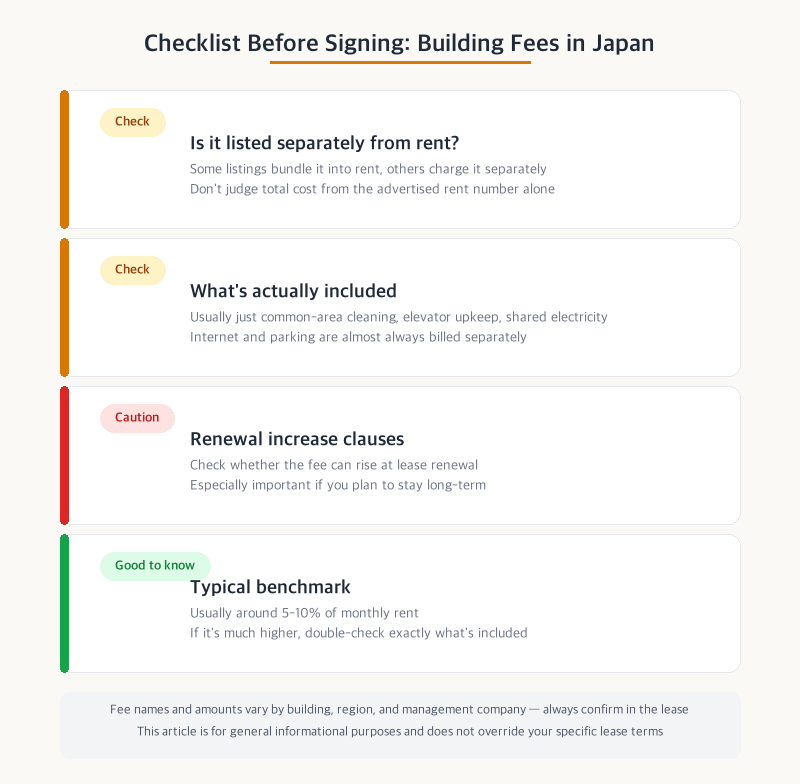
Checklist Before Signing: Building Fees in Japan
Kanrihi and Kyoekihi Are Basically the Same Thing
Here’s the short version: kanrihi and kyoekihi aren’t legally distinct categories — they’re the same type of cost, just labeled differently depending on the building or management company. Both cover the upkeep of shared areas in the building, and it’s rare for a single property to charge both separately at the same time.
Typical Cost: 5-10% of Monthly Rent
The exact amount varies with a building’s size and amenities, but the commonly cited benchmark is 5-10% of monthly rent (some sources say 5-7%). For context, as of 2026, average rent across Tokyo’s 23 wards runs roughly JPY 100,000-110,000 for a studio or 1K, and around JPY 190,000 for a 1LDK — which puts a typical kanrihi in the JPY 5,000-11,000 range per month for a studio/1K, or JPY 10,000-19,000 for a 1LDK. Newer, taller, and more amenity-rich buildings tend to carry higher fees.
How This Compares to a US HOA Fee
If you’re used to US housing costs, the closest comparison is a Homeowners Association (HOA) fee — but the comparison only goes so far. In the US, national average HOA fees run roughly $250-355 per month as of 2026, with urban high-rises averaging $400-800/month and suburban condos $200-400/month (the cheapest states run closer to $118-130/month). The key difference: HOA fees mainly apply to owned condos and planned communities. If you’re renting an apartment in the US rather than owning, you’re more likely to see smaller separate charges — often called a “utility fee” or “amenity fee” — typically in the $25-75/month range, rather than a full HOA fee.
| Japan (Kanrihi/Kyoekihi) | US (HOA Fee) | |
|---|---|---|
| Who pays it | Both renters and owners | Mainly condo/community owners |
| Typical amount | 5-10% of monthly rent | $250-355/month national average |
| What it covers | Common-area cleaning, elevator, shared electricity, trash disposal | Common-area maintenance, sometimes amenities like a pool or gym |
| Renter equivalent in the US | N/A | Smaller “utility” or “amenity” fees, ~$25-75/month |
💡 Run your own numbers — try the Japan Overtime Pay Calculator (2026).
What’s Included vs. What’s Always Billed Separately
| Category | Detail |
|---|---|
| Included (standard) | Common-area cleaning, elevator maintenance, shared electricity (hallway/lobby lighting), trash disposal |
| Included (varies by building) | Auto-lock/intercom systems, security cameras, package locker maintenance |
| Not included (almost always separate) | Your unit’s own electricity, gas, and water (metered and billed individually), internet, parking |
In short, kanrihi only covers shared spaces — not the electricity, gas, or water you actually use inside your own unit. A common mix-up is assuming “I already pay the management fee, so I don’t need to pay for electricity” — that’s not how it works.
Three Things to Check in Your Lease
- Is it listed as a separate line item from rent? Listing sites often display the rent prominently and the fee in smaller print, which can lead to underestimating your total monthly cost.
- What exactly is included? Confirm whether internet or parking are bundled in — some buildings include free internet as part of the fee, others charge it entirely separately.
- Can it increase at renewal? Check whether your lease allows the fee to rise when the lease renews (typically every two years) — especially important if you’re planning to stay long-term.
Frequently Asked Questions
Q. Do any properties charge both kanrihi and kyoekihi?
A. Very rarely. Since they represent the same type of cost, most properties use only one of the two labels. If a lease lists both separately, ask the agent to clarify exactly what each one covers.
Q. Does the management fee include my electricity and water bill?
A. No. It only covers shared-area utilities like hallway and elevator electricity. Electricity, gas, and water used inside your own unit are metered and billed to you separately.
Q. Are there apartments with no management fee at all?
A. Yes. Some listings fold it into the rent instead of listing it separately, and older, smaller buildings sometimes don’t charge one at all.
Q. What if the fee looks unusually high compared to similar listings?
A. Check what’s included first — security cameras, package lockers, or shared community facilities can justify a higher fee. If it still doesn’t add up, ask the leasing agent for a breakdown.
Key Takeaways
- Kanrihi and kyoekihi are essentially the same fee — most properties charge only one.
- Typical cost runs 5-10% of monthly rent, noticeably lower than a US HOA fee, but it applies to renters too, unlike HOA.
- It only covers shared-area upkeep — your own unit’s electricity, gas, and water are always billed separately.
- Before signing, confirm whether it’s listed separately from rent, what’s included, and whether it can rise at renewal.
This article is for general informational purposes only. Actual fee amounts and what’s included vary by building, management company, and lease terms — always confirm the current details with your leasing agent or property manager before signing.