If you’ve lived in Japan through a mid-August, you’ve probably noticed offices quiet down and trains get packed with families carrying suitcases. That’s Obon (お盆) — a traditional Buddhist observance for honoring ancestors, similar in spirit to a family homecoming holiday. Here’s the catch for foreign residents: Obon is not a set of national holidays. Only one day around it, Mountain Day, is an actual public holiday. Everything else is either a company-designated summer break or time you cover with your own paid leave.
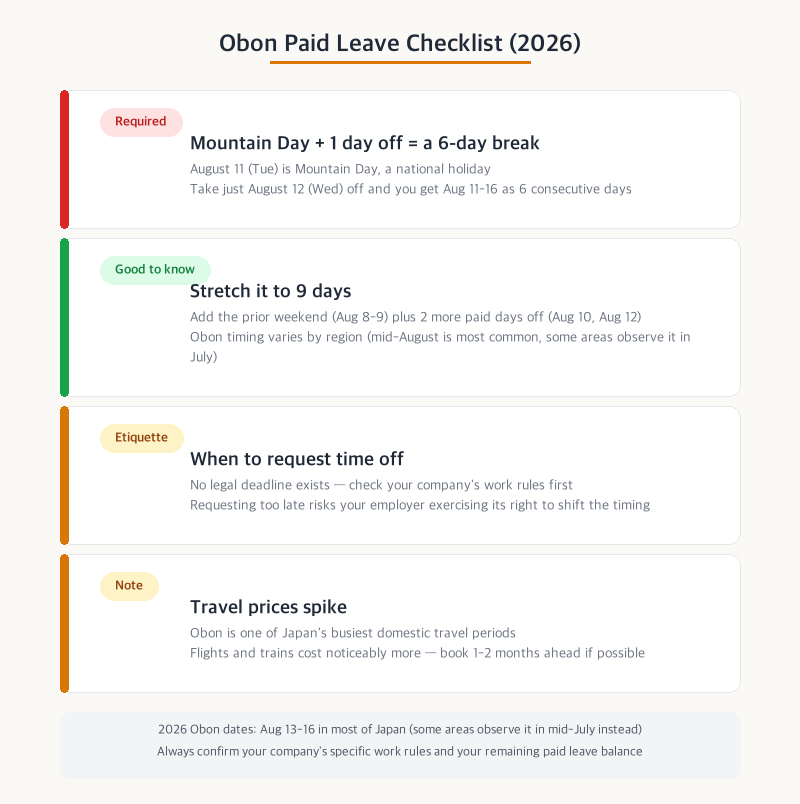
Obon Paid Leave Checklist
What Obon Actually Is
Obon is a Buddhist tradition where families visit ancestral graves, clean them, and often return to their hometowns — much like a national homecoming period, even though it isn’t a legal holiday itself. Dates vary by region: some areas (including Tokyo) observe it in mid-July, but the most common nationwide timing — and the one most companies build their summer break around — is August 13 (Thu) through August 16 (Sun), 2026.
One Day Off Gets You 6 Days; Two More Gets You 9
August 11 (Tue), 2026 is Mountain Day, an actual national holiday. Take just one additional paid day off on August 12 (Wed), and you get a continuous 6-day break from August 11 through August 16.
Want more? Start from the preceding weekend (Saturday Aug 8 and Sunday Aug 9), add two more paid days off (Monday Aug 10 and Wednesday Aug 12), and you can stretch it to a 9-day break from August 8 through August 16 — using only 2 to 4 days of your paid leave allowance depending on how far you extend it.
| Date | Status | Note |
|---|---|---|
| Aug 8 (Sat) – Aug 9 (Sun) | Weekend | Regular days off |
| Aug 10 (Mon) | Paid leave | Optional — only needed for the full 9-day version |
| Aug 11 (Tue) | Mountain Day | National holiday |
| Aug 12 (Wed) | Paid leave | Required — the key day for the 6-day break |
| Aug 13 (Thu) – Aug 16 (Sun) | Obon + weekend | Most companies’ designated summer break |
How and When to Request Time Off
There’s no legally set deadline for requesting paid leave under Japanese labor law — it comes down to your company’s internal work rules (就業規則), which typically require notice ranging from a couple of days to a week, sometimes up to two weeks depending on the industry.
- Check your company’s work rules for the exact notice period and application process.
- Since Obon is when everyone tends to request time off at once, aim to submit your request about a month ahead, or at minimum two weeks before.
- You’re not legally required to state a reason, but sharing your handover plan tends to go over much better with your team.
- Requesting too late risks your employer exercising its right to shift the timing (jiki henkou-ken) — asking you to take the days at a different point instead.
Paid leave is your legal right, so your employer isn’t technically required to “approve” it — but respecting the notice timeline goes a long way for how smoothly the request goes and for your standing with the team. Separately, note that a company forcing you to burn your entire paid leave balance just to cover its designated Obon closure is a different (and potentially problematic) issue from a normal, voluntary leave request.
Planning Travel Around Obon
- Obon is one of the busiest travel periods in Japan for both domestic flights and the Shinkansen — prices and availability get tight. If you’re planning international travel too, book at least 1-2 months ahead, since fares climb noticeably during this window.
- Expect heavy traffic on expressways if you’re driving to visit family, so build in extra time.
- Share your handover plan and emergency contact method with your team well ahead of time — it makes the return to work much smoother.
Frequently Asked Questions
Is Obon a national holiday?
A. No. Only Mountain Day (Aug 11) is an actual public holiday. The rest of the Obon period is either a company-designated summer break or covered by your own paid leave.
Do I have to explain why I’m requesting time off?
A. There’s no legal requirement to state a reason. In practice, it’s common to just share the dates for scheduling purposes.
Can my employer refuse my paid leave request?
A. Not outright, but if your absence would seriously disrupt operations, your employer can exercise its right to ask you to take the days at a different time. Requesting well in advance reduces the chance of this happening.
Obon dates seem to vary — how do I check for my area?
A. Tokyo and some other areas observe Obon in mid-July (July 13-16), while most of the rest of Japan observes it in mid-August (August 13-16). Check your local municipality or your company’s summer break announcement for the exact dates that apply to you.
Key Takeaways
- Obon 2026 falls on August 13 (Thu) through 16 (Sun) in most of Japan.
- Mountain Day (Aug 11) plus one paid day off (Aug 12) gets you a 6-day break; two more days can stretch it to 9 days.
- There’s no legal deadline to request paid leave, but since this period gets crowded, request 2 weeks to a month ahead.
- Flights and Shinkansen fares spike during Obon — book early.
This article is for general informational purposes only and is not legal advice. Confirm your specific paid leave rules and application process with your employer’s work rules and HR department.