Remote work has made “could I just live in Japan for a few months while working online” a common question. As of March 2024, Japan does have a formal digital nomad visa — but the conditions are fairly strict, and it’s built for a short stay, not a path to long-term residency. Here’s what the rules actually say.
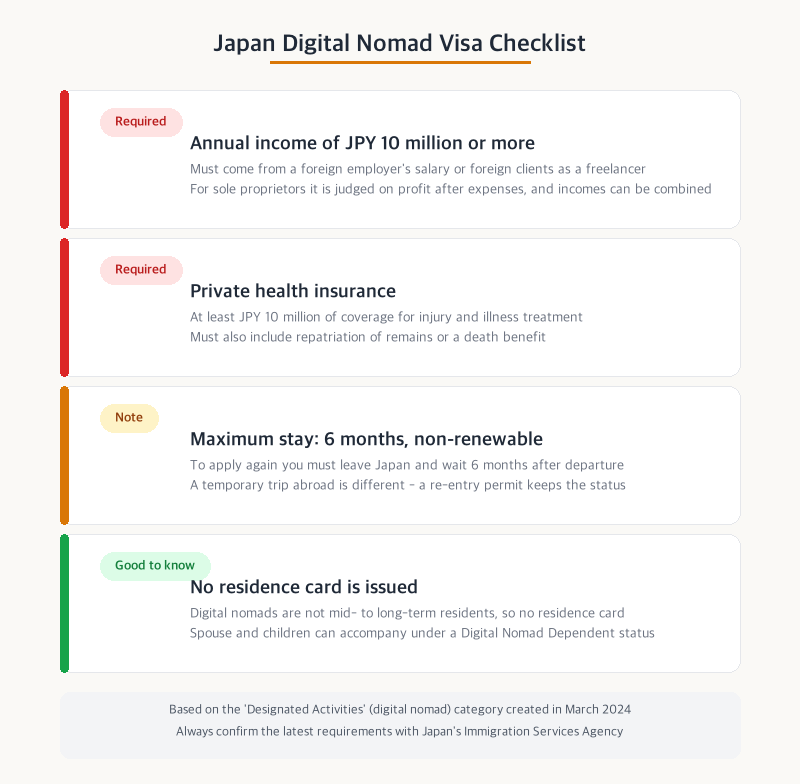
Japan Digital Nomad Visa Checklist
What It Actually Is: A Category Within “Designated Activities”
Japan’s digital nomad visa isn’t a standalone residence status — it’s a new category added to the existing “Designated Activities” (Tokutei Katsudo) status of residence, effective March 2024. It’s designed for remote workers based abroad who want to keep working while staying in Japan for a limited period.
The Four Core Requirements
| Requirement | Detail |
|---|---|
| Annual income | JPY 10 million or more, from a foreign employer’s salary or foreign clients as a freelancer |
| Nature of work | Must not be for a Japan-based company or client — income must come from abroad |
| Insurance | Private health insurance covering at least JPY 10 million for injury and illness treatment, and including repatriation of remains or a death benefit |
| Nationality | Citizen of a country that has both a tax treaty with Japan and visa-exempt entry (roughly 50 countries qualify, including the US, UK, Canada, Australia, and Singapore) |
The JPY 10 million income bar (roughly $65,000-70,000 depending on the exchange rate) is the biggest practical filter — it rules out most people who aren’t already working senior remote roles or running an established freelance business.
Length of Stay: Six Months, Not Renewable
The maximum stay under this visa is six months, and the period of stay cannot be renewed. If you want to keep staying past the six months, you have to leave Japan and file a brand-new application from outside the country.
There’s no cap on how many times you can reapply over the years, but you must wait at least six months after your previous departure before filing again — you can’t leave and immediately reapply. In other words, this is explicitly a short-term stay program, not a stepping stone toward long-term residency or permanent residency.
That six-month wait applies to filing a new application once your period of stay has ended. It does not lock you inside Japan while the status is valid: if you leave temporarily intending to return before your period of stay expires, you can depart on a re-entry permit or special re-entry permit and keep the status, provided you are back by the expiry date.
Spouses and children can accompany you under a Digital Nomad Dependent status, with the same six-month limit.
Tax Residency: Why Most Digital Nomad Visa Holders Don’t Owe Japanese Income Tax
This is the part that trips people up. Under Japanese tax law, whether you’re treated as a “resident” or “non-resident” hinges on whether you have a registered domicile in Japan, or have lived there continuously for a year or more. Because the digital nomad visa is explicitly capped at six months and structured around not establishing a living base in Japan, most people on this visa are classified as non-residents for Japanese tax purposes.
Non-residents are, as a general rule, only taxed by Japan on Japan-source income. Since the visa itself only recognizes income from a foreign employer or foreign clients, the income’s source sits outside Japan by design — which is why, in the typical case, no Japanese income tax filing obligation arises. That said, this is a general principle, not a guarantee: the specifics of work physically performed while in Japan, and how your home country’s tax treaty with Japan applies, can shift the analysis. Check with a tax professional for your specific situation.
Two Things Most Guides Leave Out
You do not get a residence card. The Immigration Services Agency states that people staying on the digital nomad status are not “mid- to long-term residents,” so no residence card is issued. That has knock-on effects: opening a Japanese bank account or signing a phone contract normally assumes you hold one.
The income bar is measured on profit, not contract value. For sole proprietors, the agency evaluates the JPY 10 million requirement using income after deducting necessary business expenses — not gross contract amounts. Income from several clients can be combined if it is judged stable, and a raise or a new contract that puts you over the line going forward can also qualify.
Documents to Prepare Before Applying
- Passport and Certificate of Eligibility application (or visa application, depending on your situation)
- Proof of annual income of JPY 10 million or more (tax withholding statements, contracts, recent pay stubs)
- Proof of employment with a foreign employer, or documentation of your freelance client contracts
- Private health insurance certificate covering at least JPY 10 million in medical expenses
- Documentation of your planned accommodation in Japan
Frequently Asked Questions
Q. Who is actually eligible for Japan’s digital nomad visa?
A. You need to be a citizen of one of roughly 50 countries that both have a tax treaty with Japan and qualify for visa-exempt entry (including the US, UK, Canada, Australia, and Singapore), earn JPY 10 million or more annually from a foreign employer or foreign clients, and carry private health insurance covering at least JPY 10 million.
Q. Can I extend my stay past six months?
A. The period of stay cannot be renewed. You need to leave Japan and wait at least six months from your departure date before filing a new application. Note that a temporary trip abroad during your stay is different — with a re-entry permit you can return and keep the status, as long as you are back before the expiry date.
Q. Can I take on Japanese clients while on this visa?
A. No. The visa is only meant for income from employers or clients based outside Japan. Working for a Japan-based company or client falls outside the intended scope of this status.
Q. Will I owe Japanese income tax while on this visa?
A. In most cases, no — you’ll typically be classified as a non-resident for tax purposes, and since the visa only recognizes foreign-source income, there’s usually no Japanese income tax filing obligation. Individual circumstances can vary, so confirm with a tax professional.
Key Takeaways
- Japan’s digital nomad visa is a category within the “Designated Activities” status, created in March 2024.
- Core requirements: JPY 10 million+ annual income from abroad, plus private health insurance.
- Maximum stay is six months, non-renewable — reapplying requires a 6-month wait after your departure, so this is not a route to long-term residency. No residence card is issued.
- Most holders are classified as tax non-residents and typically owe no Japanese income tax.
Sources
Requirements below were checked against the Immigration Services Agency’s own pages. Rules change — confirm before you apply.
- Immigration Services Agency — Designated Activities (Digital Nomad) Notice No.53/54, six-month period, JPY 10 million income bar, insurance requirement
- Immigration Services Agency — Digital Nomad Q&A (PDF, Japanese) A3 re-entry after six months, A5 no residence card, A6 temporary departure, A9 how the income bar is judged, A10 insurance coverage
This article is for general informational purposes only and is not immigration or tax advice. Residence status requirements and tax residency determinations depend on individual circumstances, so confirm the latest guidance with Japan’s Immigration Services Agency and consult a licensed professional before applying.