In the US, having a baby can mean a bill running into the thousands even with insurance — costs depend entirely on your specific plan, and there’s no single national program that hands new parents a fixed lump sum. Japan works differently. If you’re enrolled in Japanese public health insurance, you’re eligible for a ¥500,000 childbirth benefit — regardless of your nationality. Here’s how it works.
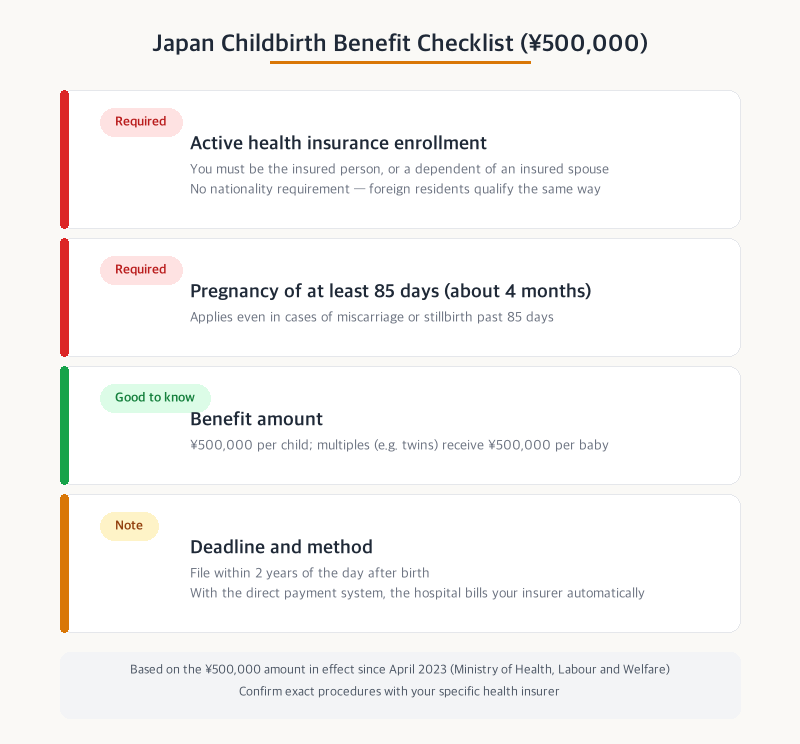
Japan Childbirth Benefit Checklist
Why the US Doesn’t Have an Equivalent
Part of what makes this benefit surprising to American expats is that there’s nothing quite like it back home. The US has no single-payer or universal health insurance enrollment system, so there’s no equivalent nationwide lump-sum childbirth payment — maternity costs and out-of-pocket amounts vary widely depending on your specific insurance plan and provider network. Japan’s system works because the benefit is tied to enrollment in Japan’s public health insurance, which is broadly mandatory for residents, not tied to citizenship at all.
What the Benefit Actually Is
The childbirth and childcare lump-sum benefit (shussan ikuji ichijikin) is paid to anyone enrolled in Japan’s public health insurance — whether through an employer’s health insurance, National Health Insurance, or a mutual aid association — when they give birth. Since April 2023, the amount has been ¥500,000 per child, and multiple births (such as twins) receive that amount per baby, so twins qualify for ¥1,000,000 total.
No Nationality Requirement — Insurance Enrollment Is What Matters
This is the key point: eligibility is based entirely on being enrolled in Japanese public health insurance, not on citizenship. Whether you’re on a work visa, spouse visa, permanent residency, or any other status, if you or your spouse are properly enrolled and paying into public health insurance, you qualify on the same terms as a Japanese national.
| Requirement | Detail |
|---|---|
| Health insurance enrollment | You must be the insured person, or registered as a dependent of an insured spouse (no nationality requirement) |
| Pregnancy duration | At least 85 days (about 4 months) — applies even to miscarriage or stillbirth past this point |
| Benefit amount | ¥500,000 per child; multiples receive that amount per baby |
| Application deadline | Within 2 years of the day after birth |
How to Apply: Direct Payment vs. Proxy Receipt
In practice, most people use the direct payment system (chokusetsu shiharai seido).
- Before or during your hospital stay, sign a document agreeing to use the direct payment system
- The hospital bills your health insurer (employer’s plan, National Health Insurance, etc.) directly for the delivery costs
- Your insurer pays the ¥500,000 (or applicable amount) straight to the hospital
- You only pay the difference between your actual delivery cost and ¥500,000 — if your delivery cost less, you can separately claim a refund for the difference
Some smaller clinics use the proxy receipt system instead, generally available if you’re within 2 months of your due date — this requires filing a separate application directly with your insurer. Confirm with both your delivery hospital and your health insurer which system applies to you.
Things to Watch For
- If your health insurance premiums are in arrears, it can complicate your eligibility — check that your enrollment is in good standing well before your due date.
- If you’re unsure whether you’re properly registered as a dependent on your spouse’s insurance, confirm with their employer’s HR department or health insurance association ahead of time.
- Any delivery costs above ¥500,000 are your responsibility, and this benefit is separate from Japan’s high-cost medical expense system.
Frequently Asked Questions
Do foreign residents really qualify regardless of nationality?
A. Yes. This benefit is based on Japanese public health insurance enrollment, not nationality. If you’re the insured person or a registered dependent of your insured spouse, you qualify on the same terms as anyone else.
Does National Health Insurance (Kokumin Kenko Hoken) also qualify, or only employer plans?
A. Both qualify. Whether you’re enrolled through an employer’s health insurance or National Health Insurance, the eligibility rules are the same.
What if my delivery costs less than ¥500,000?
A. If you used the direct payment system, you can file a separate refund claim with your insurer for the difference between ¥500,000 and your actual cost.
What happens if I miss the application deadline?
A. The deadline is 2 years from the day after birth. Missing it can jeopardize your ability to claim the benefit, so it’s best to confirm the application process soon after delivery.
Key Takeaways
- Japan’s childbirth benefit has been ¥500,000 per child since April 2023, with multiples receiving that amount per baby.
- Eligibility depends on health insurance enrollment, not nationality — foreign residents qualify equally.
- The direct payment system lets the hospital bill your insurer directly, so you only cover the difference.
- You must apply within 2 years of the day after birth.
This article is for general informational purposes only and is not medical or administrative advice. Confirm exact eligibility and application procedures with your health insurer and delivery hospital.