If you’re living in Japan long-term, inheritance tax is one of those things worth understanding before you actually need it. Japan’s system has a distinctive feature that matters a lot for foreign residents specifically — how long you’ve actually lived there changes what gets taxed.
The Basics of Japan’s Inheritance Tax
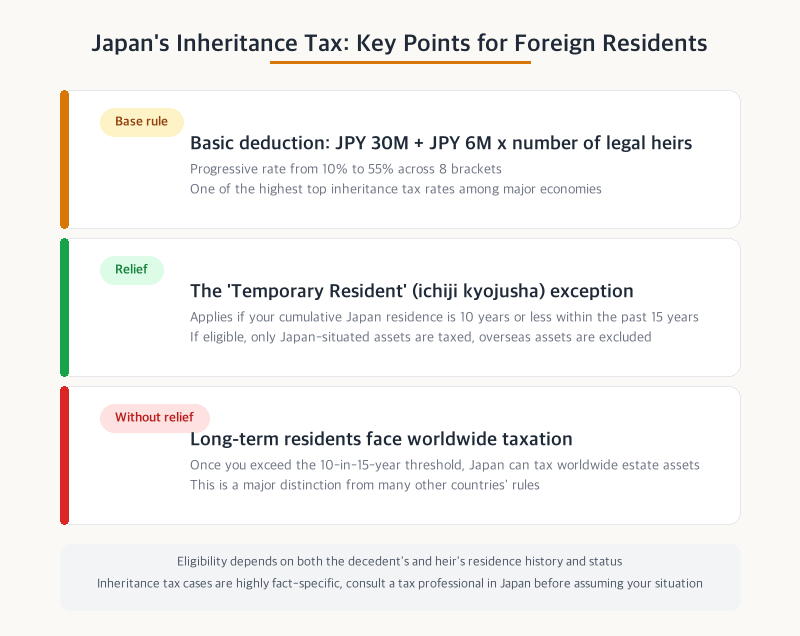
Japan’s basic deduction is calculated as JPY 30 million + JPY 6 million × the number of legal heirs. Whatever remains after that deduction is taxed on a progressive scale from 10% to 55% across eight brackets — one of the higher top rates among major economies.
The ‘Temporary Resident’ Rule — Why It Matters
Here’s the part that actually matters most for foreign residents: if you hold a status of residence and your cumulative time living in Japan totals 10 years or less within the 15 years before the inheritance occurs, you qualify as a “temporary resident” (一時居住者) for inheritance tax purposes. That means only Japan-situated assets are taxed — assets held overseas are excluded entirely.
Cross that 10-year threshold, though, and Japan can tax your worldwide estate, not just what’s physically in Japan. This is a meaningfully different approach from many other countries, and it’s easy to overlook if you’re focused only on your home country’s inheritance rules.
Filing Deadline
Japan’s inheritance tax return is due 10 months from the day after the heir becomes aware of the inheritance — typically the date of death. Missing this deadline brings penalties, so it’s worth having this on your radar well before it becomes urgent.
💡 Run your own numbers — try the Japan Retirement Tax Calculator (2026).
Quick Summary
| Item | Detail |
|---|---|
| Basic deduction | JPY 30 million + JPY 6 million × number of legal heirs |
| Tax rate range | 10% to 55% across 8 progressive brackets |
| Key relief for foreign residents | “Temporary resident” status (10 years or less of Japan residence in the past 15 years) excludes overseas assets from taxation |
| Filing deadline | 10 months from becoming aware of the inheritance |
This article is for general informational purposes only. Inheritance tax depends heavily on the residence history and status of both the decedent and the heir, plus the location of assets and any applicable tax treaty. Always consult a tax professional in Japan — and in your home country — before assuming how a specific inheritance will be treated.
💡 Want to plug in your own numbers? Try the Japan vs US Estate Tax Calculator.
Frequently Asked Questions
Q. How is Japan’s basic inheritance tax deduction calculated?
A. JPY 30 million plus JPY 6 million multiplied by the number of legal heirs. Whatever remains after that deduction is taxed progressively from 10% to 55% across eight brackets.
Q. What is the “temporary resident” rule and why does it matter for foreign residents?
A. If you hold a status of residence and your cumulative time in Japan totals 10 years or less within the 15 years before the inheritance occurs, you qualify as a temporary resident for inheritance tax purposes — meaning only Japan-situated assets are taxed, and overseas assets are excluded entirely.
Q. What happens once I’ve lived in Japan more than 10 years?
A. Cross that 10-year threshold (within the relevant 15-year lookback) and Japan can tax your worldwide estate, not just assets physically located in Japan.
Q. When is the inheritance tax return due?
A. Within 10 months from the day after the heir becomes aware of the inheritance — typically the date of death.
Key Takeaways
- Basic deduction: JPY 30 million + JPY 6 million x number of legal heirs; the excess is taxed 10-55% across 8 brackets.
- “Temporary resident” status (10 years or less of Japan residence within the past 15 years) excludes overseas assets from Japanese inheritance tax.
- Crossing that 10-year threshold exposes your worldwide estate to Japanese inheritance tax.
- The filing deadline is 10 months from becoming aware of the inheritance.