If you’ve ever received a paycheck in Japan, you’ve seen a line item called “resident tax” (住民税, juminzei) quietly taking a bite out of your take-home pay. What surprises a lot of foreign residents is that this tax is billed a full year behind your income — so you can quit your job, change employers, or even leave Japan entirely and still get a bill for tax owed on income you earned the year before. Here’s how Japan’s resident tax is structured, and how it compares to state and local income tax in the US.
Resident Tax: Japan’s Structure at a Glance
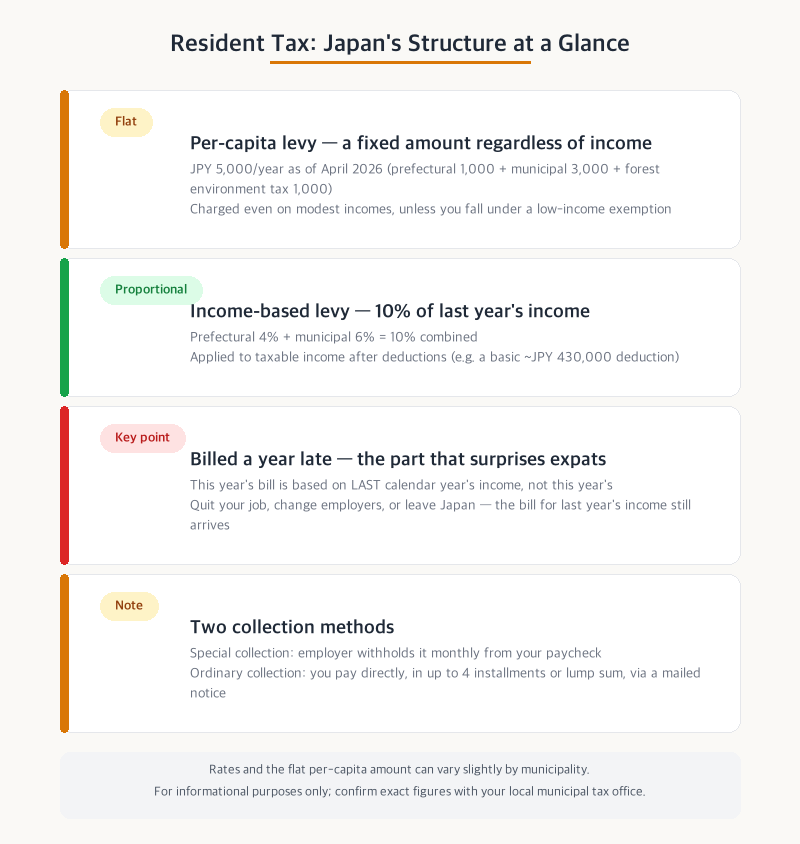
Resident Tax = A Flat Levy + An Income-Based Levy
Japan’s resident tax has two components.
| Component | Detail |
|---|---|
| Per-capita levy (kintou-wari) | A fixed amount regardless of income. As of April 2026, JPY 5,000/year (prefectural JPY 1,000 + municipal JPY 3,000 + a national forest environment tax of JPY 1,000, collected together) |
| Income-based levy (shotoku-wari) | Proportional to last year’s income. Prefectural 4% + municipal 6% = 10% combined, applied to taxable income |
Through 2023, the per-capita levy included an extra JPY 500 on each of the prefectural and municipal portions as a post-earthquake reconstruction surtax. That surtax ended in 2024 and was effectively replaced by the new JPY 1,000 national forest environment tax collected alongside it — so the total (JPY 5,000) hasn’t really changed, just how it’s broken down.
The Part That Surprises Expats: Billed a Year Late
This is the single most confusing part of Japan’s resident tax for newcomers. The bill you pay this year (June through next May) is based on your income from last calendar year (January-December). In practice, that means:
- If you earned income in Japan last year, you’ll still get billed for it this year even if you quit your job or changed employers in the meantime.
- Even if you’ve moved back to your home country, you remain liable for resident tax on income you earned in Japan last year.
- Conversely, in your very first year in Japan, you typically owe little to no resident tax — because you had no prior-year Japan income. This is why a lot of people are surprised when their take-home pay suddenly drops in year two: that’s when resident tax on year-one income kicks in.
💡 Run your own numbers — try the Japan Food Tax Savings Calculator (From April 2027).
Two Ways It Gets Collected
| Method | Detail |
|---|---|
| Special collection (tokubetsu choshu) | Your employer withholds resident tax from your paycheck every month and pays it on your behalf. This is the default for most full-time salaried employees |
| Ordinary collection (futsu choshu) | You pay it yourself, directly, via a notice mailed by your municipality — typically in up to 4 installments a year, or as a lump sum. This is common after leaving a job, or for freelancers |
While employed, special collection makes the tax nearly invisible since it’s deducted automatically every month. After leaving a job, however, any remaining balance can convert to ordinary collection and arrive as a much larger lump-sum bill than expected. If you’re planning to leave a job, it’s worth asking HR whether the remaining resident tax will be settled from your final paycheck/severance, or whether you’ll receive a separate ordinary-collection notice.
How It Compares to US State and Local Income Tax
| Japan (Resident Tax) | US (State/Local Income Tax) | |
|---|---|---|
| Timing | Billed on a one-year lag (this year’s bill = last year’s income) | Generally pay-as-you-earn via paycheck withholding in the same year, reconciled at annual filing |
| Rate structure | Flat 10% combined rate on taxable income, plus a small flat per-capita levy | Varies enormously by state — some states (e.g. Texas, Florida) have no state income tax at all; others have progressive brackets |
| What happens if you leave | You remain liable for tax on income already earned, even after leaving the country | Generally you stop owing once you’re no longer a resident/earning there, subject to part-year filing rules |
| Local layer | Split between prefecture and municipality, both included in one combined bill | State and local/city income tax (where it exists) are often billed and filed somewhat separately |
The biggest structural difference for an American expat to internalize is the one-year lag: unlike paycheck withholding in the US, where your tax roughly tracks your current income, Japan’s resident tax is always chasing last year’s paycheck. That’s precisely why so many people are blindsided by a resident tax bill after they’ve already left a job — or left Japan.
💡 Tip: Want to estimate your own resident tax bill? Try the standalone Japan Resident Tax Calculator — just enter last year’s gross salary.
Frequently Asked Questions
Q. I’ve moved back home for good. Do I still owe resident tax?
A. Yes. Resident tax on income you earned in Japan last year remains due regardless of whether you’ve since left the country. The ordinary-collection notice may be mailed to your home address, or you may need to arrange payment through a proxy in Japan — confirm the process with your employer and municipal office before you leave.
Q. Why is my resident tax so low in my first year in Japan?
A. Resident tax is based on the prior calendar year’s income, and in your first year you typically had no income in Japan the year before you arrived. Full resident tax based on your first year’s income then kicks in starting your second year, which is when many people notice a real drop in take-home pay.
Q. Can I choose between special and ordinary collection?
A. Full-time salaried employees are generally required to use special collection (employer withholding) by default, and it isn’t usually a matter of personal choice. Certain situations — leaving a job partway through the year, or a small enough salary — can result in a switch to, or eligibility for, ordinary collection.
Q. Is the JPY 5,000 per-capita levy the same everywhere in Japan?
A. The standard combined amount is JPY 1,000 (prefectural) + JPY 3,000 (municipal) + JPY 1,000 (forest environment tax) = JPY 5,000, but some municipalities set it slightly higher by local ordinance. Confirm the exact figure with your local municipal tax office.
Key Takeaways
- Resident tax = a flat per-capita levy (JPY 5,000/year) + an income-based levy (10% of last year’s income).
- This year’s bill is based on last calendar year’s income — you can be billed even after quitting your job or leaving Japan.
- While employed, tax is usually collected via employer withholding; after leaving, it can switch to a direct, self-paid notice.
- Unlike most US state/local income tax, which tracks your current-year income, Japan’s system runs on a one-year lag.
This article is for general informational purposes only. Actual tax rates, the per-capita levy amount, and deduction rules vary by municipality and individual circumstances. Confirm exact figures with your local municipal tax office or a licensed tax accountant.