
If you work for a Japanese company, you’ve probably just received (or are about to receive) your summer bonus — typically paid in June or July. It’s a welcome deposit, but two questions come up every time: why is so much withheld, and what should you actually do with the money? Here’s both parts explained.
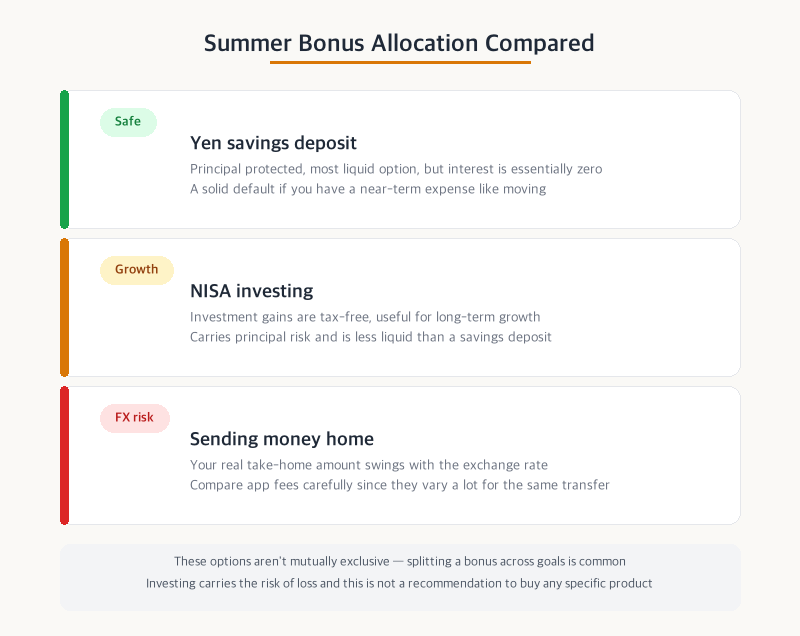
Summer Bonus Allocation Compared
When and Why Japanese Companies Pay a Summer Bonus
Most Japanese companies pay bonuses twice a year — summer (June–July) and winter (December). The exact timing and amount depend on each company’s employment rules or labor agreements; it’s not a legal requirement, but it’s standard practice for most full-time employees.
Bonus Withholding Works Differently From Your Monthly Paycheck
Income tax withheld from a bonus uses a completely separate calculation from your regular monthly salary. Japan’s tax agency uses the “Withholding Tax Rate Table for Bonuses”, applied in three steps.
- Take your salary from the month before the bonus payment and subtract social insurance premiums
- Match that amount against the table using your number of dependents to find the applicable rate
- (Bonus amount − social insurance on the bonus) × rate = income tax withheld
| Example | Value |
|---|---|
| Prior month’s salary after social insurance | JPY 250,000 |
| Number of dependents | 2 |
| Applicable rate | 2.042% |
The same bonus amount can be withheld at very different rates depending on your prior month’s salary level and dependent count. In special cases — for example, returning from leave with no salary the prior month — a different table (the standard monthly withholding table) applies instead.
For comparison, the US takes a simpler approach: bonuses are classified as “supplemental wages,” and when paid separately from regular pay, employers commonly withhold a flat 22% federal rate (37% on amounts over $1 million per year). Either way — Japan’s tiered table or the US flat rate — withholding is just an estimate; your actual tax liability gets reconciled at year-end.
Where Should the Money Actually Go? Savings vs. NISA vs. Sending It Home
Once you know your take-home bonus amount, the real question is what to do with it. Here’s how the three common options stack up.
1) Yen savings deposit
The biggest advantage is that your principal is protected and you can access the cash whenever you need it. The tradeoff is that Japanese deposit rates remain extremely low, so you won’t grow your money through interest alone. If you have a near-term expense — moving, a life event, an emergency fund gap — this is usually the right first stop.
2) NISA investing
Japan’s NISA account structure lets investment gains grow tax-free, making it an appealing option if your goal is long-term wealth building. As with any investment, there’s a risk of principal loss, and it’s less liquid than a savings deposit — you generally shouldn’t put money here that you might need on short notice. Foreign residents of Japan can open a NISA account if they meet the eligibility requirements.
3) Sending money home
Many residents send part of a bonus home — to support family, or to save or invest in their home country. Here, the exchange rate at the time of transfer can meaningfully change how much you actually end up with, and fee structures vary widely between remittance apps and banks. It’s worth comparing services based on your transfer amount and purpose before sending.
None of these are mutually exclusive. A common approach is to split the bonus by purpose: near-term cash into savings, long-term money into NISA, and the rest sent home as needed.
Frequently Asked Questions
Q. Why is bonus withholding calculated differently from my paycheck?
A. Japan’s tax agency uses a separate ‘Withholding Tax Rate Table for Bonuses,’ based on your prior month’s salary after social insurance and your number of dependents.
Q. What happens if I had no salary the month before my bonus?
A. In that case, the standard monthly withholding table is used instead of the bonus-specific rate table.
Q. Can foreign residents open a NISA account?
A. Yes. Foreign residents of Japan can open a NISA account regardless of nationality, as long as they meet the residency eligibility requirements.
Q. Do I have to choose just one of savings, NISA, or sending money home?
A. No. It’s common to split a bonus by purpose — near-term cash into savings, long-term money into NISA, and the rest sent home as needed.
Key Takeaways
- Japan’s summer bonus is typically paid in June–July, and withholding uses a different calculation from your regular paycheck.
- The formula: prior month’s salary after social insurance → match dependents → find the rate → calculate withholding.
- Allocation options generally fall into three buckets: savings (safe) · NISA investing (growth) · sending money home (FX risk).
- You don’t have to pick just one — splitting the bonus across these goals is common practice.
This article is for general informational purposes only and is not investment or tax advice. Withholding rates and tax rules can change with individual circumstances and future reforms, so confirm exact calculations with your employer’s payroll department or a qualified tax professional. Investing carries the risk of loss and this is not a recommendation to buy any specific product.