Ever looked at your Japanese pay stub and wondered whether your overtime pay was calculated correctly? If you’re on salary rather than hourly pay, there’s no obvious hourly rate to check your math against, which makes it hard to know if you’re being paid correctly. This guide walks through how to back-calculate your hourly wage from a monthly salary, Japan’s statutory overtime premium rates, and a common trap — the “fixed overtime” allowance — that catches a lot of workers off guard.
If You’re on Salary, Start by Back-Calculating Your Hourly Wage
Before you can check your overtime pay, you need to know your actual hourly wage. For salaried employees in Japan, it’s roughly calculated as:
Hourly wage = monthly base wage (plus certain allowances) ÷ monthly scheduled working hours
“Monthly base wage” typically means base salary plus certain allowances (though allowances like family or commuting allowances are often excluded), and “monthly scheduled working hours” is your annual scheduled hours divided by 12 — commonly around 160 hours. For example, if your monthly base wage is 240,000 yen and your monthly scheduled hours are 160, your hourly wage works out to 1,500 yen. You need this number to calculate what your actual overtime pay should be once the premium rates are applied.
Statutory Premium Rates — They Differ by Situation
Overtime pay in Japan carries different minimum premium rates depending on the circumstances:
| Category | Minimum Premium | Notes |
|---|---|---|
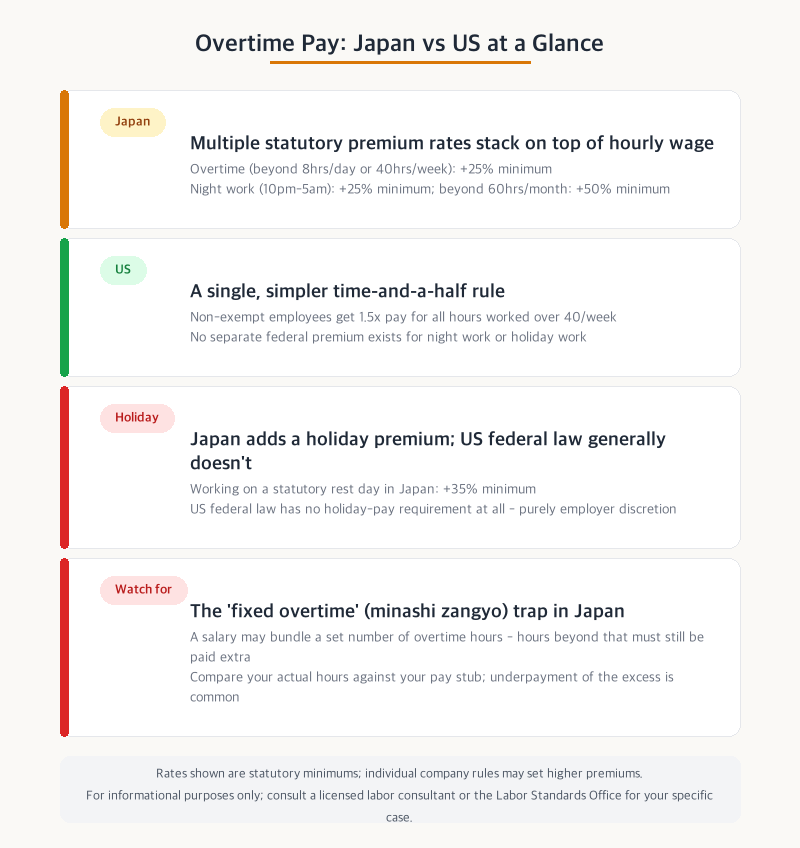
| Overtime (beyond 8 hrs/day or 40 hrs/week) | +25% | Hourly wage x 1.25 |
| Overtime beyond 60 hrs/month | +50% | Applies to small/mid-size businesses too since April 2023 |
| Night work (10pm – 5am) | +25% | Stacks with overtime premium up to +50% combined |
| Statutory holiday work | +35% | Calculated separately from the overtime premium |
For example, an employee earning 1,500 yen/hour who works 2 hours of overtime on a weekday evening earns 1,500 yen x 1.25 x 2 hours = 3,750 yen. If those same 2 hours fall after 10pm, both the overtime premium (25%) and night premium (25%) stack, giving 1,500 yen x 1.5 x 2 hours = 4,500 yen.
One important nuance: the 35% holiday premium only applies to work on a “statutory rest day” — the one day per week your employer is legally required to give you off. If you work on a company-designated day off that isn’t your legally mandated rest day, only the standard overtime premium (25%) typically applies.
The “Fixed Overtime” (Minashi Zangyo) Trap — Always Check This
Many Japanese companies build a set amount of overtime pay directly into the salary — for example, “includes a fixed 20 hours of overtime pay per month.” This practice itself is legal, but two things commonly go wrong:
- Hours beyond the fixed amount must still be paid separately. If your salary includes 20 hours of fixed overtime but you actually worked 30 hours, you’re legally entitled to extra pay for the additional 10 hours.
- The fixed overtime portion must be clearly separated from base salary on your pay stub for the arrangement to be valid. If the breakdown isn’t clear, the entire fixed-overtime scheme can be ruled invalid.
In practice, failing to pay the excess hours is a common problem, so it’s worth developing a habit of comparing your actual logged hours (time card or attendance system records) against the fixed-overtime hours stated on your pay stub each month. Keeping your own copy of your time records can also serve as evidence if a dispute ever comes up.
How Japan Compares to US Overtime Rules (FLSA)
If you’re American, the US system will feel far simpler by comparison — and that simplicity cuts both ways. Under the Fair Labor Standards Act (FLSA), non-exempt employees are entitled to a single overtime premium: 1.5x their regular rate for all hours worked beyond 40 in a workweek. There’s no separate federal premium for working nights, and no federal requirement for extra pay on holidays at all — holiday pay in the US is purely a matter of employer policy, not law. The bigger difference for many US workers is the exempt/non-exempt line itself: salaried employees classified as “exempt” (generally those earning above a federal salary threshold and performing certain duties) get no overtime pay whatsoever, no matter how many hours they work — a distinction that doesn’t really have a parallel in Japan’s system, where the fixed-overtime hours still must be topped up once exceeded.
Frequently Asked Questions
Q. I’m on salary — how do I calculate my overtime pay?
A. First, divide your monthly base wage (plus certain allowances) by your monthly scheduled working hours to back-calculate your hourly wage. Then multiply your actual overtime hours by the applicable premium rate (25% for standard overtime, 25% for night work, 35% for statutory holiday work, etc.).
Q. Does the premium rate change if I work more than 60 hours of overtime in a month?
A. Yes. Overtime beyond 60 hours in a month carries a minimum 50% premium. This rule now applies to small and mid-size businesses as well, since April 2023.
Q. My salary includes fixed overtime pay — can I still be owed more?
A. Yes. Fixed overtime pay only covers a preset number of hours. If your actual overtime exceeds that number, you’re legally entitled to separate additional pay for the excess hours.
Q. Does the 35% holiday premium apply to any day off my company designates?
A. No. It only applies to work on your legally mandated statutory rest day (at least one per week). Working on a company-designated day off that isn’t your statutory rest day typically only triggers the standard overtime premium (25%).
Key Takeaways
- Salaried employees should first back-calculate their hourly wage: monthly base wage divided by monthly scheduled hours.
- Premium rates differ by situation — 25% for standard overtime, 50% beyond 60 hrs/month, 25% for night work, 35% for statutory holiday work — and can stack.
- Fixed overtime pay only covers a preset number of hours; anything beyond that must be paid as additional overtime.
- Comparing your pay stub against your actual logged hours each month is the most reliable way to catch unpaid overtime.
This article is for general informational purposes only. Actual wage calculations, premium rate applications, and the validity of fixed-overtime arrangements depend on your company’s work rules, individual employment contract, and the judgment of the relevant Labor Standards Office. Confirm your specific situation with a licensed labor consultant or the Labor Standards Office.