
“Should I convert now, or wait?” It’s the question everyone asks when the yen moves, but predicting exchange rate direction reliably is genuinely hard — even for professionals. So instead of guessing which way the yen is headed, here are four practical strategies that work regardless of direction.
4 Strategies That Don’t Require Guessing Direction
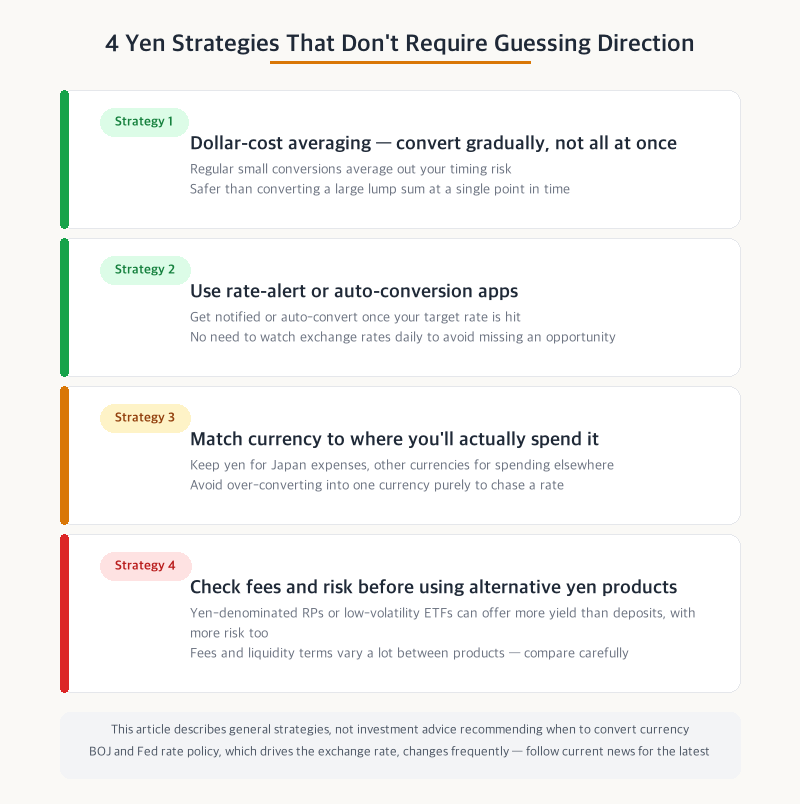
Strategy 1: Dollar-Cost Average Your Conversions
Converting a large sum all at once ties your outcome entirely to that day’s rate. Converting smaller amounts regularly instead means you land closer to an average rate over time, whether the yen strengthens or weakens — reducing your exposure to any single bad moment.
Strategy 2: Use Rate-Alert or Auto-Conversion Tools
You don’t need to watch exchange rates every day. Services like Wise let you set a target rate and either notify you or automatically convert once the market hits it — so you don’t miss a favorable moment just because you weren’t watching.
Strategy 3: Match Currency to Where You’ll Actually Spend It
This is the most basic principle, and also the most commonly overlooked. Keep yen for expenses in Japan, and other currencies for spending elsewhere. Chasing a better rate by converting more than you need into one currency can leave your actual day-to-day spending money exposed if the rate moves against you.
Strategy 4: Check Fees and Risk Before Using Alternative Yen Products
Beyond a plain yen deposit, options like yen-denominated repurchase agreements (RPs) through a brokerage or low-volatility yen ETFs/ETNs exist. These can offer higher expected returns than a deposit, but with correspondingly more risk — and fees and liquidity terms vary significantly between products, so compare carefully before committing.
Quick Summary
| Strategy | Key Point |
|---|---|
| Dollar-cost averaging | Convert regularly in smaller amounts rather than all at once |
| Rate-alert / auto-conversion | Automate around your target rate instead of watching daily |
| Currency matching | Allocate currency to where you’ll spend it, avoid over-concentrating |
| Alternative products | Yen RPs, ETFs, etc. — check risk and fees carefully first |
This article describes general strategies only and is not a recommendation to convert or invest at any specific time. Exchange rates move based on BOJ and Federal Reserve policy and many other factors — check current information and consult a financial professional before acting.
💡 Want to plug in your own numbers? Try the Japan to US Money Transfer Fee Calculator.
Frequently Asked Questions
Q. Is converting a lump sum or converting gradually the safer approach?
A. Converting smaller amounts regularly (dollar-cost averaging) reduces exposure to any single day’s rate, compared to converting everything at once.
Q. Do I need to watch exchange rates every day?
A. No — services like Wise let you set a target rate and either get notified or have the conversion happen automatically once the market hits it.
Q. Should I convert most of my money into one currency to chase a better rate?
A. No — match currency to where you’ll actually spend it (yen for Japan expenses, other currencies for spending elsewhere). Over-concentrating in one currency risks your actual day-to-day spending money if the rate moves against you.
Q. What alternatives exist beyond a plain yen deposit?
A. Yen-denominated repurchase agreements (RPs) through a brokerage and low-volatility yen ETFs/ETNs. These can offer higher expected returns but with more risk, and fees and liquidity terms vary by product.
Key Takeaways
- Dollar-cost averaging your conversions reduces reliance on any single day’s exchange rate.
- Rate-alert / auto-conversion tools like Wise remove the need to watch rates daily.
- Match currency to where you’ll actually spend it rather than chasing a better rate in one direction.
- Yen RPs and ETFs/ETNs offer higher potential return but carry more risk and fee variation than a plain deposit.
A rate-alert tool is easy to describe and a little abstract until you’ve actually used one.
Wise lets you set a target rate and converts automatically once the market hits it — no need to check the rate every day.
If you live in Japan, sign up for a Japanese account — that is what lets you send from your local bank.
This is an affiliate link. If you sign up as a new user and complete a first transfer, TheFinExpat receives a commission at no extra cost to you. Our comparisons stay the same either way.