
If you’re leaving a Japanese employer and about to receive a retirement payout (退職金, taishokukin), the tax treatment is worth understanding before you assume the worst — Japan’s system is, honestly, more generous than most people expect.
How the Tax Is Actually Calculated
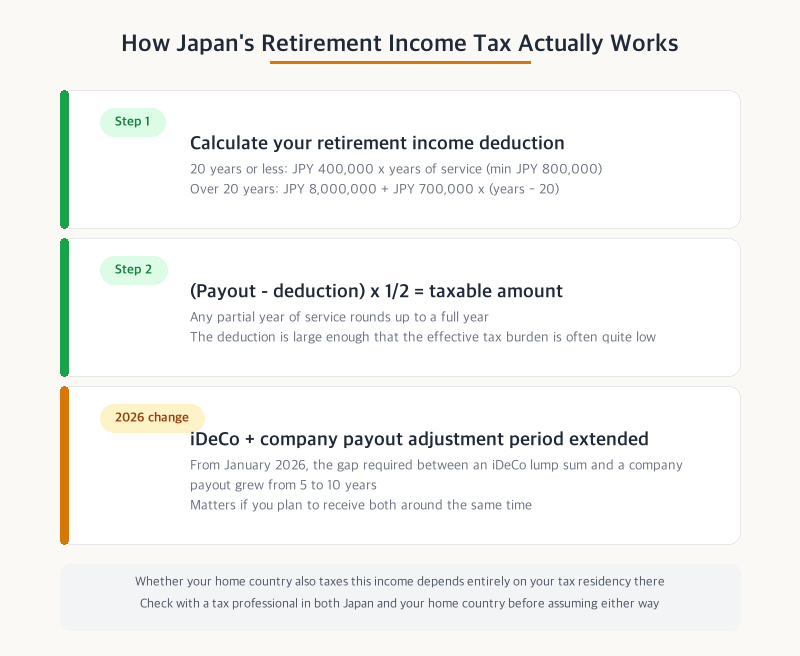
Rather than taxing your full payout, Japan taxes only half of the amount remaining after a deduction based on your years of service.
- Calculate your retirement income deduction: 20 years or less of service → JPY 400,000 × years of service (minimum JPY 800,000); over 20 years → JPY 8,000,000 + JPY 700,000 × (years – 20)
- Calculate the taxable amount: (Payout − deduction) × 1/2
For example, with 10 years of service and a JPY 5,000,000 payout, the deduction is JPY 4,000,000 (JPY 400,000 × 10), leaving just (JPY 5,000,000 − JPY 4,000,000) × 1/2 = JPY 500,000 as taxable income. Even a single day counts as a full year when calculating years of service.
⚠️ Starting in January 2026, the required gap between receiving an iDeCo lump-sum payout and a company retirement payout — needed to claim the full deduction on both without overlap penalties — was extended from 5 years to 10 years. If you’re planning to receive both around the same time, check the timing carefully first.
Do You Also Owe Tax Back Home?
This depends entirely on your tax residency status in your home country at the time you receive the payout — and the rules vary significantly by country. As a general pattern (using Korea as one example we cover on this blog): non-residents of their home country are typically not taxed on foreign-source income like a Japanese retirement payout, while residents generally must report it as worldwide income and can claim a foreign tax credit for tax already paid in Japan to avoid double taxation.
Since this varies by country, it’s worth checking your specific home country’s rules on foreign-source retirement income and tax residency before assuming either way.
💡 Run your own numbers — try the Japan Retirement Tax Calculator (2026).
Quick Summary
| Item | Detail |
|---|---|
| How Japan taxes it | Only (payout − service-based deduction) × 1/2 is taxable — the deduction is large enough that the effective burden is often low |
| 2026 change | iDeCo lump-sum-to-company-payout adjustment period extended from 5 to 10 years |
| Home-country tax | Depends on your tax residency status there — check local rules and any foreign tax credit available |
This article is for general informational purposes only. Tax residency determinations and actual tax calculations depend on your specific circumstances. Always consult a tax professional in Japan and your home country before filing.
Frequently Asked Questions
Q. How is the taxable amount of a Japanese retirement payout calculated?
A. First, calculate your retirement income deduction based on years of service (JPY 400,000 x years, minimum JPY 800,000, for 20 years or less; JPY 8,000,000 + JPY 700,000 x (years – 20) beyond that). The taxable amount is then (payout – deduction) x 1/2.
Q. Can you give an example of how small the actual tax burden can be?
A. With 10 years of service and a JPY 5,000,000 payout, the deduction is JPY 4,000,000, leaving only JPY 500,000 as taxable income — a small fraction of the total payout.
Q. What changed in January 2026 involving iDeCo and company retirement payouts?
A. The required gap between receiving an iDeCo lump-sum payout and a company retirement payout, needed to claim the full deduction on both without overlap penalties, was extended from 5 years to 10 years.
Q. Will I also owe tax on this payout in my home country?
A. It depends entirely on your tax residency status there at the time you receive the payout. Using Korea as an example: non-residents typically aren’t taxed on foreign-source income like this, while residents generally must report it as worldwide income and can claim a foreign tax credit for tax already paid in Japan.
Key Takeaways
- Japan taxes only (payout – service-based deduction) x 1/2, not the full retirement payout.
- Even a single day of service counts as a full year in the deduction calculation.
- The iDeCo-to-company-payout adjustment period was extended from 5 to 10 years starting January 2026.
- Home-country tax treatment depends on your residency status there — check local rules and foreign tax credit availability.