Japan’s consumption tax runs on a system that has no real US equivalent: the “invoice system” (Qualified Invoice Retention System), introduced in October 2023. If you’re a freelancer or sole proprietor in Japan, understanding this system matters even if your revenue is small enough that you’re technically tax-exempt — because your registration status directly affects your clients’ tax bills. Here’s how Japan’s consumption tax and invoice registration actually work.
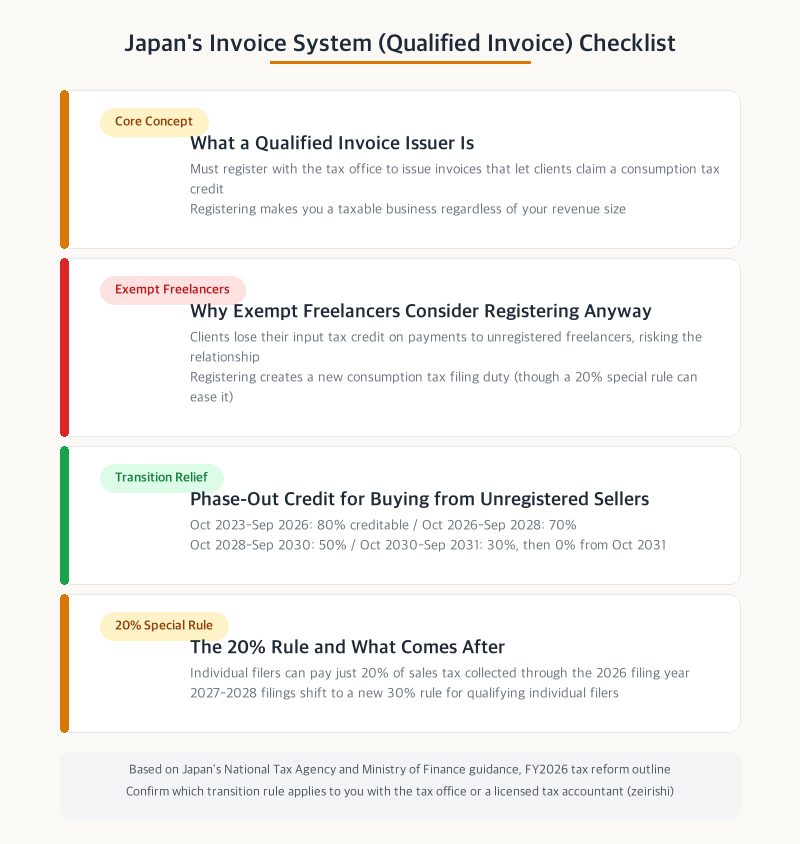
Japan’s Invoice System (Qualified Invoice) Checklist
Consumption Tax and the Input Tax Credit, in Brief
Japan’s consumption tax (shohizei) is a value-added tax: at each stage of a transaction, a business pays tax only on the difference between the tax it collected on sales and the tax it paid on its own purchases — the “input tax credit.” Under the invoice system that took effect in October 2023, only invoices and receipts issued by a business that has registered with the tax office as a “Qualified Invoice Issuing Business” (given a registration number starting with “T”) count as valid documentation for that credit.
The critical detail: registering makes you a consumption-tax-paying business regardless of your revenue size. Normally, a business with taxable sales of 10 million yen or less in the relevant base period is exempt from consumption tax. Registering as a Qualified Invoice Issuer overrides that exemption — you take on filing and payment obligations either way.
Why Tax-Exempt Freelancers Register Anyway
If your revenue is low enough that you’re currently exempt from consumption tax, it’s tempting to think “I’ll just skip registering.” But look at it from your client’s side, especially if your client is a taxable business (most corporations are).
- If a client doesn’t receive a qualified invoice from you, they can’t claim the full input tax credit on what they paid you (only a partial credit during the transition period described below).
- That means continuing to work with an unregistered freelancer raises your client’s own tax cost — so some clients will require you to register, or try to lower your rate to offset their lost credit.
- On the other hand, if you mostly work with individual consumers or other tax-exempt businesses, your clients likely don’t care about the input tax credit, so registering may matter far less.
The real question isn’t “do I want to pay consumption tax” — it’s “are my clients taxable businesses, and does the input tax credit matter to them.”
Transition Relief for Buying from Unregistered Sellers
Losing the input tax credit didn’t happen all at once when the system launched — a phase-out schedule softens the impact for buyers who purchase from unregistered sellers.
| Period | Creditable share |
|---|---|
| Oct 2023 – Sep 2026 | 80% |
| Oct 2026 – Sep 2028 | 70% |
| Oct 2028 – Sep 2030 | 50% |
| Oct 2030 – Sep 2031 | 30% |
| From Oct 2031 | 0% (no credit) |
Note that this timetable reflects Japan’s FY2026 tax reform outline, which eased the October 2026 rate to 70% instead of the originally planned 50%, and pushed the final expiration from September 2029 out to September 2031. The exact schedule could still shift depending on how the relevant bill moves through the Diet.
The 20% Special Rule, and What Replaces It
To ease the burden on businesses that were previously tax-exempt but became taxable specifically because they registered for invoices, Japan introduced a simplified “20% special rule”: instead of calculating your actual input tax credit, you can simply pay 20% of the consumption tax you collected on sales.
- Individual filers (sole proprietors) can use the 20% rule through their 2026 filing year.
- Corporations can use it only through the fiscal year that includes September 30, 2026, with no extension beyond that.
- For individual filers only, a follow-on “30% special rule” (paying 30% of sales tax collected) is planned for the 2027 and 2028 filing years, subject to conditions such as taxable sales of 10 million yen or less in the base period.
In short: individual freelancers get a two-step glide path — the 20% rule through 2026, then the 30% rule through 2027-2028 — while corporations return to full calculation (simplified or standard) right after September 2026.
How to Decide Whether to Register
- Check whether your main clients are taxable consumption-tax businesses (most corporations and taxable individual businesses are).
- Find out whether those clients actually care about the input tax credit, and whether they’d change your contract terms if you’re unregistered.
- Weigh the new consumption tax filing burden against whether you’d qualify for the 20% (or 30%) special rule.
- If it’s a close call, talk to your local tax office or a licensed tax accountant (zeirishi) about what fits your specific client mix.
Frequently Asked Questions
Q. If I’m tax-exempt, is skipping invoice registration automatically a bad move?
A. Not necessarily. If you mainly serve individual consumers or other tax-exempt businesses, your clients don’t care about the input tax credit, so staying unregistered may have little practical impact. If most of your clients are taxable corporations, though, registering is worth serious consideration.
Q. Does registering make me a taxable business immediately?
A. You become a consumption-tax-paying business from your registration date. Processing an application takes time, so if you need to issue qualified invoices from a specific date, apply with enough lead time.
Q. Do I need to separately apply to use the 20% special rule?
A. In principle, no separate advance application is required — you simply calculate your tax using the 20% rule and report it on your final tax return. Eligibility rules and procedures can change with each year’s tax reform, though, so check the latest guidance before filing.
Q. Who actually needs to track the 80%/70% transition credit percentages?
A. Those percentages apply to the taxable business buying from an unregistered seller (the client), for calculating their own input tax credit — not to the freelancer themselves. It’s a number that directly affects the corporate or business clients who work with you, which is exactly why your registration status matters to them.
Key Takeaways
- Registering as a Qualified Invoice Issuer makes you a consumption-tax-paying business regardless of revenue size, and only registered issuers can provide invoices that let clients claim the input tax credit.
- Purchases from unregistered sellers are only partially creditable during the transition period — the creditable share drops to 70% from October 2026 and phases down to 0% by October 2031.
- Individual filers can pay just 20% of sales tax collected through the 2026 filing year (the 20% rule), then 30% for 2027-2028 (the 30% rule) — corporations get no extension past September 2026.
- Decide whether to register by first checking whether your main clients are taxable businesses for whom the input tax credit actually matters.
This article is for general informational purposes only and is not tax advice. The transition schedule, the 20% rule, and the 30% rule reflect Japan’s FY2026 tax reform outline and may change as the relevant legislation moves through the Diet. Confirm exact details with your local tax office or a licensed tax accountant (zeirishi).