If you’re self-employed in Japan, July can bring a confusing piece of mail: a notice for “estimated tax” (yotei nozei, 予定納税) — even though you already filed your annual tax return months ago. This isn’t an extra tax on top of what you owe; it’s a system for prepaying part of this year’s tax in installments. Here’s who it applies to, how the amounts are calculated, when you can ask for a reduction, and how it compares to the US quarterly estimated tax system.
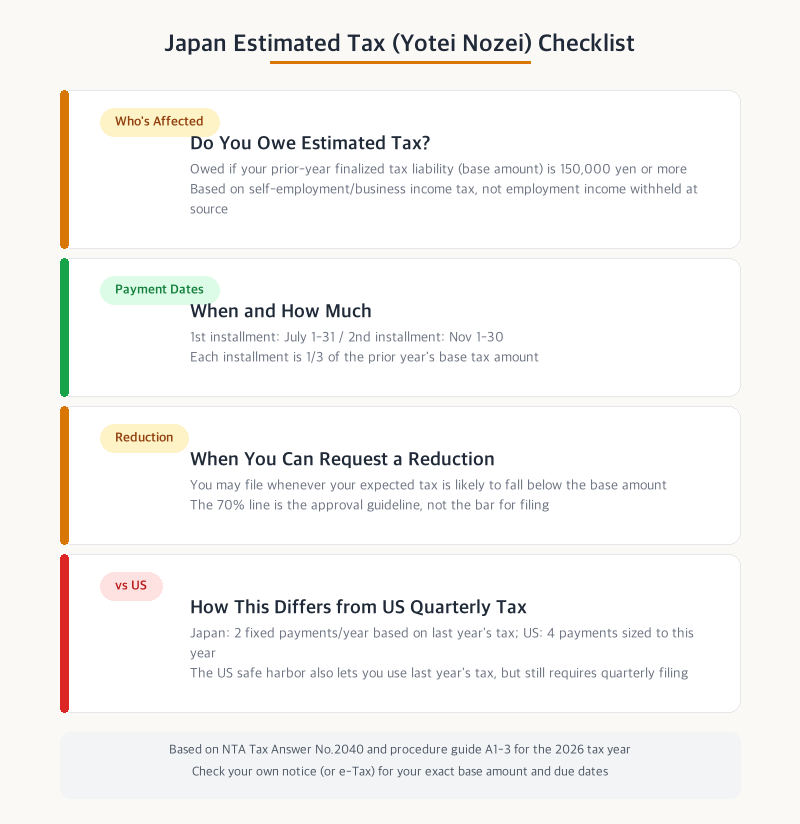
Japan Estimated Tax (Yotei Nozei) Checklist
What Estimated Tax Prepayment Actually Is
Japan’s estimated tax system assumes that if you owed a certain amount of income tax last year, you’ll likely owe something similar this year — so the tax office has you prepay part of it in advance. This reference figure is called the “estimated tax base amount,” and if it comes to 150,000 yen or more, you’re required to prepay.
The key detail: this base amount is calculated from income that wasn’t already withheld at source — mainly business/self-employment income — not from salary income where tax is withheld automatically. That’s exactly why freelancers and sole proprietors are far more likely to fall under this system than regular employees.
When and How Much You Pay
| Installment | Payment window | Amount due |
|---|---|---|
| 1st | July 1 – July 31 | 1/3 of the estimated tax base amount |
| 2nd | November 1 – November 30 | 1/3 of the estimated tax base amount |
The remaining third is reconciled against your actual income the following year when you file your final return. In other words, the money you prepay isn’t lost — it’s credited against your final tax bill as tax already paid.
A Simple Example
Say last year’s filing produced an estimated tax base amount of 600,000 yen. You’d pay 200,000 yen in the 1st installment (July), 200,000 yen in the 2nd (November), and the remaining 200,000 yen gets reconciled against your actual tax liability at your next annual filing. The tax office calculates your base amount and each installment automatically and mails you a notice around June every year — you don’t need to calculate it yourself, just check the notice.
When You Can Request a Reduction
If you’re confident your income this year will be noticeably lower than last year, you don’t have to pay the full base amount — you can file a reduction request to lower your installments.
- Your income dropped sharply due to closing or suspending your business, or unemployment
- Business conditions worsened and this year’s income is clearly lower than last year’s
- You gained dependents, or deductions like medical expense or donation deductions increased significantly
- You suffered losses from a disaster or theft
You file the reduction request form with your local tax office. If you’re requesting a reduction for both installments, the deadline is July 1-15; if you’re only requesting a reduction for the 2nd installment, the deadline is November 1-15. Miss the deadline and you’re required to pay the full base amount for that period.
What Happens If You Don’t Pay
Missing the payment deadline can trigger a late-payment penalty (delinquent tax). If cash flow is tight, don’t just let the deadline pass — first check whether you qualify for a reduction, and if not, contact your tax office about installment or deferral options.
How This Compares to US Quarterly Estimated Tax
If you’ve dealt with the US quarterly estimated tax system, some of this will feel familiar, but the mechanics differ. The US requires 4 payments per year (mid-April, mid-June, mid-September, and mid-January), and self-employed taxpayers generally estimate the amount themselves based on expected current-year income — though the “safe harbor” rule lets you base payments on 100% (or 110% for higher earners) of last year’s tax to avoid a penalty. Japan’s system pays in just 2 installments and the base amount is calculated for you by the tax office directly from last year’s return, with the 3rd portion trued up at your next annual filing rather than through a 4th quarterly payment.
Frequently Asked Questions
Q. How is the 150,000 yen threshold calculated?
A. The tax office calculates it from your prior year’s finalized income tax (excluding income already taxed at source, like salary withholding), following a set formula. The exact calculation for your case is shown on the estimated tax notice mailed out around June each year.
Q. If I just started my business this year, do I owe estimated tax?
A. Estimated tax is based on your prior year’s finalized tax return. If this is your first year in business and you have no prior-year filing, you generally won’t owe estimated tax this year. Whether you owe it next year depends on this year’s filing results.
Q. If I request a reduction but my income ends up higher than expected, what happens?
A. A reduction request is based on your expectation at the time you file it, so there’s no penalty just for guessing wrong. Your final tax liability is still reconciled against actual income at your annual filing, so you’d simply pay any shortfall then.
Q. Can I pay estimated tax with a credit card or a payment app?
A. Yes — options include the NTA’s credit card payment site, smartphone payment apps, direct debit from a bank account, and convenience-store payment via QR/barcode. Fees and limits vary by method, so check the National Tax Agency’s current guidance.
Key Takeaways
- You owe Japan’s estimated tax if your prior-year finalized tax comes to 150,000 yen or more (the ‘base amount’).
- You pay 1/3 of the base amount in each of two installments (July 1-31 and Nov 1-30), with the rest reconciled at your next annual filing.
- You can file a reduction request whenever this year’s expected tax is likely to fall below the base amount (deadline July 1-15 for both installments, or Nov 1-15 for the 2nd installment only). Approval is not automatic above the 70% line — see below.
- Japan’s 2-installment system and the US 4-installment quarterly system run independently — check both sets of deadlines if you owe tax in both countries.
Sources
- NTA No.2040 — Estimated tax (Japanese) ¥150,000 threshold, one-third per installment, July 1-31 and Nov 1-30
- NTA A1-3 — Reduction request procedure (Japanese) Filing requirement (estimate expected to fall below the base amount) and deadlines
- NTA Basic Circular 113-1 — Approval standard (Japanese) The 70% line is the approval guideline, not the bar for filing
This article is for general informational purposes only and is not tax advice. Your base amount, reduction eligibility, and procedures depend on individual circumstances and that year’s tax rules, so confirm exact details with your local tax office or a licensed tax accountant (zeirishi).