Every summer, friends or family from back home start messaging: “We’re finally coming to visit you in Japan!” Along with the excitement comes a practical question they’ll almost certainly ask you: “How should we exchange money?” If you live in Japan, you’ve likely already learned the hard way what to avoid — here’s a rundown of currency exchange scams worth warning your visitors about, plus what’s actually safe.
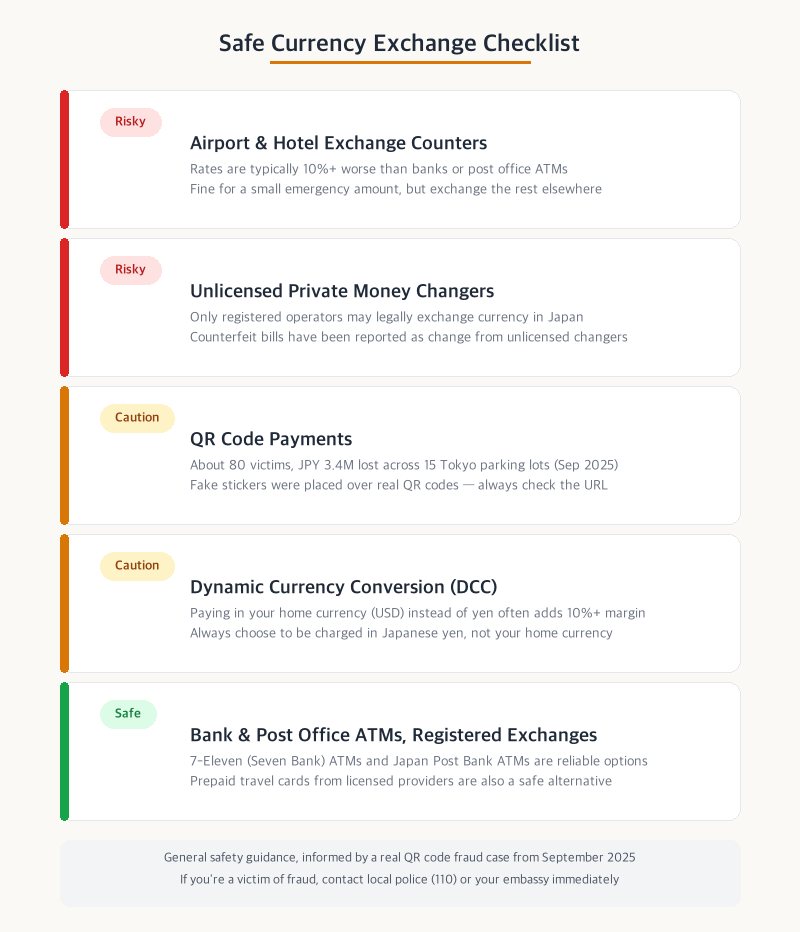
Safe Currency Exchange Checklist
1. Airport & Hotel Exchange Counters — Not a Scam, But Still a Bad Deal
Exchange counters at Narita, Haneda, or next to hotel front desks aren’t illegal or fraudulent, but their exchange rates are typically 10% or worse than what you’d get at a bank or post office ATM. It’s worth telling visitors to exchange only a small amount right after arrival — enough for transit and a meal — and handle the rest at a bank or registered exchange downtown.
2. Unlicensed Private Money Changers — This One’s Actually Illegal
Under Japan’s Payment Services Act (資金決済法), only registered operators are legally permitted to run a currency exchange business. Unlicensed street operators who approach tourists near busy areas offering “great rates” are, by definition, operating illegally — and there have been reports of counterfeit bills showing up as change. If you can’t verify an operator is properly registered, the safest rule is simply not to use it, no matter how good the rate looks.
3. QR Code Payment Fraud — A Real Incident, Not a Hypothetical
In September 2025, this actually happened across roughly 15 coin parking lots in Tokyo’s Shibuya, Shinjuku, and Minato wards. Scammers placed fake stickers — matching the size and design of the real ones exactly — over legitimate payment QR codes. Scanning the fake code redirected victims to a fraudulent payment page with a slightly altered domain name. About 80 people were affected, with total losses of roughly JPY 3.4 million. The same technique could be used on vending machines or restaurant table QR codes, so before scanning any QR code, check whether the sticker looks lifted or double-layered, and confirm the payment page’s URL matches the official domain exactly.
4. Social Media & Marketplace Currency Exchange — Skip the “Great Rate” DMs
Expat community groups and online marketplaces occasionally see posts offering to exchange yen at an unusually favorable rate — the catch is they ask for a bank transfer up front, then disappear. No matter how the offer is framed (a friend of a friend, a fellow expat), peer-to-peer currency exchange carries real risk. Stick to banks, registered exchanges, or prepaid travel card top-ups instead.
Four Safe Ways to Exchange Money
| Method | What to Know |
|---|---|
| 7-Eleven (Seven Bank) ATMs | Widely available at convenience stores, reliably accepts foreign-issued cards |
| Japan Post Bank ATMs | Found at post offices nationwide, generally fair exchange rates |
| Prepaid travel cards | Load funds before you travel; many offer zero foreign transaction fees |
| Registered downtown exchange counters | Better rates than the airport, but confirm the operator is properly licensed |
Always Choose Local Currency at the Register or ATM (Watch for DCC)
When paying by card or withdrawing cash in Japan, you’ll sometimes be asked: “Would you like to be charged in yen or in your home currency?” Always choose yen (the local currency). Choosing your home currency triggers Dynamic Currency Conversion (DCC) — the merchant or ATM operator applies their own exchange rate, typically with a markup of 10% or more, on top of whatever your card issuer already charges. This isn’t unique to Japan; it’s a good rule to follow anywhere you travel internationally, including trips back to the US.
Frequently Asked Questions
Q. Should visitors avoid airport exchange counters entirely?
A. Not entirely — they’re fine for a small amount right after landing. Just avoid exchanging large sums there, since rates run 10% or worse compared to banks, registered exchanges, or prepaid travel cards.
Q. What should I do if I fall for a QR code payment scam?
A. Contact your card issuer immediately to dispute the charge or freeze the card, and report it to the local police (call 110 in an emergency). Keep screenshots of the payment page and any receipts as evidence.
Q. Is it against the law for me to use an unlicensed money changer, as a customer?
A. The legal responsibility falls mainly on the unlicensed operator, but as a customer you still risk real financial loss — counterfeit bills or unfavorable rates — so it’s best to avoid them altogether.
Q. My card reader asks if I want to be charged in dollars instead of yen — what should I pick?
A. Always choose yen (the local currency). Choosing your home currency triggers Dynamic Currency Conversion, which typically adds a hidden markup of 10% or more to the exchange rate.
Key Takeaways
- Airport and hotel exchange counters aren’t illegal, but rates typically run 10% or worse — exchange only a small amount there.
- Unlicensed private money changers are illegal under Japan’s Payment Services Act and carry counterfeit-bill risk.
- A real QR code scam in Tokyo (Sept 2025, ~80 victims, JPY 3.4M lost) shows why you should verify the URL before scanning.
- Always pick local currency (yen) at the register or ATM to avoid Dynamic Currency Conversion’s hidden markup.
This article is for general informational purposes only and does not guarantee protection against fraud. If you believe you’ve been the victim of a scam, contact your card issuer, local police (110), or your embassy immediately.
As covered above, peer-to-peer currency deals are worth avoiding no matter how good the rate sounds.
If family needs to send travel funds ahead of a visit, or you need to move a larger amount, a licensed provider is the safer route. Wise is regulated by financial authorities including the UK’s FCA.
See a licensed transfer service →
If you live in Japan, sign up for a Japanese account — that is what lets you send from your local bank.
This is an affiliate link. If you sign up as a new user and complete a first transfer, TheFinExpat receives a commission at no extra cost to you. Our comparisons stay the same either way.