Plenty of guides will tell you iDeCo (individual-type Defined Contribution pension) is Japan’s answer to a 401(k) — open to foreign residents, fully tax-deductible, tax-free growth. All true. What most of those guides leave out is what happens on the US side once you’re an American citizen or green card holder holding a Japanese retirement account. iDeCo isn’t a US-based IRA — it’s a foreign financial account, and that changes your reporting obligations in ways that rarely make it into the general overview.
Japan’s iDeCo at a Glance
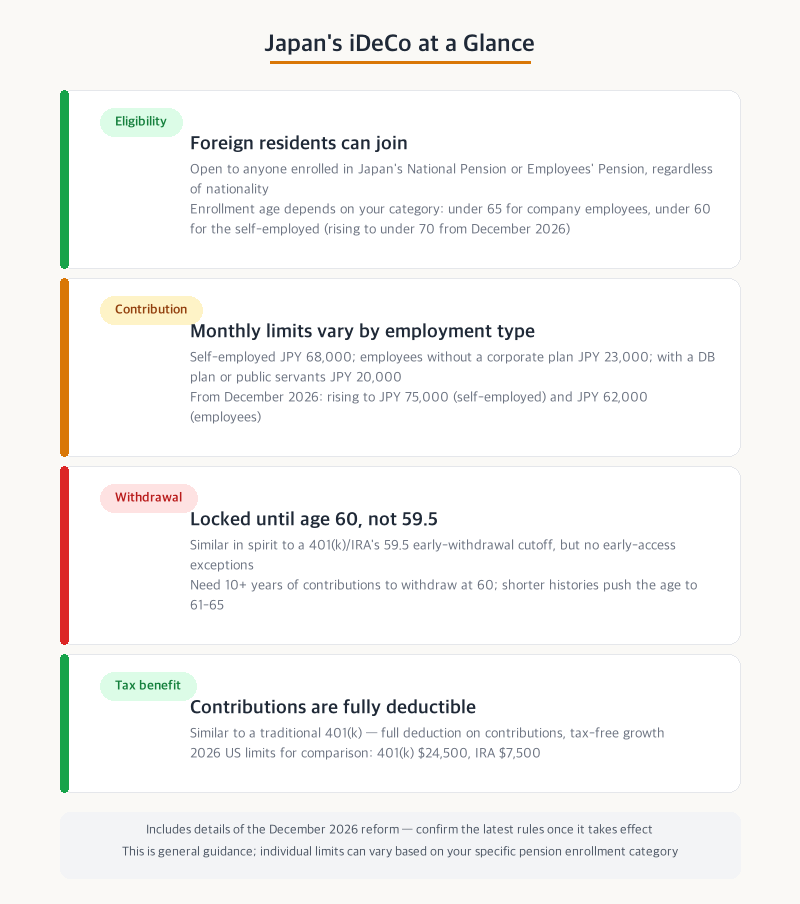
iDeCo is open to anyone enrolled in Japan’s National Pension or Employees’ Pension Insurance, regardless of nationality — most working foreign residents qualify. Contributions are fully deductible from taxable income, and growth inside the account isn’t taxed in Japan while it stays invested. So far, this looks exactly like a traditional 401(k) or IRA. The difference shows up the moment you file a US tax return.
Why iDeCo Is Reportable — Unlike a US IRA
If your retirement savings sit in a US-based IRA or 401(k), you don’t report the account itself under FBAR or FATCA — the IRS already knows about it. iDeCo doesn’t get that pass. It’s a foreign financial account held at a Japanese institution, and US citizens and green card holders are required to disclose foreign accounts once they cross certain balance thresholds, regardless of whether the account is a “retirement” account under Japanese law.
FBAR: The $10,000 Trigger
If the combined value of all your foreign financial accounts — iDeCo included — exceeds USD 10,000 at any point during the year, you’re required to file an FBAR (FinCEN Form 114). This is a low bar: most people who’ve been contributing to iDeCo for more than a year or two will cross it well before the account feels like “real retirement money.”
FATCA Form 8938: Higher Thresholds, Still Applies
FATCA reporting (Form 8938) uses higher thresholds than FBAR, and the thresholds are more generous if you genuinely live abroad (a foreign tax home, physically outside the US for at least 330 days in the year):
| Filing status (living abroad) | Threshold (year-end / any point in year) |
|---|---|
| Single / married filing separately | $200,000 / $300,000 |
| Married filing jointly | $400,000 / $600,000 |
iDeCo balances count toward these thresholds alongside your other foreign accounts (Japanese bank accounts, NISA, brokerage accounts). If your household’s total foreign assets cross the line, Form 8938 gets added to your US return on top of the FBAR.
The Bigger Problem: PFIC Status on iDeCo’s Fund Options
This is the part general iDeCo guides almost never mention. If you invest your iDeCo contributions in Japanese mutual funds — the default option at most providers — the IRS generally classifies those funds as PFICs (Passive Foreign Investment Companies). That triggers a separate Form 8621 for every PFIC fund you hold, and the default “excess distribution” tax regime is punitive: back-dated interest charges and a top marginal tax rate applied retroactively across your holding period, regardless of your actual bracket. The elections that soften this (QEF, mark-to-market) generally require information Japanese fund providers don’t publish, which makes them impractical in practice for most iDeCo investors.
A Practical Workaround: The Principal-Guaranteed Option
Most iDeCo providers also offer a principal-guaranteed (元本確保型) option — a fixed deposit or insurance-type product rather than a fund. Because it isn’t a mutual fund, it generally falls outside PFIC classification. The trade-off is obvious: you give up any real investment growth in exchange for avoiding a genuinely painful compliance burden. Whether that trade is worth it depends entirely on your time horizon, your risk tolerance, and how much you value not filing a Form 8621 every year — this is exactly the kind of call a cross-border tax preparer should weigh in on before you pick a fund.
Monthly Contribution Limits by Category
| Category | Monthly limit (as of July 2026) |
|---|---|
| Self-employed / freelancers | JPY 68,000 |
| Company employees with no corporate pension | JPY 23,000 |
| Company employees with a Defined Contribution (DC) plan only | JPY 20,000 |
| Company employees with a Defined Benefit (DB) plan / civil servants | JPY 20,000 |
| Dependent spouses of company employees | JPY 23,000 |
From December 2026 (effective for January 2027 contributions), limits are set to rise: self-employed contributors to JPY 75,000, and employees (combined with any corporate plan) to JPY 62,000. Confirm the exact effective date and calculation details with the National Pension Fund or your financial institution once the reform takes effect.
Withdrawal Age: 60, Not 59.5
You can generally start receiving iDeCo benefits from age 60. If you’ve contributed for fewer than 10 years, the eligible starting age is pushed back on a sliding scale to somewhere between 61 and 65. Unlike a 401(k) or IRA, iDeCo has essentially no early-withdrawal exceptions for things like first-time home purchases or hardship — treat the money as locked away until your 60s.
Sources
Figures and requirements in this article were verified against the primary sources below. Rules change, so check the originals before you enroll or contribute. (Verified 15 Aug 2026)
- MHLW — iDeCo changes from December 2026 (Japanese) current caps by member type and the December 2026 reform
- MHLW — iDeCo cap raised from JPY 12,000 to 20,000 (Dec 2024, Japanese) JPY 20,000/month and JPY 240,000/year for civil servants and DB members
- iDeCo official site (NPFA) — eligibility, contributions, payouts (Japanese) age requirements by member category and payout start age
- NTA No.1135 — Small Business Mutual Aid contribution deduction (Japanese) the full amount paid in the year is deductible
Frequently Asked Questions
Q. Does iDeCo need to be reported on my FBAR?
A. Yes. If the combined value of your foreign financial accounts, including iDeCo, exceeds USD 10,000 at any point in the year, you must file an FBAR (FinCEN Form 114).
Q. Is iDeCo also subject to FATCA (Form 8938)?
A. It can be, once your total specified foreign assets cross the relevant threshold — $200,000/$300,000 for single filers living abroad, $400,000/$600,000 for married filing jointly, measured at year-end and at any point in the year respectively.
Q. Are the mutual funds inside iDeCo treated as PFICs?
A. Generally yes — most Japanese mutual funds are classified as PFICs by the IRS, requiring a separate Form 8621 per fund and triggering a punitive default tax regime unless a QEF or mark-to-market election is made, which is often impractical for Japanese funds in practice.
Q. Is there a way to avoid PFIC issues inside iDeCo?
A. Choosing a principal-guaranteed (元本確保型) deposit or insurance-type option instead of a mutual fund generally avoids PFIC classification, at the cost of giving up real investment growth.
Key Takeaways
- Unlike a US-based IRA or 401(k), iDeCo is a foreign financial account and must be reported once you cross FBAR ($10,000) or FATCA ($200,000+) thresholds.
- Japanese mutual funds inside iDeCo are generally classified as PFICs, requiring a Form 8621 per fund and a punitive default tax regime.
- A principal-guaranteed option inside iDeCo can sidestep PFIC status, trading away growth for simpler compliance.
- Japan-side tax benefits (full deduction, tax-free growth, ~age-60 withdrawal) are real — but they don’t cancel out your US reporting obligations.
This article is for general informational purposes only and is not tax or investment advice. PFIC, FBAR, and FATCA rules are complex, fact-specific, and carry real penalties for non-compliance — work with a tax preparer experienced in cross-border US/Japan filings before deciding how to invest inside iDeCo.