
Every June through August, Japan’s biggest companies open their summer internship applications — and international students often ask whether they can even apply. The short answer is yes. But whether the internship is paid or unpaid changes what paperwork you need, and if you’re getting paid, there’s a tax side to think about too.
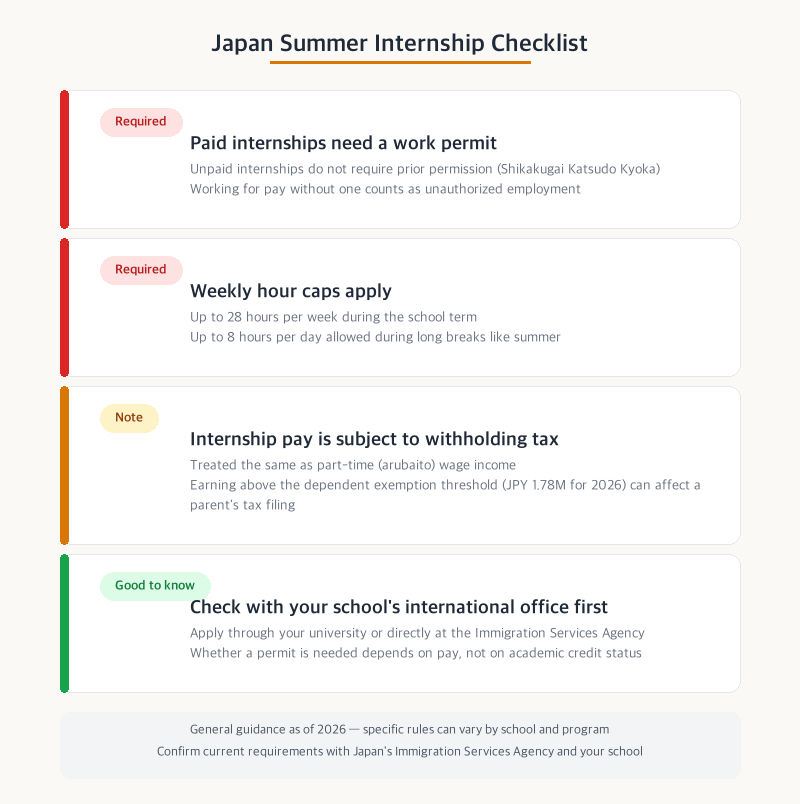
Japan Summer Internship Checklist
Why Recruiting Clusters Around June–August
Most large Japanese companies run internships as an early step toward the following year’s new-graduate hiring, typically in summer (June–August) and winter (December–February). Summer programs range from one-day taster sessions to multi-week hands-on placements, and a growing number of companies now run separate tracks aimed specifically at international students — often conducted in English and linked to global-hire recruiting pipelines. Completing an internship can also give you an edge in later hiring rounds, so it’s worth pursuing even if you’re not a Japanese-language speaker.
Paid Internships Require a Work Permit
If you’re in Japan on a student (“ryugaku”) visa and the internship pays you, you need prior authorization called Shikakugai Katsudo Kyoka — permission to engage in activity outside your permitted status of residence. Unpaid internships don’t require this permit at all.
| Category | Detail |
|---|---|
| Unpaid internship | No prior permit needed — you can start right away |
| Paid internship | Work permit required; working for pay without one is unauthorized employment |
| Hours during the school term | Up to 28 hours per week |
| Hours during long breaks (e.g. summer) | Up to 8 hours per day |
For comparison, F-1 students in the US face a related but distinct hurdle: any credit-bearing internship — paid or unpaid — needs Curricular Practical Training (CPT) authorization from your school’s international office, and you generally need at least a full academic year of enrollment before you’re eligible. During an optional summer term, CPT can be authorized full-time (21+ hours per week), which is more generous than Japan’s daily cap but requires the internship to be tied to your academic program.
You can apply for the Japanese work permit through your university’s international student office or directly at the Immigration Services Agency. Processing takes time, so start the moment you accept an offer.
💡 Run your own numbers — try the Japan Retirement Tax Calculator (2026).
How Internship Pay Is Taxed
Internship wages are treated the same as part-time (arubaito) wage income in Japan — they’re subject to withholding tax, and the amount withheld shows up on your pay slip. Depending on your total income for the year, you may be able to claim a refund by filing a year-end tax return.
If a parent claims you as a dependent, staying under Japan’s annual income threshold matters. The long-standing “1.03 million yen wall” was raised under 2025 tax reforms, and under the 2026 tax reform outline (finalized December 2025), the applicable threshold for 2026 income is set to rise to JPY 1.78 million. Implementation details can still shift with the latest tax agency guidance, so if your internship pay is likely to approach this range, check with your school or a tax professional in advance.
Before You Apply: A Quick Checklist
- Confirm the internship posting is open to international students at your school
- Check the offer letter or job posting to see whether the position is paid or unpaid
- If paid, contact your school’s international office about the work permit process
- Prepare your residence card, student ID, and any other required documents
- Confirm which hour cap applies — term-time (28 hrs/week) or long break (8 hrs/day)
Frequently Asked Questions
Q. Do unpaid internships need a work permit?
A. No. Unpaid internships can start without prior authorization. Whether a permit is required depends on whether you’re being paid, not on whether the internship carries academic credit.
Q. How many hours can I work per day during summer break?
A. With a valid work permit, you can work up to 8 hours per day during long breaks like summer. During the school term, the cap drops to 28 hours per week.
Q. Do I need to file a separate tax return for internship pay?
A. Withholding tax is already deducted from your pay, so most students don’t need to file anything extra — but depending on your total annual income, filing a year-end return can get you a refund.
Q. Can my internship income affect a parent’s taxes?
A. If a parent claims you as a dependent, your own annual income exceeding the threshold (set to rise to JPY 1.78 million for 2026) can affect their dependent exemption.
Key Takeaways
- Japan’s summer internship season clusters around June–August, with different paperwork for paid vs. unpaid roles.
- Paid internships require a work permit (Shikakugai Katsudo Kyoka); hour caps are 28/week during term and 8/day during long breaks.
- Internship pay is subject to withholding tax, and staying under the dependent exemption threshold (set to rise to JPY 1.78M for 2026) matters if a parent claims you.
- Apply for the work permit through your school’s international office or directly with the Immigration Services Agency.
This article is for general informational purposes only and is not legal or tax advice. Work permit requirements and income thresholds for dependent status can change with individual circumstances and future tax reforms, so confirm the latest details with Japan’s Immigration Services Agency, your school, and a qualified tax professional before applying.