If you’ve compared job listings in Tokyo against ones in a rural prefecture, you may have noticed the hourly wage floor is different. Japan doesn’t have a single nationwide minimum wage – each of the 47 prefectures sets its own rate. This guide breaks down the highest and lowest rates under the 2025 revision, the national average, how the rate-setting process works, and how it all compares to the US system.
Minimum Wage: Japan vs the US
National Average: JPY 1,121/hr – the Largest Increase on Record
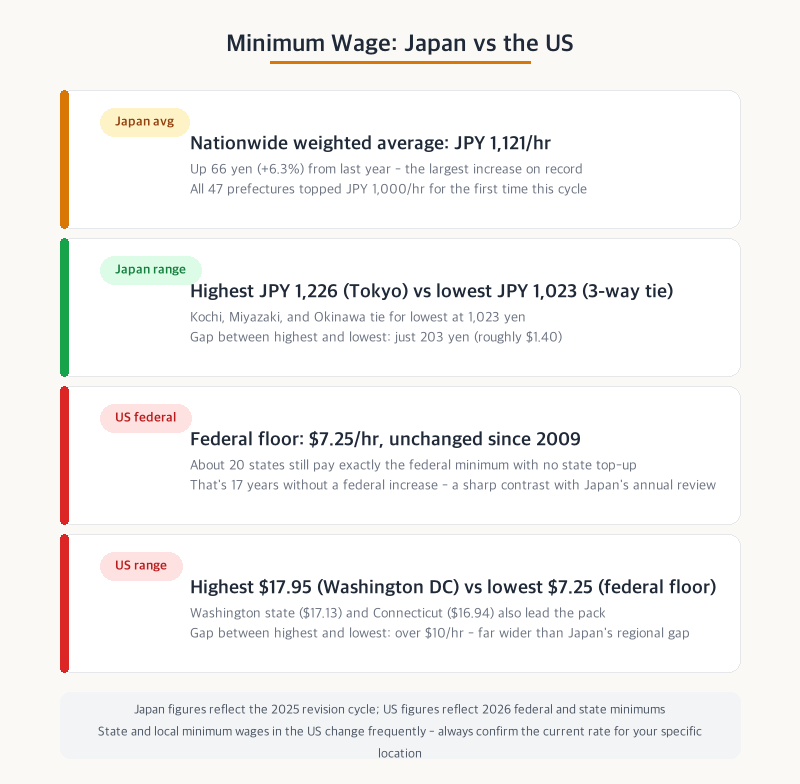
Under the 2025 revision cycle, Japan’s nationwide weighted average minimum wage rose to JPY 1,121 per hour, up JPY 66 (+6.3%) from the previous year – the largest single-year increase since statistics began. Just as notable: this revision marks the first time all 47 prefectures have crossed the JPY 1,000/hr line. Given that some rural prefectures were still in the 800-yen range just a few years ago, the pace of increase has been fast.
Highest and Lowest Prefectures
| Rank | Prefecture | Hourly wage |
|---|---|---|
| Highest | Tokyo | JPY 1,226 |
| 2nd | Kanagawa | JPY 1,225 |
| 3rd | Osaka | JPY 1,177 |
| Tied for lowest | Kochi / Miyazaki / Okinawa | JPY 1,023 |
The gap between Tokyo and the lowest-paying prefectures (Kochi, Miyazaki, Okinawa) is JPY 203/hr. Working full-time (8 hours a day, 5 days a week), that gap can add up to more than JPY 30,000 a month – so where you work in Japan meaningfully affects your take-home pay. The size of the increase also varied by region, ranging from JPY 63 to JPY 82; Akita prefecture, for instance, jumped 80 yen and moved up sharply in the rankings.
How and When the Rate Gets Set
Japan’s minimum wage is revised annually in October, as a general rule. The process runs like this:
- The Central Minimum Wages Council, under the Ministry of Health, Labour and Welfare, ranks prefectures into tiers (A through D) and issues a target increase (mokuyasu) for each tier.
- Each prefecture’s own Local Minimum Wages Council reviews that target alongside local cost-of-living and wage data, then deliberates and sets the actual rate.
- The proposed rate goes through an objection period before being finalized and officially published.
- The new rate takes effect a set period after publication.
This is why effective dates differ by prefecture. Most rates take effect sometime in October 2025, but a handful of prefectures see their effective date pushed back to March or even April 2026 due to objection procedures (for example, Gunma takes effect March 1, 2026, and Akita on March 31, 2026). If you’re working an hourly job, it’s worth checking the exact effective date for your specific prefecture through the Ministry or your regional labor bureau.
One Thing to Watch: It’s Based on Where You Work, Not Where You Live
A common point of confusion: the minimum wage that applies to you is based on where your workplace is located, not where you live. If you live in Saitama but commute to a job in Tokyo, the Tokyo minimum wage applies to your work – not Saitama’s.
How Japan’s System Compares to the US
The contrast with the US is striking. The federal minimum wage has been stuck at $7.25/hour since 2009 – 17 years without an increase – and roughly 20 states still pay exactly that federal floor with no state-level top-up. States that do set their own higher minimums vary enormously: Washington, DC leads at $17.95/hour, followed by Washington state at $17.13 and Connecticut at $16.94. That creates a gap of over $10/hour between the highest- and lowest-paying parts of the country – roughly five times wider, proportionally, than the JPY 203 gap between Tokyo and Japan’s lowest-paying prefectures. The other key structural difference: Japan revises its rate every single year through a formal national-to-local council process, while in the US, whether (and how much) the minimum wage rises depends entirely on individual state or city legislation, with no guaranteed annual review at the federal level.
Frequently Asked Questions
Q. Is Japan’s minimum wage based on where I live or where I work?
A. It’s based on the prefecture where your workplace is located. If you live in one prefecture and commute to work in another, the minimum wage of your workplace’s prefecture applies.
Q. Why did Japan’s minimum wage rise so much in this revision?
A. The nationwide weighted average rose JPY 66 (+6.3%) year-over-year, the largest recorded increase, reflecting rising living costs and the government’s ongoing push to raise minimum wages nationally.
Q. Do all prefectures change their minimum wage on the same day?
A. No. Most take effect sometime in October, but the exact date varies by prefecture depending on local council procedures and objection periods, with some pushed back as far as March or April of the following year.
Q. What should I do if I’m being paid less than the minimum wage?
A. This could be a violation of Japan’s Minimum Wage Act, so it’s worth contacting the Labor Standards Office covering your workplace. Having your pay stubs and work-hour records organized in advance makes the consultation easier.
Key Takeaways
- Japan’s 2025 nationwide weighted average is JPY 1,121/hr (+66 yen, +6.3%), the largest increase on record.
- Highest is Tokyo at JPY 1,226; lowest is a three-way tie at JPY 1,023 (Kochi, Miyazaki, Okinawa) – a JPY 203 gap.
- Rates are revised every October as a general rule, but effective dates vary by prefecture.
- The US federal minimum has been frozen at $7.25 since 2009, with a state-to-state gap of over $10/hour – far wider than Japan’s regional spread.
This article is for general informational purposes only and is not legal or labor advice. Minimum wage rates are revised periodically and effective dates vary by location – confirm the latest figures with Japan’s Ministry of Health, Labour and Welfare or your regional labor bureau, or with the US Department of Labor for state-specific rates.