Thinking about picking up a side job while living in Japan? Whether your employer allows it, how side income gets taxed, and whether your visa lets you take it on are three separate questions that often get mixed up. This guide breaks down Japan’s rules on moonlighting, the tax filing threshold for side income, the visa considerations foreign workers need to check, and how the whole picture compares to how side hustles are taxed in the US.
Japan Side Job Tax Checklist
Can Your Employer Actually Stop You? Japan’s Model Work Rules
Japan does not have a blanket legal ban on side jobs. In fact, the Ministry of Health, Labour and Welfare’s Model Rules of Employment, revised in 2018, explicitly state as a default principle that “employees may engage in work for another company outside of working hours.” That said, the model rules are just a non-binding template – individual companies are free to write stricter language into their own work rules, and many still require prior notification or approval, or prohibit side jobs outright.
Even where a company’s work rules say side jobs are prohibited, that clause isn’t automatically enforceable in every case. The general legal view is that how you use your own off-hours time is fundamentally your own choice, and an employer can only restrict it for reasonable grounds – such as the side job interfering with your main job (fatigue, sleep deprivation), damaging the company’s reputation, or working for a direct competitor. Still, before starting anything, check your own company’s work rules first and follow whatever notification or approval process is required.
The Government Guideline on Promoting Side Jobs
The Ministry first issued its “Guidelines for Promoting Side Jobs and Dual Employment” in 2018, revised them in September 2020, and released a new plain-language explainer version in March 2025. The key points:
- Combined working-hour management: If you work at multiple workplaces, your hours across all of them must be tracked and combined. Once the combined total exceeds statutory limits (8 hours/day, 40 hours/week), the excess is generally subject to overtime premium pay.
- Health management: Employers are encouraged to check whether a side job is causing overwork and to offer health consultations if needed.
- Combined wage basis for workers’ comp (rosai): A legal revision changed how workers’ compensation insurance benefits are calculated – instead of using wages from only one workplace, the daily benefit base is now calculated using combined wages from all workplaces. This is more favorable to workers than the old system if an accident happens while working a side job.
Japan’s Tax Rule: The ¥200,000 Threshold, and the Trap Most People Miss
If you’re a salaried employee who also earns side income (miscellaneous income, business income, occasional income, etc.), you’re required to file an income tax return once your total side income exceeds JPY 200,000 per year. Below that threshold, many people assume they don’t need to file anything at all.
Here’s the trap: the JPY 200,000 rule is a special exemption that applies only to national income tax. There’s no equivalent exemption for resident tax (juminzei), which is a local tax. In other words, even if your side income is under JPY 200,000 and you skip the national income tax return, you’re still generally required to separately report that income to your local municipal office for resident tax purposes – regardless of the amount. This is a commonly missed step, so if you have any side income at all, it’s worth checking with your municipal tax office.
If You’re on a Work Visa: Check This Before You Start
If you’re in Japan on a work-based residence status – such as “Engineer/Specialist in Humanities/International Services,” which covers many Korean and other foreign professionals – you need to confirm whether your planned side job falls within the scope of activities your visa actually permits.
| Situation | Do you need special permission? |
|---|---|
| Side work of the same nature as your main job (e.g., an interpreter doing interpretation work for another company) | Usually not required – falls within your visa’s permitted activities |
| Simple labor unrelated to your visa category (restaurant serving, convenience store shifts, etc.) | Required – you need “Permission to Engage in Activity Other Than That Permitted” or it’s illegal |
Taking on a side job outside your visa’s scope without permission can create problems when you renew your status or apply for permanent residency, and in serious cases could be grounds for revocation. If you’re considering a side job, confirm your specific situation with Japan’s Immigration Services Agency or a licensed immigration lawyer (gyoseishoshi) before starting.
How This Compares to Side Hustle Taxes in the US
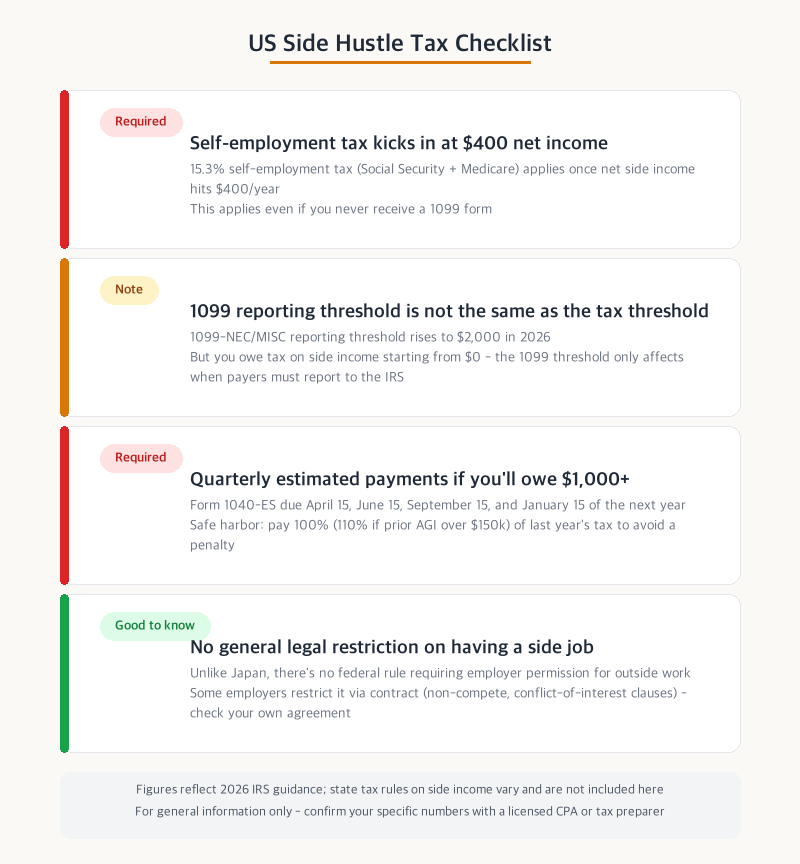
If you’re American, the framework will look quite different. There’s no general federal restriction requiring your employer’s permission to take on outside work (though your own employment contract might include a non-compete or conflict-of-interest clause worth checking). On the tax side, the trigger point is much lower and simpler than Japan’s ¥200,000 rule: once your net side income hits $400 in a year, you owe self-employment tax (15.3%, covering Social Security and Medicare) – even if you never receive a 1099 form. Speaking of which, the 1099-NEC/MISC reporting threshold (the point at which a payer must send the IRS a copy) rises to $2,000 in 2026, but that’s a reporting threshold, not a tax threshold – you technically owe tax on side income starting from $0. If you expect to owe $1,000 or more for the year, you’re also expected to make quarterly estimated tax payments (Form 1040-ES) rather than settling everything at filing time.
Frequently Asked Questions
Q. If my company’s rules ban side jobs, does that mean I absolutely can’t do one?
A. Not necessarily. How you spend your off-hours is fundamentally your own choice, and a blanket ban clause is often interpreted narrowly unless there’s a reasonable justification, like interference with your main job or working for a direct competitor. That said, to avoid disputes, it’s safer to go through whatever notification or approval process your company requires.
Q. If my side income is under JPY 200,000, do I need to file anything at all?
A. You may be exempt from the national income tax return, but resident tax (juminzei) is separate – there’s no minimum-amount exemption for it, so you generally still need to report the income to your municipal office.
Q. I’m on a work visa in Japan – can I take a convenience store side job?
A. Generally, you’d need “Permission to Engage in Activity Other Than That Permitted.” Simple labor like convenience store work falls outside what visas like “Engineer/Specialist in Humanities/International Services” permit. Doing it without permission can create problems for future visa renewals.
Q. How is workers’ comp calculated if I’m injured while doing a side job in Japan?
A. Following a legal revision, the daily benefit base for workers’ compensation insurance is now calculated using combined wages from all your workplaces, not just your main job – an improvement over the previous system.
Key Takeaways
- Japan has no blanket legal ban on side jobs, and the government’s own model work rules default to allowing them.
- Side income over JPY 200,000/year triggers a national income tax return – but resident tax must be reported separately, regardless of amount.
- Work visa holders must confirm their side job falls within their visa’s permitted activities, or obtain special permission.
- In the US, self-employment tax kicks in at just $400 in net side income, regardless of whether you receive a 1099.
This article is for general informational purposes only and is not tax, immigration, or legal advice. Company work rules, visa activity scope, and tax filing obligations depend on individual circumstances – consult your HR department, a licensed immigration lawyer, or a tax professional for your specific situation.